- About
- Mission Statement
Education. Evidence. Regrowth.
- Education.
Prioritize knowledge. Make better choices.
- Evidence.
Sort good studies from the bad.
- Regrowth.
Get bigger hair gains.
Team MembersPhD's, resarchers, & consumer advocates.
- Rob English
Founder, researcher, & consumer advocate
- Research Team
Our team of PhD’s, researchers, & more
Editorial PolicyDiscover how we conduct our research.
ContactHave questions? Contact us.
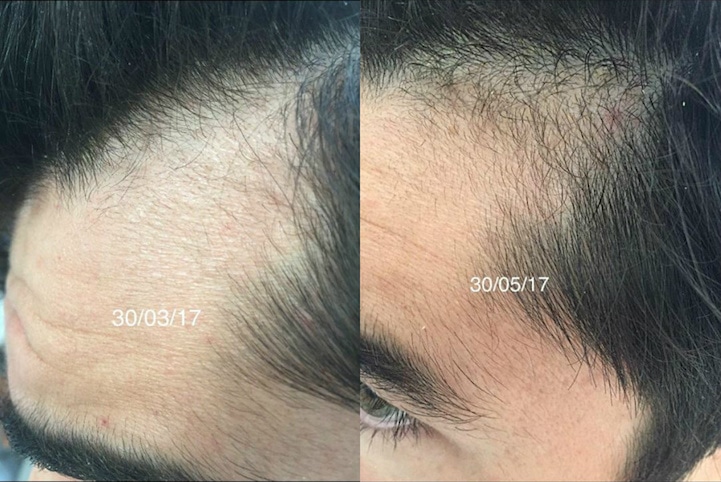
Before-Afters- Transformation Photos
Our library of before-after photos.
- — Jenna, 31, U.S.A.
I have attached my before and afters of my progress since joining this group...
- — Tom, 30, U.K.
I’m convinced I’ve recovered to probably the hairline I had 3 years ago. Super stoked…
- — Rabih, 30’s, U.S.A.
My friends actually told me, “Your hairline improved. Your hair looks thicker...
- — RDB, 35, New York, U.S.A.
I also feel my hair has a different texture to it now…
- — Aayush, 20’s, Boston, MA
Firstly thank you for your work in this field. I am immensely grateful that...
- — Ben M., U.S.A
I just wanted to thank you for all your research, for introducing me to this method...
- — Raul, 50, Spain
To be honest I am having fun with all this and I still don’t know how much...
- — Lisa, 52, U.S.
I see a massive amount of regrowth that is all less than about 8 cm long...
Client Testimonials150+ member experiences.
 Scroll DownPopular Treatments
- Treatments
Popular treatments. But do they work?
- Finasteride
- Oral
- Topical
- Dutasteride
- Oral
- Topical
- Mesotherapy
- Minoxidil
- Oral
- Topical
- Ketoconazole
- Shampoo
- Topical
- Low-Level Laser Therapy
- Therapy
- Microneedling
- Therapy
- Platelet-Rich Plasma Therapy (PRP)
- Therapy
- Scalp Massages
- Therapy
- More
IngredientsTop-selling ingredients, quantified.
- Saw Palmetto
- Redensyl
- Melatonin
- Caffeine
- Biotin
- Rosemary Oil
- Lilac Stem Cells
- Hydrolyzed Wheat Protein
- Sodium Lauryl Sulfate
- More
ProductsThe truth about hair loss "best sellers".
- Minoxidil Tablets
Xyon Health
- Finasteride
Strut Health
- Hair Growth Supplements
Happy Head
- REVITA Tablets for Hair Growth Support
DS Laboratories
- FoliGROWTH Ultimate Hair Neutraceutical
Advanced Trichology
- Enhance Hair Density Serum
Fully Vital
- Topical Finasteride and Minoxidil
Xyon Health
- HairOmega Foaming Hair Growth Serum
DrFormulas
- Bio-Cleansing Shampoo
Revivogen MD
- more
Key MetricsStandardized rubrics to evaluate all treatments.
- Evidence Quality
Is this treatment well studied?
- Regrowth Potential
How much regrowth can you expect?
- Long-Term Viability
Is this treatment safe & sustainable?
Free Research- Free Resources
Apps, tools, guides, freebies, & more.
- Free CalculatorTopical Finasteride Calculator
- Free Interactive GuideInteractive Guide: What Causes Hair Loss?
- Free ResourceFree Guide: Standardized Scalp Massages
- Free Course7-Day Hair Loss Email Course
- Free DatabaseIngredients Database
- Free Interactive GuideInteractive Guide: Hair Loss Disorders
- Free DatabaseTreatment Guides
- Free Lab TestsProduct Lab Tests: Purity & Potency
- Free Video & Write-upEvidence Quality Masterclass
- Free Interactive GuideDermatology Appointment Guide
- More
Articles100+ free articles.
-
Does Anavar Cause Hair Loss?
-
10 Best Shampoos for Hair Loss in 2026
-
XYON Review: Do Their Products Actually Regrow Hair?
-
Minoxidil Before and After Photos [2026] | Does It Work?
-
How to Get Finasteride: Is It Over the Counter?
-
Keeps Review: The Truth About Their Hair Loss Treatments?
-
7 Best Oils for Hair Growth
-
Hims Hair Growth Reviews: The Pros, Cons, and Real Results
PublicationsOur team’s peer-reviewed studies.
- Microneedling and Its Use in Hair Loss Disorders: A Systematic Review
- Use of Botulinum Toxin for Androgenic Alopecia: A Systematic Review
- Conflicting Reports Regarding the Histopathological Features of Androgenic Alopecia
- Self-Assessments of Standardized Scalp Massages for Androgenic Alopecia: Survey Results
- A Hypothetical Pathogenesis Model For Androgenic Alopecia:Clarifying The Dihydrotestosterone Paradox And Rate-Limiting Recovery Factors
Menu- AboutAbout
- Mission Statement
Education. Evidence. Regrowth.
- Team Members
PhD's, resarchers, & consumer advocates.
- Editorial Policy
Discover how we conduct our research.
- Contact
Have questions? Contact us.
- Before-Afters
Before-Afters- Transformation Photos
Our library of before-after photos.
- Client Testimonials
Read the experiences of members
Before-Afters/ Client Testimonials- Popular Treatments
-
Articles
Oral minoxidil for women with hair loss: an underutilized treatment?
Although topical minoxidil seems to get most of the attention as a hair loss treatment, its oral counterpart is also effective at promoting hair regrowth in both males and females.
Generally, higher dosing means better efficacy, but with a higher risk profile. As it relates to oral minoxidil, this means limb swelling, low blood pressure, and, potentially, heart palpitations. But, there’s one side effect that may be more concerning for women taking oral minoxidil than men: excessive body hair growth.
Considering this is something most women want to avoid or may also struggle with alongside their hair loss (in cases of female androgenic alopecia), this side effect could be of significant concern.
So, is there a way we can harness the hair-growing effects of oral minoxidil without the side effects?
Yes. This Quick Win dives into the research: the clinical evidence, the best dosages, and the best ways to avoid excessive body hair growth while taking this medication.
Note: Quick Wins are short articles focused on answering one question about hair loss. Given their specificity, these articles are written in a more scientific tone. If you’re new to hair loss education, start with these articles.
Interested in Oral Minoxidil?
Low-dose oral minoxidil available, if prescribed*
Take the next step in your hair regrowth journey. Get started today with a provider who can prescribe a topical solution tailored for you.
*Only available in the U.S. Prescriptions not guaranteed. Restrictions apply. Off-label products are not endorsed by the FDA.

Oral minoxidil: research at a glance
What is oral minoxidil?
Oral minoxidil was initially developed as a treatment for ulcers, but later rebranded as a medication that might potentially lower blood pressure. During clinical trials, a lot of participants started reporting unexpected hair growth. This led researchers to reformulate minoxidil as a topical for hair loss, which eventually became FDA-approved in 1988.
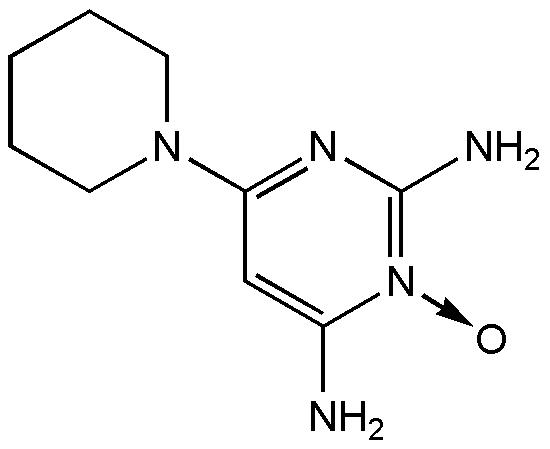
Minoxidil’s structure

While no one is quite sure how minoxidil works to regrow hair, researchers suspect that it has something to do with minoxidil’s ability to (1) improves blood flow, and (2) increase prostaglandin E2 synthesis – a fatty acid derivative that likely plays a role in hair cycle maintenance.
Is oral minoxidil better than topical minoxidil?
Potentially. Both oral and topical minoxidil need to interact with an enzyme called sulfotransferase before becoming active and eliciting any effects on our hair follicles. Unfortunately, many men and women who are losing their hair also lack enough sulfotransferase in the scalp skin for topical minoxidil to do its job. This likely explains why for 30-40% of people, topical minoxidil doesn’t work at all (myself included).
Enter oral minoxidil. This drug is metabolized is activated in the liver – where there is plenty of sulfotransferase to go around – and then rapidly distributed to tissues throughout the body. This is why, when it comes to regrowing hair, oral minoxidil has a much higher response rate – typically 90-100%.
Unfortunately, with the rapid tissue distribution of oral minoxidil, we can also experience its hair-growing effects elsewhere in the body: namely, across our chests and faces.
This isn’t such a problem for men (in fact, many men enjoy the increased body and facial hair growth). But for women, this can be a dealbreaker – with the fear of unwanted body hair growth relegating them topical minoxidil or other treatment options.
So, for females, is there a way to mitigate any unwanted side effects of oral minoxidil while still maximizing its hair-promoting effects?
Yes.
Clinical studies
Unlike the research on topical minoxidil, oral minoxidil research is sparse (especially in women). Nevertheless, there do seem to be certain dosages of oral minoxidil – and combination therapies – that greatly reduce the risk of unwanted hair growth in women.
Here’s a table of the studies conducted on women taking oral minoxidil for hair loss.
Daily Dose (duration) Type of Hair Loss Results Side Effects 1mg daily (6 months) (1) Female Pattern Hair Loss 12% increase in hair count Limb Swelling: 4% Hypotension: 0%
Excess Hair Growth Outside the Scalp: 27%
0.25mg + 25mg spironolactone daily (12 months) (2) Female Pattern Hair Loss 72% improvement in hair loss severity Limb Swelling: Not reported Hypotension: 2%
Hives: 2%
Excess Hair Growth Outside the Scalp: 4%
0.25mg-2.5mg with most patients taking 1mg (12 months) (3) Chronic Telogen Effluvium 45% improvement in hair loss severity Limb Swelling: Not reported Hypotension: 5%
Excess Hair Growth Outside the Scalp: 38%
Looking at the results, we see that all doses of oral minoxidil are effective at promoting hair growth: 1.5-2 mg by itself, and 0.25 mg of oral minoxidil in combination with 25 mg of spironolactone (an anti-androgen drug).
When analyzing side effects, serious adverse events – like hypotension and limb swelling – are uncommon, even with doses as high as 1-2.5mg. But at these dosages, there are quite a few women (27-38%) reporting unwanted hair growth elsewhere on the body… which is exactly what we’d like to avoid.
But there’s an inflection point: a dosage that we can minimize the risk of unwanted hair growth (hypertrichosis) while maximizing oral minoxidil’s pro-hair effects on the scalp.
It’s with 0.25mg of oral minoxidil + 25mg of spironolactone daily.
With this daily dosage of oral minoxidil + oral spironolactone, only 4% of women report excess hair growth… while the majority of females in the study saw significant improvements to their scalp hair loss.
What this means: this combination therapy of low-dose minoxidil + low-dose spironolactone (an anti-androgen drug) is sort of the oral minoxidil “sweet spot” – at least in terms of lowering your risk of body hair growth, and raising your likelihood of scalp hair growth.
Low-dose oral minoxidil + low-dose oral spironolactone is a winning formula for female hair loss sufferers
But, what if you’re sensitive to spironolactone?
Although 0.25 mg of oral minoxidil alongside 25 mg of spironolactone daily might be a viable option for many women with hair loss, spironolactone can cause mild allergic reactions in sensitive individuals. (4, 5) While these effects are rare, we have had some members of our community echo these concerns and even report adverse reactions of their own.
So, maybe you’ve found that you’re sensitive to spironolactone and that combining low dose spironolactone + oral minoxidil isn’t an option for you. What’s the next best option?
At this point, it really depends on what your tolerance for higher dosages of oral minoxidil (and their potential for side effects). Higher doses of 1mg to 2.5mg will likely provide results, but also increase your risk of body/facial hair growth.
If you have milder hair loss or really aren’t comfortable with increased body/facial hair (or don’t want to manage it with other therapies), you can always start with 0.25mg of minoxidil on its own. If it still isn’t providing the results you’re looking for, you can always look into alternative oral or topical therapies to bolster your results. As always, discuss your options with your doctor before doing anything.
You may also decide to implement totally different therapies. After all, many females have seen success treating hair loss outside of the drug model, and with therapies like:
…and more. So, before you jump on any treatment, make sure that you have a firm understanding of 1) the drivers of your hair loss, and 2) your treatment options. Then, make an action plan for hair recovery that’s tailored to your needs and preferences.
What’s the bottom line?
If you’re a female with pattern hair loss, and your goal is to maximize the hair-promoting properties of oral minoxidil while minimizing your risks of hypertrichosis, research shows that combining 0.25mg of oral minoxidil with 2.5mg of spironolactone is likely your best option. At these dosages, you’re positioning yourself for scalp hair growth while minimizing the risk of body hair growth.
If spironolactone isn’t an option for you, that’s okay. Higher doses of oral minoxidil (1-2.5mg) don’t present with any increased risk of hypotension or limb swelling, but at these dosages, 27-38% of women do report excess body/facial hair growth in clinical studies. If this is a concern for you, consider combining low-dose oral minoxidil with alternative therapies or opting for another treatment altogether.
Lastly, oral minoxidil is a prescription medication. So be sure to consult your doctor before doing anything.
Question? Comments? Please reach out in the comments section.
References
- Ramos, Paulo Müller et al. Minoxidil 1 mg oral versus minoxidil 5% topical solution for the treatment of female-pattern hair loss: A randomized clinical trial. Journal of the American Academy of Dermatology, Volume 82, Issue 1, 252 – 253
- Sinclair, R.D. (2018), Female pattern hair loss: a pilot study investigating combination therapy with low‐dose oral minoxidil and spironolactone. Int J Dermatol, 57: 104-109. doi:1111/ijd.13838
- Perera E, Sinclair R. Treatment of chronic telogen effluvium with oral minoxidil: A retrospective study. F1000Res. 2017;6:1650. Published 2017 Sep 6. doi:10.12688/f1000research.11775.1
- Alonso JC, Ortega FJ, Gonzalo MJ, Palla PS. Cutaneous reaction to oral spironolactone with positive patch test. Contact Dermatitis. 2002;47:178–9.
- Corazza, M., Strumia, R., Lombardi, A.R. and Virgili, A. (1996), Allergic contact dermatitis from spironolactone. Contact Dermatitis, 35: 365-366. doi:1111/j.1600-0536.1996.tb02421.x
Ketoconazole shampoo is an anti-fungal, anti-inflammatory shampoo that is sometimes used to treat androgenic alopecia (AGA).
There are two formulations of ketoconazole shampoo: 1% and 2%. While 1% ketoconazole is sold over-the-counter as an ingredient in many hair loss shampoos, only 2% ketoconazole is clinically shown to improve pattern hair loss. And unfortunately, 2% ketoconazole requires a prescription from your doctor.
This leads a lot of pattern hair loss sufferers to opt for 1% ketoconazole shampoo, and mainly out of convenience. But if you’re opting for 1% ketoconazole instead of 2%, are you selling yourself short any potential hair gains?
More specifically, when it comes to 1% versus 2% ketoconazole for hair loss, does one percentage point really matter?
This Quick Win dives into the studies on ketoconazole to answer this question.
Note: Quick Wins are short articles focused on answering one question about hair loss. Given their specificity, these articles are written in a more scientific tone. If you’re new to hair loss education, start with these articles.
Interested in Topical Finasteride?
Low-dose & full-strength finasteride available, if prescribed*
Take the next step in your hair regrowth journey. Get started today with a provider who can prescribe a topical solution tailored for you.
*Only available in the U.S. Prescriptions not guaranteed. Restrictions apply. Off-label products are not endorsed by the FDA.

Is 2% ketoconazole better than 1% ketoconazole?
Currently, there are no studies directly comparing 1% to ketoconazole to 2% ketoconazole in their ability to promote hair growth.
However, we can look at some different studies that use either formulation and compare how each one performs in its respective studies. Then, we can compare the results of each study to get a feel for which one is more effective.
First, let’s look at 2% ketoconazole. This study investigated 2% ketoconazole’s ability to increase hair counts in AGA patients. They found that, after 6 months (and 3x per week of use), participants experienced an average 18% increase in hair count.
Now, let’s evaluate 1% ketoconazole. This study looked at the effectiveness of 1% ketoconazole for AGA. After 6 months of use 3x per week, 1% ketoconazole didn’t increase hair count, but it did decrease hair shedding. In other words, 1% ketoconazole is effective enough to slow or stop shedding, but not to promote hair regrowth.
Both studies employed the same frequency for the same amount of time and on subjects with the same condition. Because of this, we can assume that ketoconazole at a 2% concentration is likely more effective than at 1%.
An additional study also compared 1% versus 2% ketoconazole in their ability to combat the scalp yeast Malassezia and the condition seborrheic dermatitis. Malassezia overgrowths and seborrheic dermatitis are often observed alongside pattern hair loss. These conditions lead to excessive sebum production and scalp flaking (i.e., dandruff), and thereby may accelerate AGA by increasing overall scalp inflammation. Moreover, there’s also research suggesting that resolving Malassezia overgrowths and seborhheic dermatitis may enhance hair regrowth. Long-story short: if we’re going to use a ketoconazole formulation for hair loss, it only benefits us if that formulation also improves these conditions.
The findings from that research team? When it came to decreasing Malassezia load and scalp flakiness from seborrheic dermatitis, 2% ketoconazole outperformed 1% ketoconazole in both categories. Moreover, 2% ketoconazole led to fewer relapses of either condition.
“During follow-up [ketoconazole] 2% showed a trend to fewer relapses than [ketoconazole] 1%. [Ketoconazole] 2% had superior efficacy compared to [ketoconazole] 1% in the treatment of severe dandruff and scalp seborrhoeic dermatitis”
So, in summary: yes, there is evidence to suggest that when it comes to improving pattern hair loss, 2% ketoconazole is more effective over a six-month period versus 1% ketoconazole. The one percentage point difference does matter.
The questions then becomes: why?
Why is 2% ketoconazole better than 1% ketoconazole?
Ketoconazole is suspected to work in three ways to slow/stop hair loss and promote hair regrowth. The drug:
- Reduces inflammation related to microbial activity on the scalp.
- Reduces levels of dihydrotestosterone, the most powerful male hormone and the culprit behind AGA.
- Prolongs the anagen phase (i.e., growing phase) of the hair cycle, thereby reducing excessive shedding.
We don’t exactly know why 2% ketoconazole is better than 1% ketoconazole. But, chances are that the 2% dilution simply accomplishes these things more effectively and (maybe) more rapidly, meaning that it:
- Kills off more Malassezia, resulting in a more dramatic reduction in inflammation.
- Reduces scalp DHT more effectively and more rapidly, preventing further follicle miniaturization in AGA.
- Stimulates the transition to the anagen phase faster, thereby halting shedding and promoting hair regrowth in a shorter amount of time.
But with increasing efficacy, drugs often come with an increased risk of side effects. This is why clinical researchers often test several dilutions and doses of any drug: they’re trying to uncover which dilution or dose maximizes clinical efficacy while minimizing the risk of side effects.
So, with 1% versus 2% ketoconazole, does the increased concentration lead to an increased risk of side effects?
Does a 2% ketoconazole have a higher risk of side effects compared to 1% ketoconazole?
Although oral ketoconazole comes with significant side effects, these same side effects haven’t been reported with topical ketoconazole or ketoconazole shampoos.
This is because topical and shampoo formulations of ketoconazole are metabolized rapidly within the skin tissues, so very little (if any) topical ketoconazole actually reaches the bloodstream.
On that note, research continues to demonstrate that for the overwhelming majority of people, both 1% and 2% topical ketoconazole concentrations do not come with a notable risk of side effects.
Some individuals may experience a hypersensitivity reaction to ketoconazole topicals, however, this is relatively rare.
That being said, there is a small risk associated with the formulation of a 2% ketoconazole topical cream containing sodium sulfite. But this is a risk with the sodium sulfite, not the ketoconazole itself. And to be clear: sodium sulfite is not a standard ingredient in ketoconazole shampoo formulations (which are the ones prescribed for hair loss); it’s typically only found in topical formulations used to treat conditions like acne.
The bottom line: ketoconazole is rapidly metabolized in the skin, and therefore has minimal risks of side effects. This is why its 1% shampoo formulations are sold over-the-counter.
Should you use a 2% ketoconazole shampoo or topical?
Much like comparative studies between 1% and 2% ketoconazole, no studies have been conducted to assess whether a shampoo or a leave-on topical is more effective for hair growth.
But for now, the 2% shampoo formulation is probably the best way to go, and for two reasons:
- Topical ketoconazole hasn’t been studied for hair loss
- Topical ketocoanzole is not easy to find
In other words, 2% ketoconazole shampoo has several clinical studies demonstrating its efficacy, whereas topical ketconazole has only been evaluated in very small clinical studies (i.e., 6 participants), and typically for conditions like acne (not hair loss).
Moreover, 2% ketoconazole shampoo is readily available – all you need is a prescription from your doctor. Topical ketoconazole is typically only sold for research purposes. And while topical ketoconazole would remain on the skin for longer (and thereby potentially have a greater effect on the hair follicles), we don’t think the potential additional benefits of topical ketoconazole outweigh the risks associated with acquiring and using it.
And with 2% ketoconazole shampoo consistently demonstrating a significant benefit for AGA sufferers, it makes the most sense to opt for what we already know is safe and works.
2% ketoconazole shampoo: clinical efficacy for pattern hair loss
- This study demonstrated that a 2% ketoconazole shampoo improves hair counts in men with AGA. It also found that 2% ketoconazole is nearly twice as effective as minoxidil.
- This study compared a few singular and combination therapies: minoxidil alone, finasteride alone, minoxidil + finasteride, and 2% ketoconazole shampoo + finasteride. Although the minoxidil + finasteride combination outperformed the ketoconazole + finasteride combination, it demonstrates that 2% ketoconazole can enhance finasteride’s benefits.
- This study found that 2% ketoconazole shampoo works well in combination with finasteride in minoxidil. Participants experienced hair regrowth in as little as 30 days.
The verdict: opt for a 2% ketoconazole shampoo
The available evidence suggests that when it comes to treating pattern hair loss (AGA), a 2% ketoconazole shampoo produces better, more rapid results than a 1% ketoconazole shampoo.
Yes, you’ll need to get a prescription for 2% ketoconazole. Yes, this requires an appointment with a doctor. And yes, this is a hassle. But in all likelihood, the benefits of 2% ketoconazole outweigh the convenience of the 1% formulation.
Questions? Comments? Please reach out in the comments section.
This article explores the characteristics, causes, and unknowns of pattern hair loss – also known as androgenic alopecia (AGA).
If you’re new to hair loss research, this is a good starting point to learn the science behind AGA as well as the concepts that come up frequently in the literature.
- Hair follicle miniaturization
- Telogen:anagen ratios
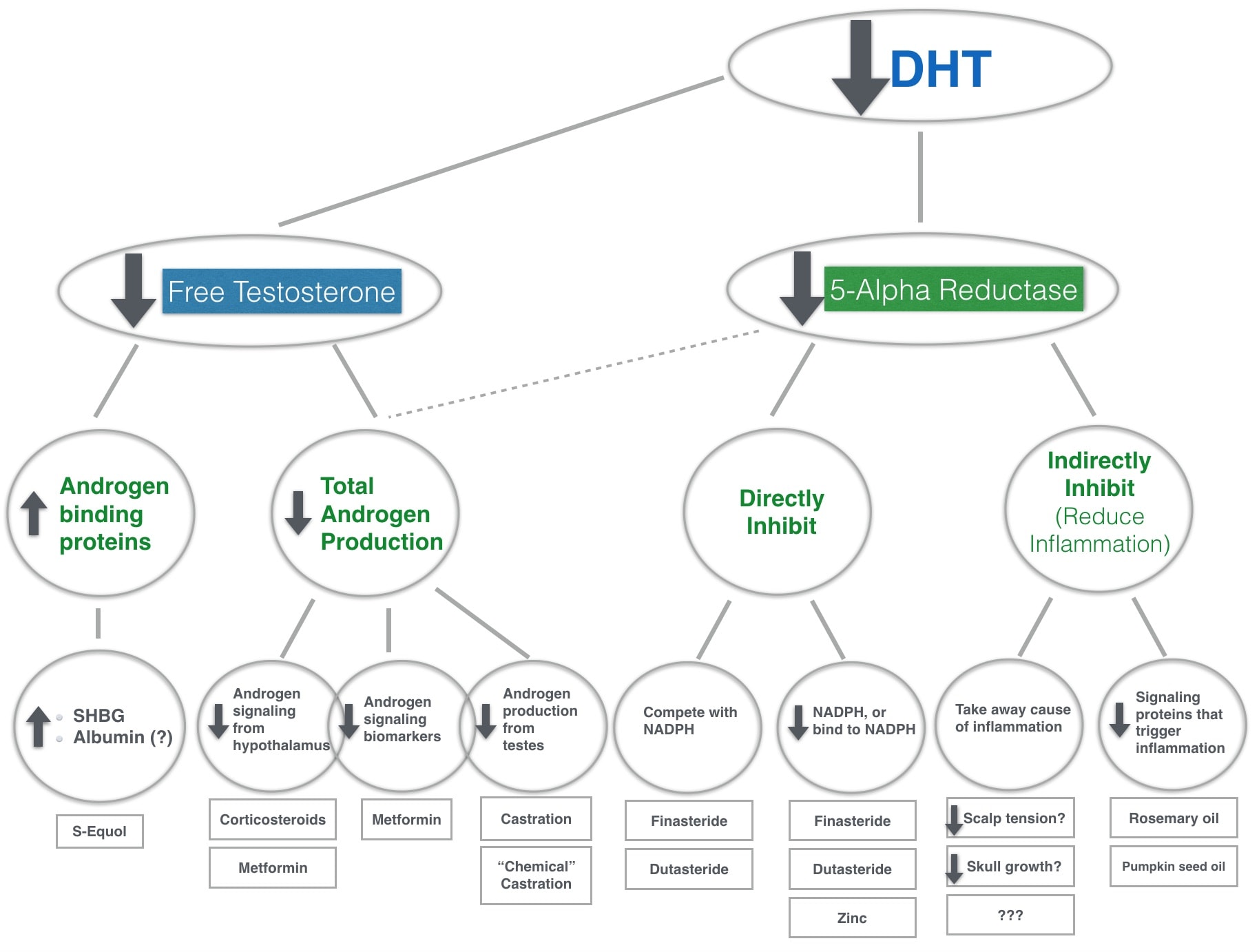
- Dihydrotestosterone, 5-alpha reductase, androgen receptors, and androgen receptor co-activation
- Prostaglandin activity
- Wnt-ß catenin pathways
- Future research focuses: olfactory receptors, galea interaction, and more
After all, the better we understand a condition, the better equipped we are to treat it.
We’ll explore how the interplay between genetics and male hormones may lead to hair follicle miniaturization. Then, we’ll reveal what still puzzles researchers about AGA, despite 50+ years of study.
Finally, we’ll dive into more recent evidence on AGA that is paving a new direction of research – and reshaping the future of treatments.
Interested in Topical Finasteride?
Low-dose & full-strength finasteride available, if prescribed*
Take the next step in your hair regrowth journey. Get started today with a provider who can prescribe a topical solution tailored for you.
*Only available in the U.S. Prescriptions not guaranteed. Restrictions apply. Off-label products are not endorsed by the FDA.
What is androgenic alopecia?
Androgenic alopecia (AGA), also known as pattern hair loss, is one of the most common hair loss disorder in the world. It’s chronic, progressive, and affects up to 50% of women and 80% of men at some point in their lives. In the U.S. alone, 30 million women and 50 million men are dealing with AGA that is severe enough to become diagnosable (NIH).
What does AGA look like?
AGA can occur both in men and women, but it manifests differently between the two sexes.
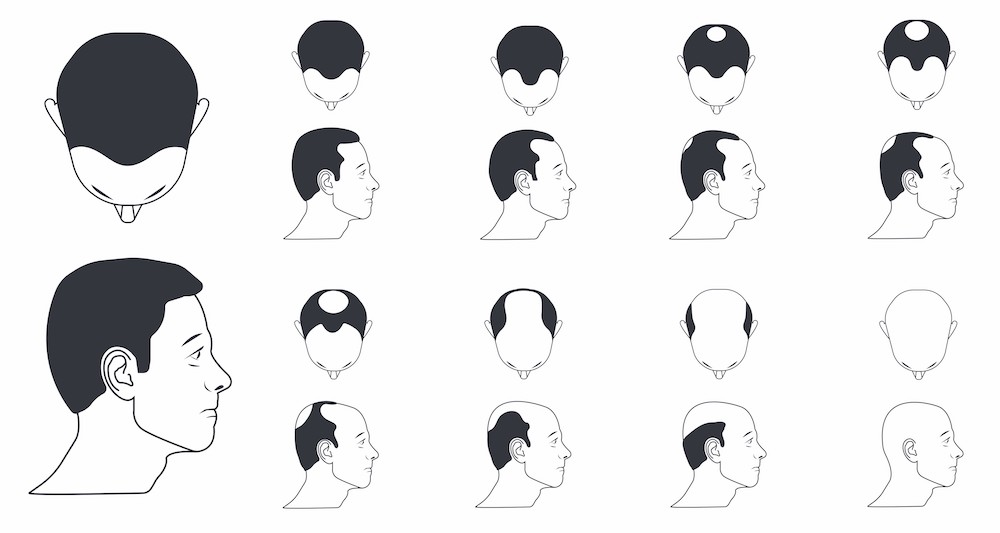
In men, classic pattern balding appears as:
- Recession of the hairline at the temples
- Loss of hair at the vertex (crown)
Norwood-Hamilton Scale (Male Pattern Hair Loss)

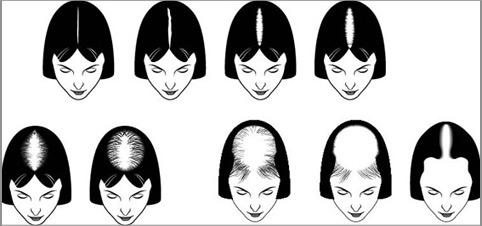
However, female pattern hair loss can present in a few different ways (Herskovitz et al., 2013):
- Diffuse, even thinning of the crown with preservation of the front hairline
- Christmas tree-pattern hair loss, with a widening of the scalp beginning at the front and tapering towards the crown
- Thinning at the temples
Ludwig Scale (Female Pattern Hair Loss)

What are the hallmark characteristics of AGA?
AGA has specific features that distinguish it from other types of hair loss.
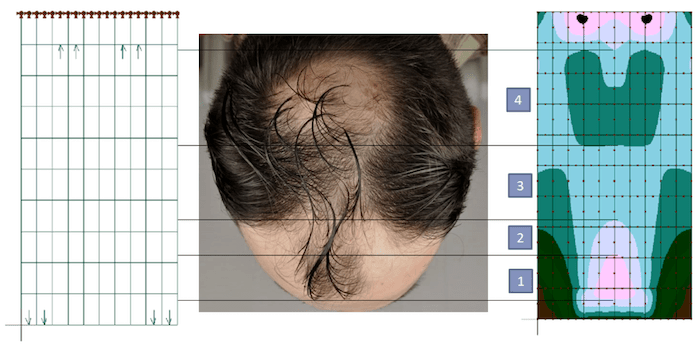
For starters, it primarily affects hair at the top part of the scalp – above the galea aponeurotica (the dense fibrous membrane that stretches across the top of the scalp).
Secondly, scalp regions affected by AGA show three defining characteristics of the condition:
- Hair follicle miniaturization
- Increased telogen:anagen hairs
- Shortened anagen cycling
Each of these phases are covered below.
Hair follicle miniaturization
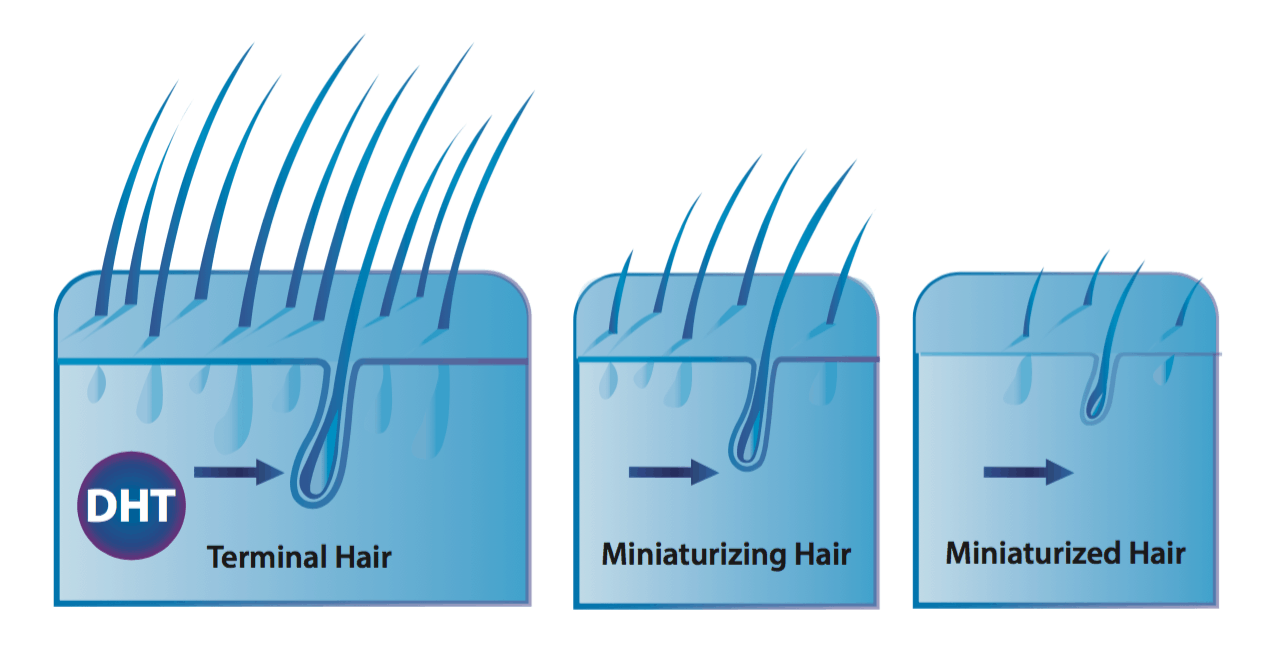
Follicle miniaturization is unique to AGA. It is a process by which AGA-affected hair follicles progressively get smaller until they produce fewer hairs. The hairs that are left may transition into fine, wispy hairs – known as vellus hairs.
Hair follicle miniaturization: a defining characteristic of AGA

While the causes and step-processes of hair follicle miniaturization are still debated, this process is often accompanied by histological (i.e. structural) changes – particularly to the tissues surrounding these hair follicles.
In fact, researchers believe these structural changes help to explain why pattern hair loss is a progressive condition – as they limit miniaturized hair follicles’ capabilities of returning back to full-size. They are:
- Dermal sheath thickening
- Perifollicular fibrosis
Both of these histological changes can be considered forms of scarring.
Dermal sheath thickening and perifollicular fibrosis
Dermal sheath is a term used to describe the skin tissues that surround our hair follicles. Dermal sheaths are comprised of collagen (i.e., skin), blood vessels, sweat glands, lymphatic networks, and more.
In men and women with AGA, dermal sheaths surrounding miniaturizing hair follicles have thickened. Specifically, their collagen bundles are up to 2.5 times larger – a characteristic of early scar tissue development (Jaworsky et al., 1992).
As dermal sheaths thicken, they widen into the space occupied by hair follicles – thereby impeding their growth space. And as AGA progresses, these dense collagen bundles turn into scar tissue – also known as perifollicular fibrosis.
Together, dermal sheath thickening and perifollicular fibrosis restrict the growth space of surrounding hair follicles, which creates a spacial barrier for miniaturizing hair follicles to recover back to their original size.
Fibrosis (scar tissue) surrounding an AGA-affected hair follicle

Dermal sheath thickening is consistently observed in AGA. However, its advancement to perifollicular fibrosis has been found, according to some studies, in over 71% of AGA sufferers – with moderate levels observed in at least 37% (Whiting et al., 1996).
By progressively restricting the growth space of miniaturizing hair follicles, these histological changes also explain the chronic, progressive nature of AGA – along with why most treatments are limited mainly to stopping the progression of pattern hair loss rather than fully reversing it (English, 2018).
Hair follicle miniaturization is a hallmark of AGA. This is when the size of each hair follicle shrinks and thus starts producing smaller, wispier hairs.
This process is accompanied by dermal sheath thickening around miniaturizing hair follicles. This skin thickening is an early step-process of scarring. In later stages of AGA, this turns to perifollicular fibrosis.
Dermal sheath thickening and perifollicular fibrosis prevent AGA-affected hair follicles from rebounding to their full size. They help to explain the chronic, progressive nature of AGA.
Increased telogen:anagen ratio
Beyond hair follicle miniaturization, the second defining characteristic of AGA is an increase in telogen versus anagen hairs.
Telogen and anagen are terms used to describe specific stages of the hair cycle.
The hair cycle is the natural, ever-repeating cycle of regeneration and degeneration of hair follicles. A hair grows, stops growing, and eventually falls out – at which point a new hair follicle reforms and a new hair starts growing again. In human scalps, these hair cycles last between two to seven years.
The Hair Cycle

In non-balding scalps, 80-85% of scalp hairs are in their growth (anagen) phase, 1-2% have stopped growing and are in their resting (catagen) phase, and 10-15% have already fallen out and entered their shedding (telogen) phase.
In healthy scalps, this cycle repeats indefinitely. Thus, many hair loss disorders can sometimes be identified by measuring the number of shedding versus growing hairs – and then comparing that ratio to what is seen in normal scalps. If the ratio is high, this suggests abnormal hair loss. If it’s low, this suggests normal, healthy hair.
This is the telogen:anagen ratio.
In normal scalps, there is generally one telogen hair for every 12 anagen hairs, or a 1:12 ratio.
However, in men with AGA, the telogen:anagen ratio can exceed 1:4 (or 25%). In women, this ratio often exceeds 2:5 (or 40%).
Shortened anagen cycling
Moreover, in balding scalps, the anagen phase of a miniaturizing hair is shortened. This means that rather than growing for 2-7 years, these hairs may only grow for a few months (Ho et al., 2019).
This is why so many AGA-affected men and women notice short terminal hairs near their hairline or vertex – hairs that won’t grow more than a few inches. This is the result of a shortened anagen phase and an increased telogen:anagen ratio.
In AGA, balding regions have an elevated ratio of shedding to growing hairs. This is called the telogen:anagen ratio.
While healthy scalps have a telogen:anagen ratio of 10-15%, balding regions will have a ratio of 25-40%, and sometimes higher.
Moreover, growing (anagen) hairs in balding regions often do not grow for more than a few months. This is called a shortened anagen phase. This helps to explain why so many balding men and women see shorter hairs in balding regions that never reach more than an inch or two in length.
What causes AGA?
While the exact step-processes of AGA aren’t yet determined, there is general consensus on two contributing factors: genetics and androgens (i.e., male hormones).
Genetics
AGA has an undisputed genetic component, with one study measuring a 2.5-fold increased risk of developing pattern hair loss in men whose fathers had pattern hair loss, as compared to those whose fathers didn’t (Chumlea et al., 2004). Moreover, women affected by AGA often report having other family members affected by the same condition (Ramos et al., 2015).
However, the exact genes involved in androgenic alopecia have not yet been discovered.
In fact, research suggests that there is no one gene involved in AGA. Rather, pattern hair loss is likely a polygenic disorder, meaning there are many gene variances that are involved in the predisposition of its development.
Scientists are still trying to uncover which polymorphisms may prompt individual susceptibility to AGA. Particular focus is on genes that code for androgen receptors (more on this soon).
Androgen activity
Male hormones (i.e., testosterone) are closely tied to AGA. In the 1940’s, researchers observed that (Hamilton et al., 1942):
- Men castrated before puberty (i.e., before their sex hormones spike) never develop AGA later in life.
- Men with AGA who are castrated (and thereby lose 95% of androgen production) also see a stop in AGA progression.
- Castrated men who are injected with testosterone begin to develop temple recession and/or vertex thinning.
Thirty years later, scientists uncovered the specific male hormone involved in AGA: dihydrotestosterone (DHT).
DHT: the main hormone implicated in pattern baldness

Dihydrotestosterone (DHT)
DHT – a metabolite of testosterone – is causally linked to pattern hair loss (English, 2018).
- Men who cannot make scalp DHT never develop AGA.
- Balding scalp regions have higher amounts of DHT versus non-balding regions.
- Drugs that reduce scalp DHT improve AGA outcomes in 80-90% of men.
DHT drives part of hair follicle miniaturization

However, not all types of DHT are implicated in pattern hair loss. Rather, research is focused more so on one specific type of DHT: DHT made from an enzyme called type II 5-alpha reductase.
Type II 5-alpha reductase
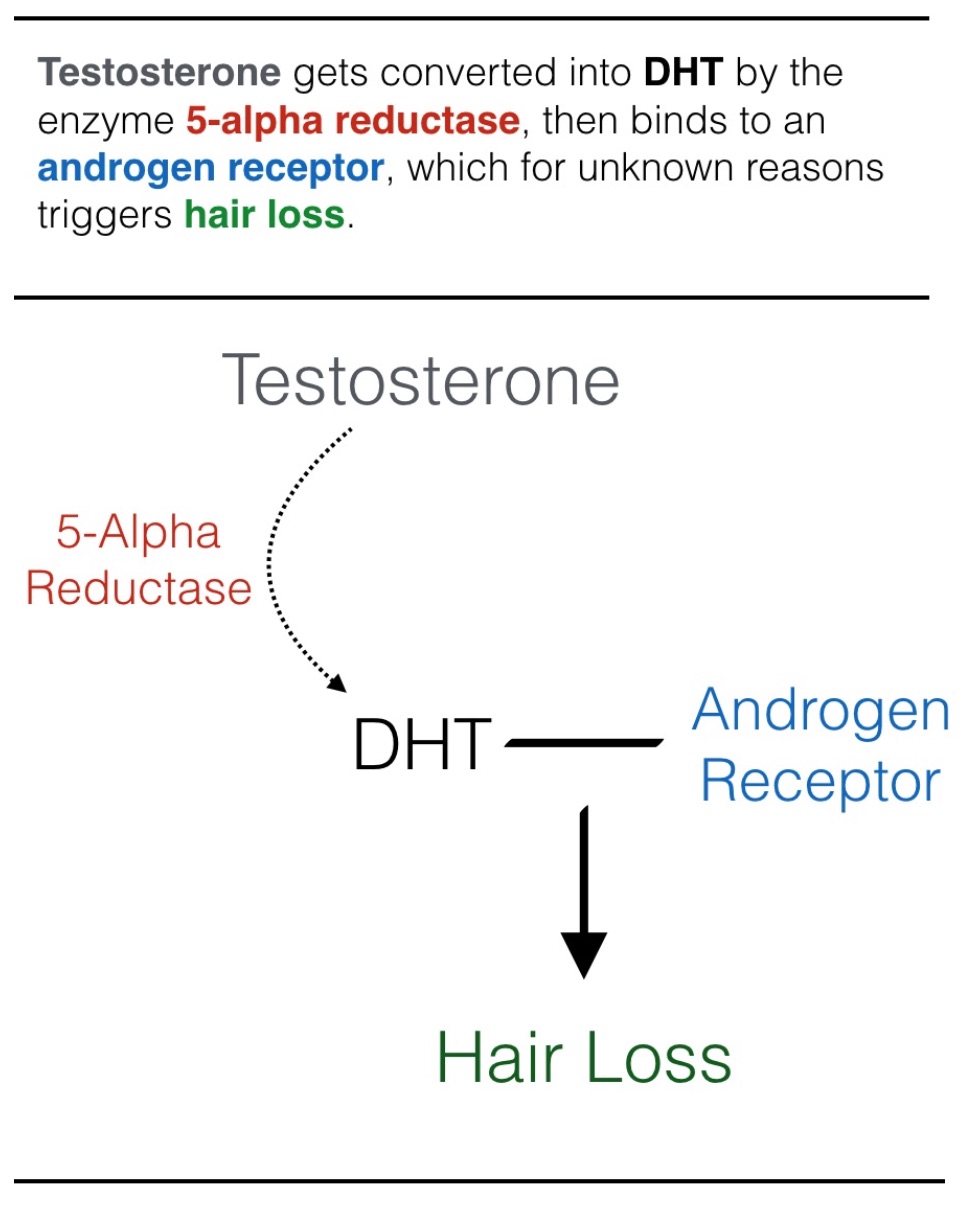
In the body, nearly all DHT is created when unbound testosterone comes into contact with the enzyme 5-alpha reductase. This enzyme binds to free testosterone and then changes testosterone’s structure into DHT.
There are different types of 5-alpha reductase, and most types correspond to a specific tissue or region in which the enzyme expresses (i.e., the skin, brain, prostate, etc.).
When it comes to AGA, the type II 5-alpha reductase is most heavily implicated.
This is because (1) type II 5-alpha reductase is greatly expressed in scalp tissues, and (2) men with a gene mutation who cannot produce type II 5-alpha reductase never go bald (Adachi et al., 1970). Moreover, drugs that inhibit the type II 5-alpha reductase enzyme (i.e., finasteride) help to improve pattern hair loss in men.
Together, these findings implicate DHT and the type II 5-alpha reductase enzyme in AGA. But there’s at least one more androgenic factor involved in the onset and progression of pattern hair loss: that of androgen receptors.
Androgen receptors
When free testosterone comes into contact with type II 5-alpha reductase and converts into DHT, that DHT needs a place to bind to a cell. Once DHT is bound to a cell, this hormone can begin to influence that cell’s functionality.
Androgen receptors are where DHT binds to cells. They’re considered cellular “landing pads” – a place for male hormones to attach, so that they can begin to change cellular behavior.
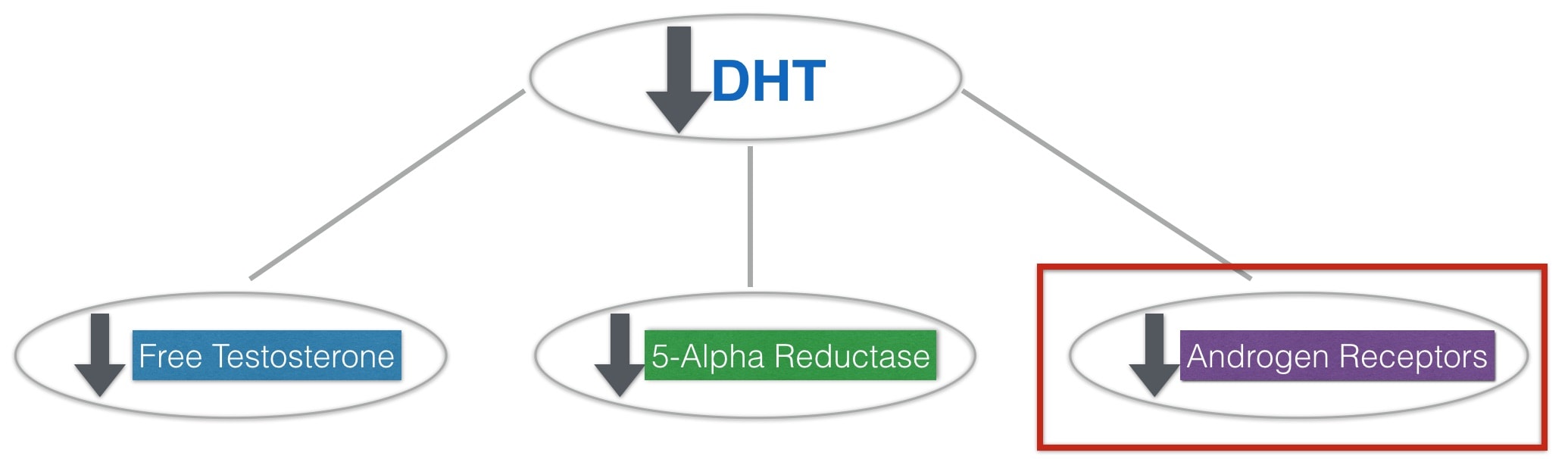
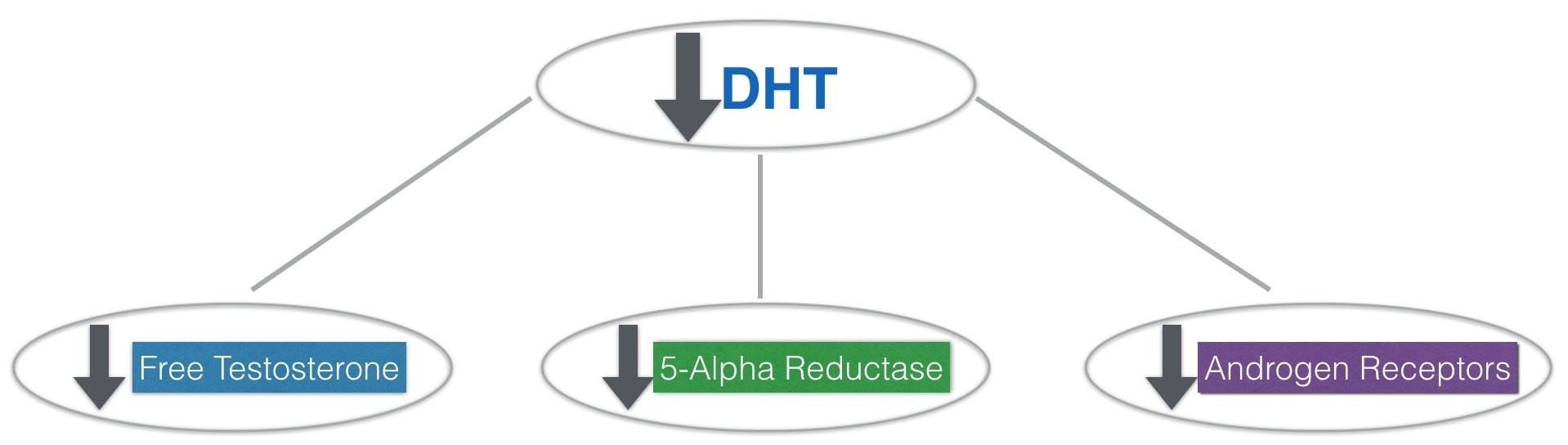
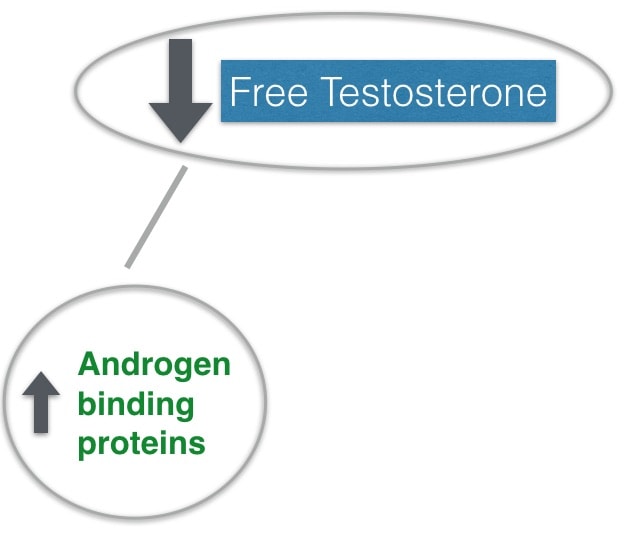
That means that for (most) scalp DHT to form, we need (1) free testosterone, (2) type II 5-alpha reductase, and (3) an androgen receptor.

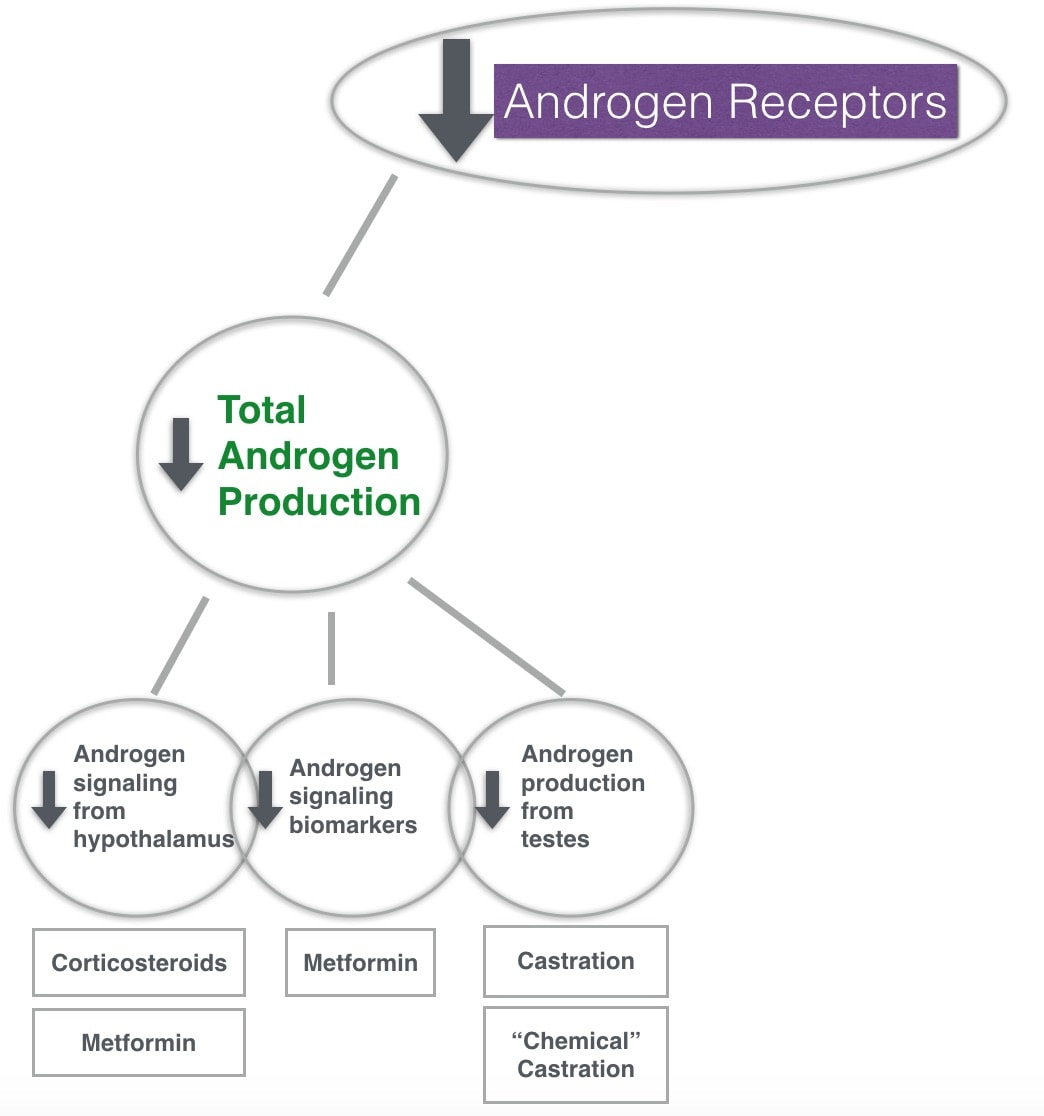
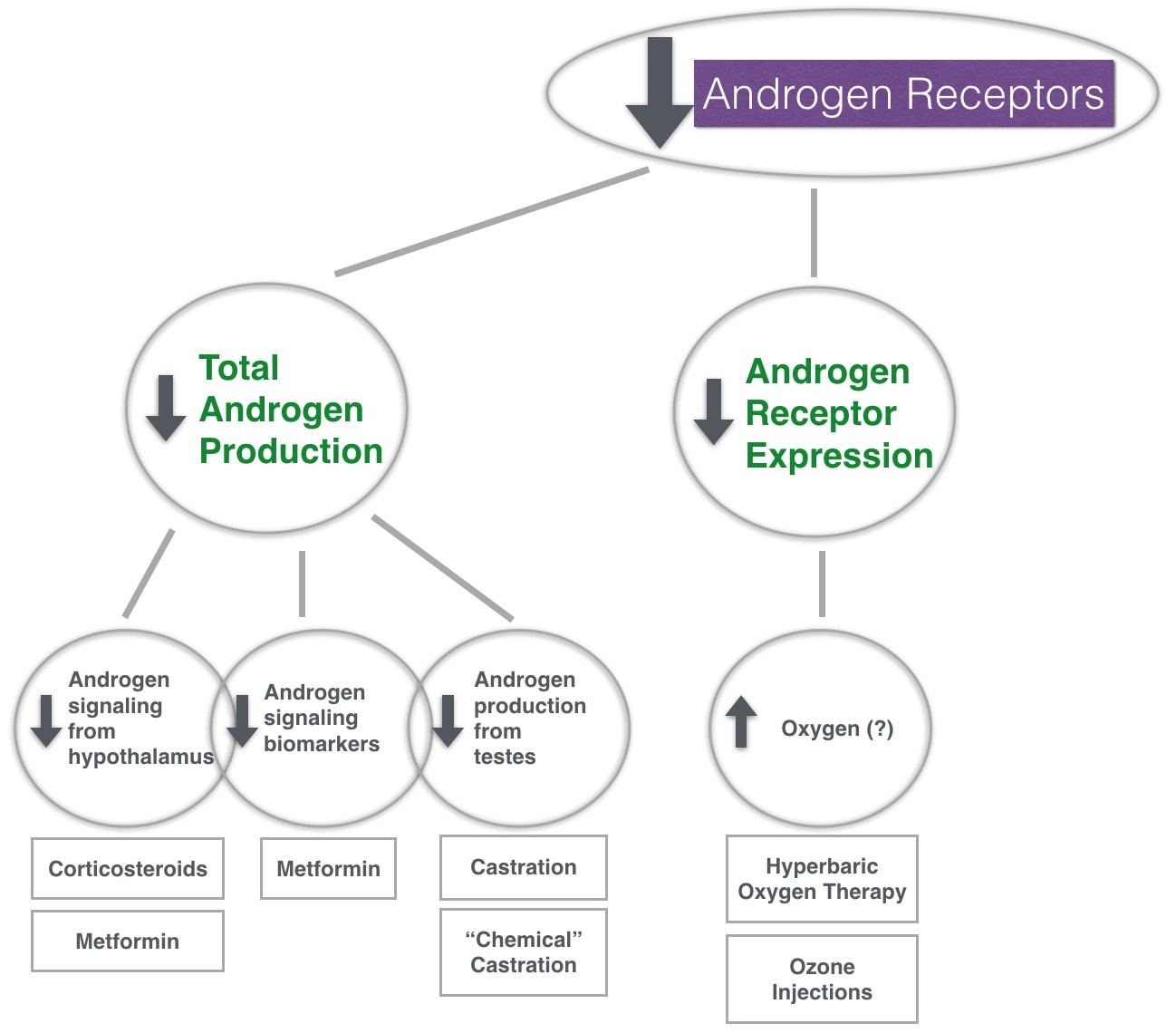
This is why androgen receptors are a major focus of AGA research: without androgen receptors, DHT cannot bind to scalp cells and influence their functionality.
“DHT sensitivity”
Type II 5-alpha-DHT has a 5x higher affinity for the androgen receptor than other hormones like testosterone (Trüeb, 2002). This means that in balding scalps, DHT will begin preferentially bind to androgen receptors and exert more effects on cell function, at least compared to other male hormones.
This is why some researchers speak of AGA sufferers developing a “genetic sensitivity” to DHT. In the scalp, the more type II 5-alpha-DHT bound to androgen receptors, the more likely a person is to suffer from pattern hair loss.
Is DHT also involved in female pattern hair loss?
DHT is still involved, but there’s debate over its degree of involvement.
Some studies have demonstrated that both men and women have elevated levels of 5α-reductase in the frontal hair follicles (Orme et al, 1999, Sawaya et al., 1997). This suggests that DHT may play a role in at least some female AGA cases.
At the same time, case studies have demonstrated female pattern hair loss can occur in women who are androgen-deprived, meaning they lack the ability to produce any male hormones at all (Orme et al., 1999).
While some have argued that these instances are just cases of mistaken identity (i.e., not AGA), others have used these findings as starting points to explore other aspects of AGA – and what the DHT-genetic sensitivity argument might not be telling us.
Other potential factors: prostaglandin D2, retinoid receptors, and PPAR pathways
A new wave of AGA research is focusing more so on non-androgenic factors that might influence hair follicle functionality.
In 2014, excitement was generated over prostaglandin D2 and its potential connection to pattern hair loss. Prostaglandin D2 is a fatty acid derivative that, theoretically, can express as a result of androgenic activity (i.e., DHT) (Nieves et al., 2014).
Prostaglandin D2 was once found to be elevated in balding scalp regions and even impede hair lengthening. However, follow-up studies have shown conflicting findings – suggesting that prostaglandin D2 might be less involved in AGA than initially believed (Villarreal-Villarreal et al., 2019).
Interestingly, evidence is accumulating that in addition androgenic activity, retinoid receptors and the PPAR pathway are intimately tied to hair follicle miniaturization – and may even explain why some women develop AGA despite having normal scalp DHT levels (Siu-Yin Ho et al., 2019).
Evidence implicates genes and androgen activity in the onset of AGA.
The hormone DHT is causally linked to AGA. Men who can’t produce DHT never go bald, DHT levels are higher in the scalps of balding men, and drugs that reduce scalp DHT help to stop AGA’s progression.
Scalp DHT is formed when free testosterone comes into contact with the enzyme, type II 5-alpha reductase. This enzyme converts free testosterone into DHT, and then that DHT attaches to an androgen receptor in scalp tissues – thereby influencing cell function.
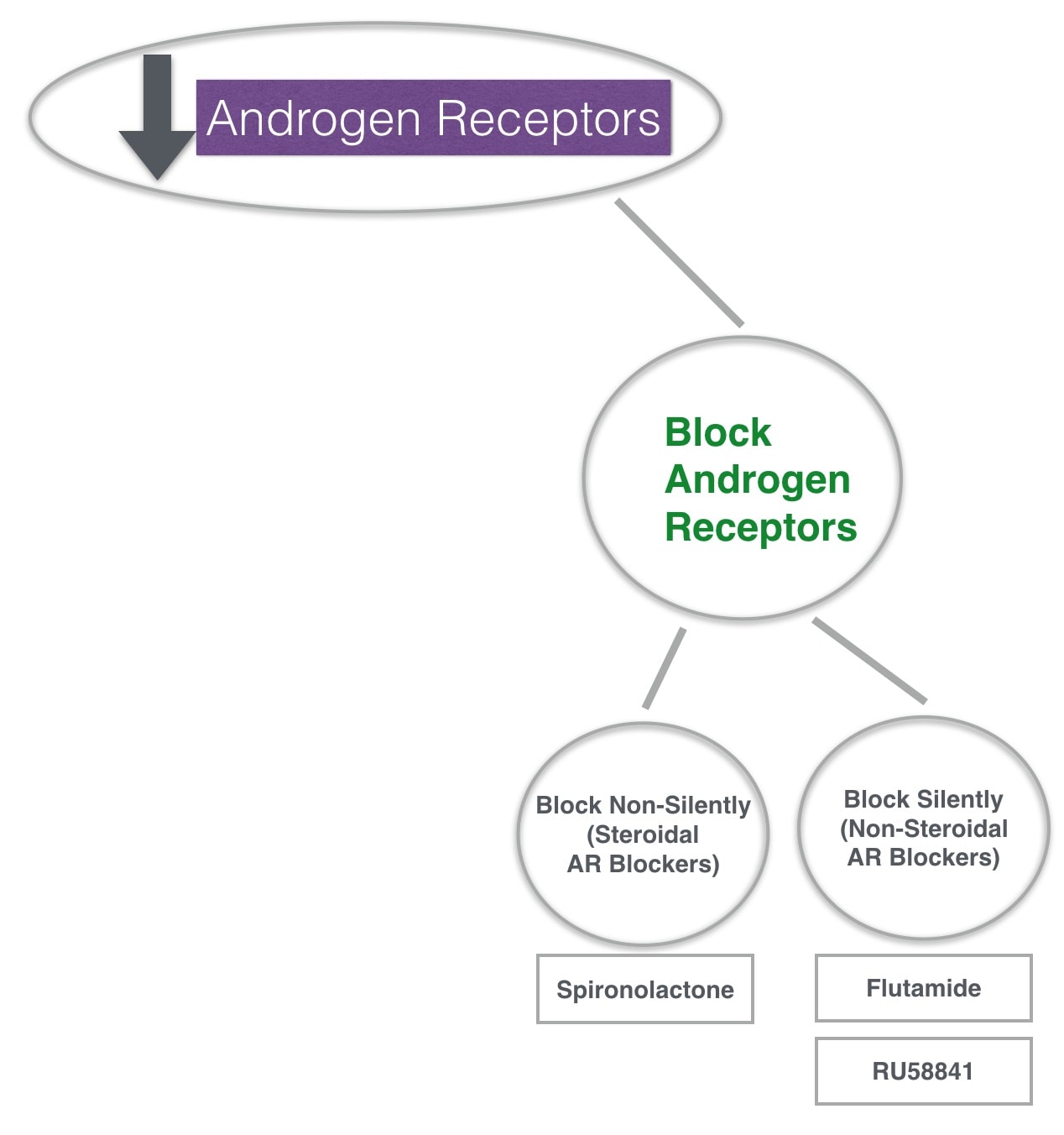
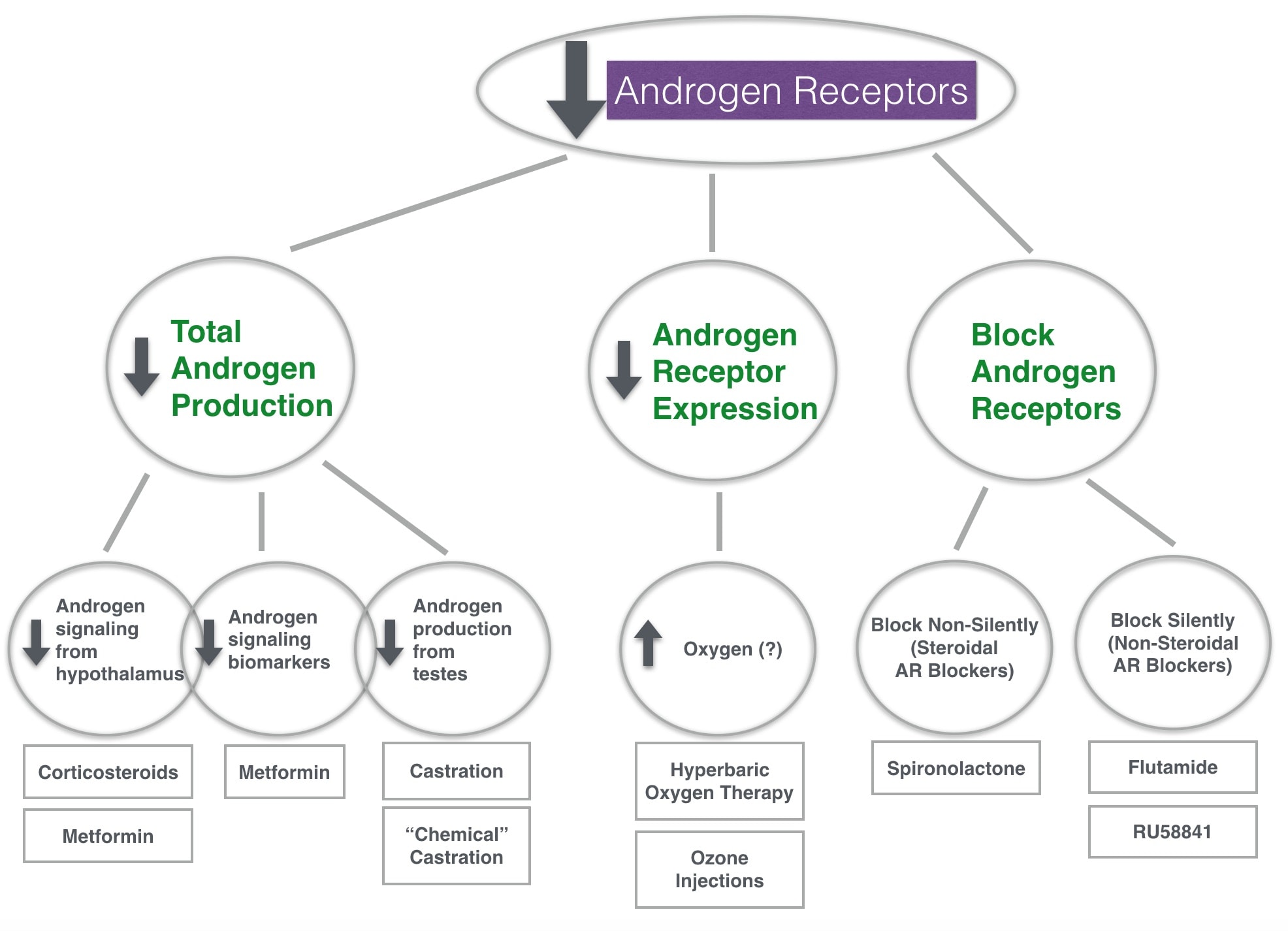
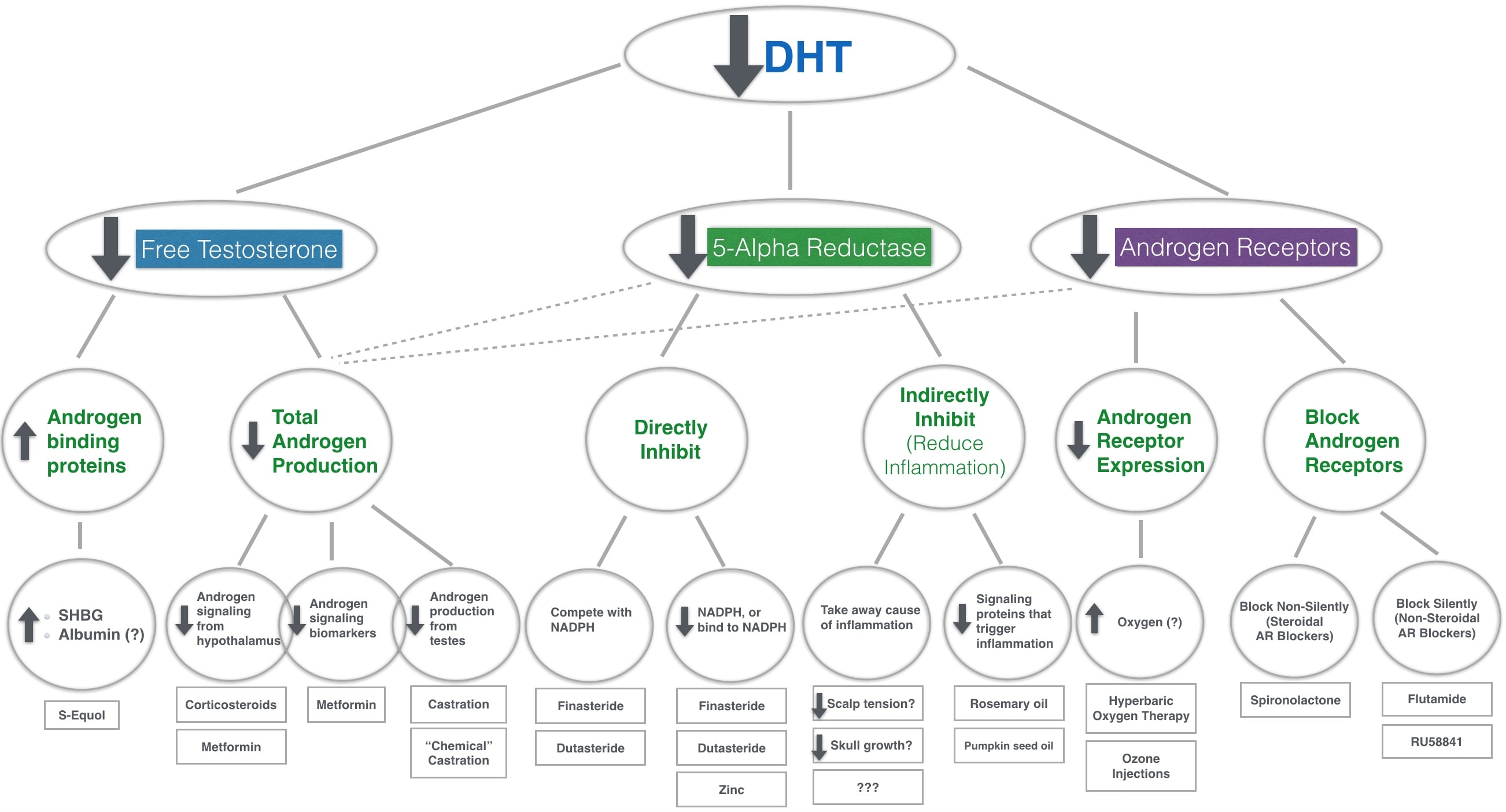
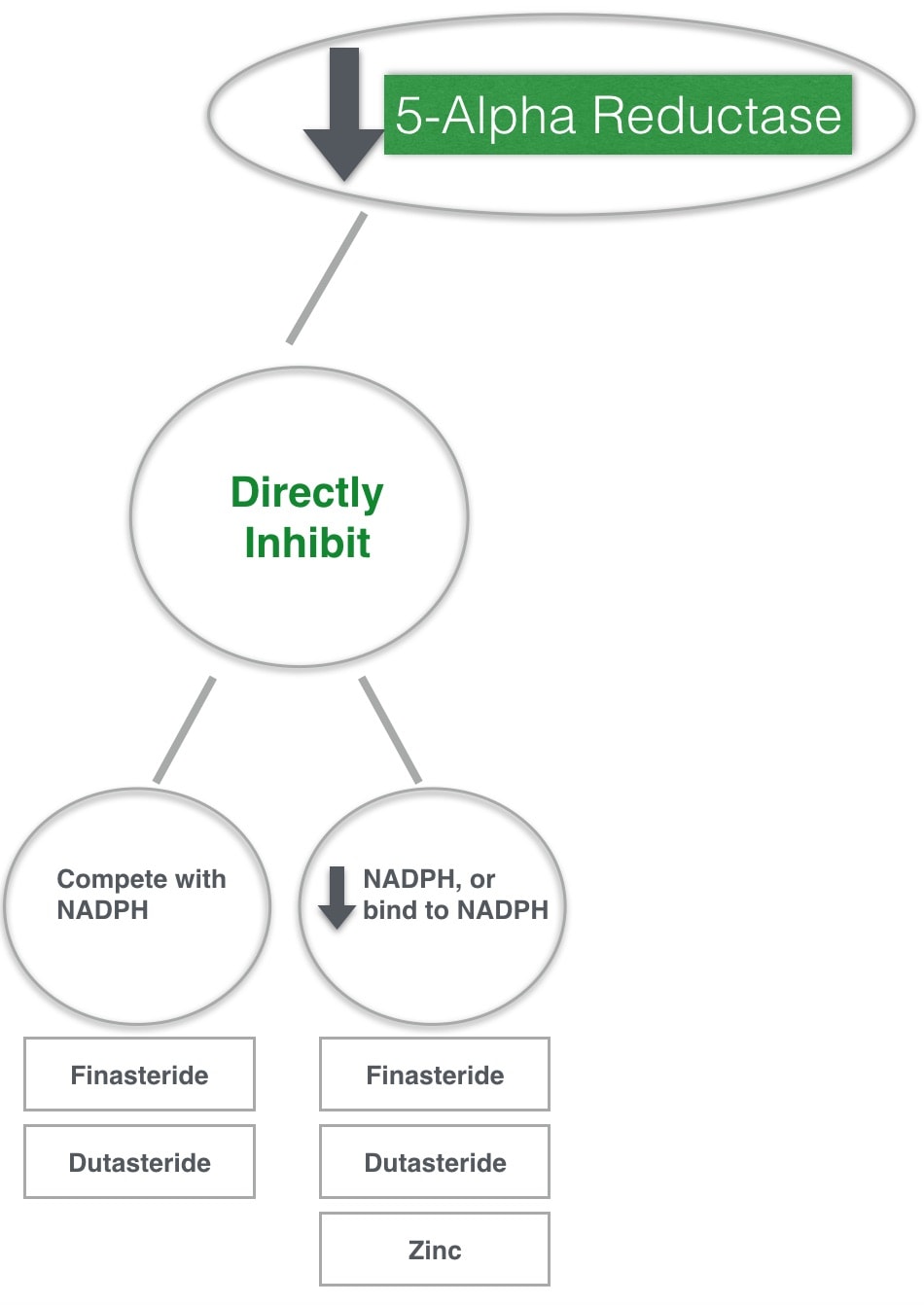
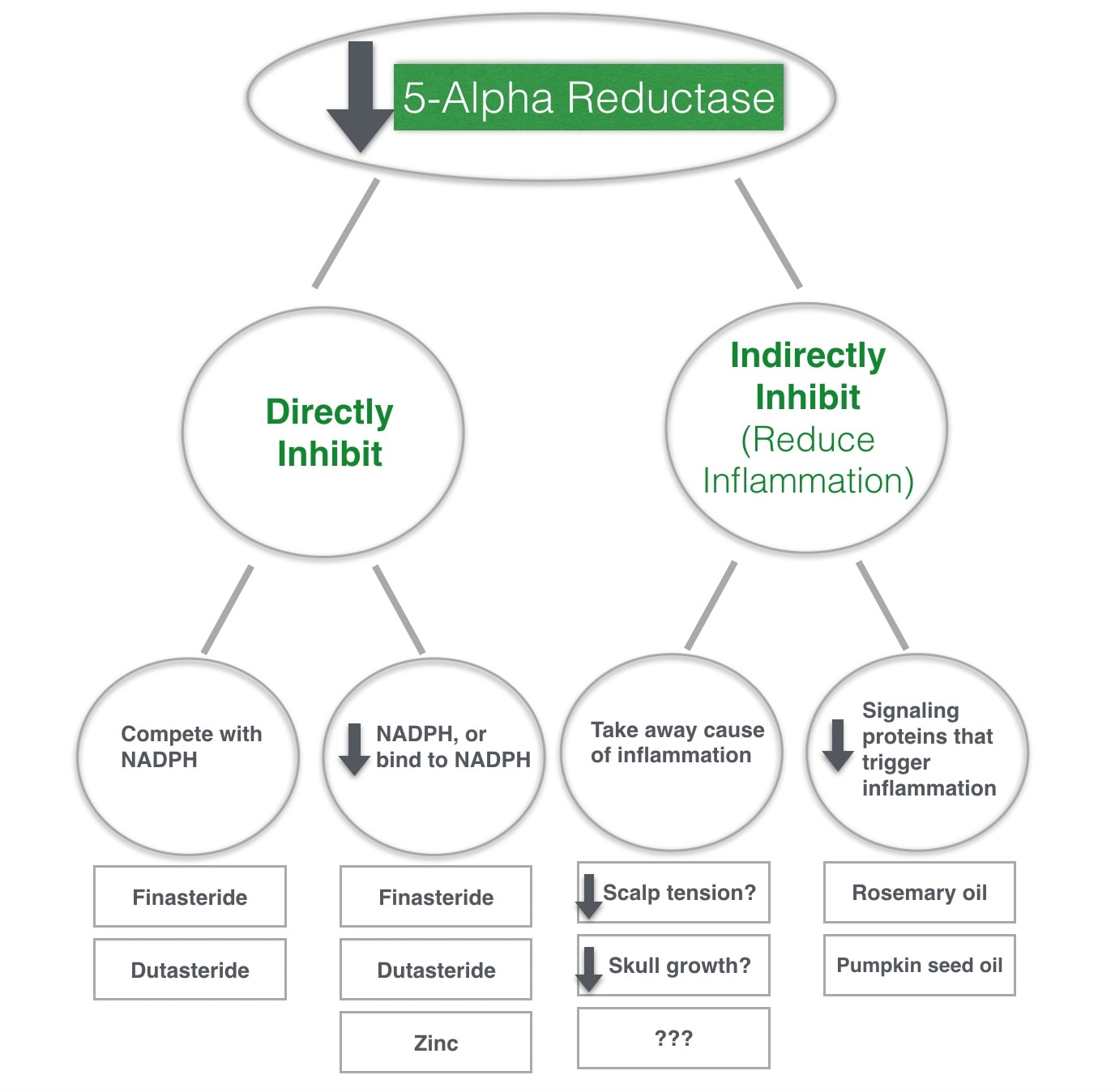
For these reasons, type II 5-alpha reductase and androgen receptors have been targets of both AGA research and AGA-related drugs. Finasteride is a type II 5-alpha reductase inhibitor; spironolactone and RU58841 are androgen receptor blockers. While these drugs don’t lead to complete AGA reversals, they do seem to improve AGA outcomes.
“DHT sensitivity” is a term used to describe how, in scalp tissues, DHT might begin to preferentially bind to androgen receptors – thereby having up to 5x greater influence over these cells’ behavior than other male hormones like testosterone.
While DHT is causally linked to AGA, it’s still unclear how this hormone causes hair follicle miniaturization. Research in female pattern hair loss brings to question DHT’s involvement in AGA – and suggests that in addition to androgens, other factors must be involved.
What don’t we know about AGA?
Despite AGA’s prevalence and decades of study, there are still a lot of unknowns about this hair loss disorder.
The specific genetics involved
As mentioned, AGA is a polygenic disorder. It has been unequivocally established that male pattern baldness is more likely to occur in men whose fathers suffer from AGA.
However, recent evidence suggests that genetic variances in the gene that encodes for androgen receptors are prevalent among men with male pattern baldness (Ellis et al., 2001). Because the androgen receptor gene is located on the X chromosome, which inherited by men from their mother, this raises questions about whether or not AGA is strictly related to paternal genetics.
Even more confounding is female AGA. Of the genetic components explore in male AGA, none seem to be present in women suffering from pattern hair loss (Ramos et al., 2015).
However, some research has demonstrated is that female pattern hair loss may be associated with polymorphisms in the aromatase gene (aromatase helps synthesize estrogen). Aromatase enzymes help convert testosterone into estrogen. However, it’s still unclear how (or why) these polymorphisms impact both female pattern hair loss – especially as this hair loss disorder has been characterized as “androgenic” since the 1970’s.
From the current body of evidence, it’s almost impossible to distinguish a specific gene or set of genes that is indisputably linked to all cases of AGA.
What causes DHT to increase in balding scalp regions?
If DHT is elevated in balding scalps of most men (and some women), what causes DHT to increase in these regions? This is one question researchers are still trying to answer.
One small-scale study indicates that whole-body DHT may not be the culprit – or that AGA patients don’t seem to have elevated serum DHT versus controls (Urysiak-Czubatka et al., 2014). This gives the impression that elevated DHT in balding scalp tissue is likely a local issue, and not a systemic problem.
So, then, what causes DHT to increase in scalp tissues, specifically? Elevated 5α-reductase activity has been implicated, which explains the ability of 5α-reductase inhibitors like finasteride to halt the progression of AGA (English, 2018). However, finasteride treatment doesn’t fully reverse AGA; it generally just stop its progression.
Findings that AGA is not associated with polymorphisms in the 5α-reductase genes suggest that this enzymatic upregulation is unrelated to genetic predisposition (Ellis et al., 1998). This indicates a possible environmental factor. This assumption is supported by studies showing that in genetically identical twins, one twin can bald faster than his counterpart – despite both twins having the same sets of genes (Nyholt et al., 2003).
Although research is sparse regarding environmental factors influencing 5α-reductase activity, there are some clues.
In women with PCOS, insulin resistance is related to increased 5α-reductase activity, possibly explaining why pattern hair loss is often a feature of the disorder (Wu et al., 2017). Male AGA is also associated with insulin resistance, however, whether this is a result of enhanced enzyme activity is unclear (González-González et al., 2009).
But again, no research team has discovered a definitive answer to this question.
How, exactly, does DHT miniaturize hair follicles?
No one is sure. The closest answers we have (so far) come from DHT and its link to a signaling protein called transforming growth factor beta 1 (TGF-β1).
Follicular miniaturization, as well as dermal sheath thickening and perifollicular fibrosis, are key features of AGA. In vitro studies strongly implicate the role of a growth factor, TGF-β1, in these processes (Yoo et al., 2006).
One of TGF-β1’s primary roles in the body is promoting both wound healing and the deposition of fibrous scar tissue (Pakyari et al., 2013). Thus, elevated TGF-β1 activity is likely involved in AGA follicle miniaturization and may even contribute to the process.
TGF-β1 expression can be triggered by the binding of androgens – like DHT – to androgen receptors, and in a potentially dose-dependent manner (Yoo et al., 2006). TGF-β1 may also enhance androgen activity through an androgen co-activator, Hic-5, that allows androgens like DHT to more effectively influence gene expression, like TGF-β1, within cells (Dabiri et al., 2008).
Essentially, increased androgen activity enhances TGF-β1 expression, and TGF-β1 exacerbates androgen activity. This feedback loop creates a vicious cycle that may underpin AGA progression.
Genetically-determined increased androgen receptor expression in AGA tissue contributes to this upregulated androgen activity, but this genetic component alone isn’t enough to dictate AGA progression (Nyholt et al., 2003).
This begs the question: in AGA, what causes androgen activity to increase?
If activity is dictated by androgen availability in the hair follicle, the rate of DHT conversion by 5α-reductase (which is controlled by the number of 5α-reductase enzymes and their activity), and the involvement of co-activators, then what, beyond genetics, could trigger any one of these factors?
Future research will hopefully begin to answer these questions.
Why is DHT also associated with body and facial hair growth?
DHT is linked to hair loss in AGA scalps. But ironically, this same hormone also enhances facial and body hair growth (Thornton et al.,1993). This occurs in spite of a 3-5 times higher 5α-reductase activity in beard follicles.
Given androgens and their negative impact on hair growth in the scalp, one would assume that elevated 5α-reductase activity would result in beard hair loss, not growth. But, this isn’t true for either case. Why might this be?
Why is there a pattern to androgenic alopecia?
No one is sure. Initially, researchers thought the pattern of AGA was due to different levels of androgen activity in balding regions. However, anecdotes of females with AGA and no androgen activity have raised questions about whether this actually makes sense.
In AGA scalps, there are differences in androgen receptor density and 5α-reductase activity in balding and non-balding regions (Cranwell et al., 2016). This may be explained by in vitro research that proposes individual follicles can “self-regulate”, modulating levels of androgen receptors and 5α-reductase enzymes.
Another question is then: what triggers these follicles to self-regulate? The current state of evidence leaves the answers to these questions purely speculative.
The activation of androgen co-activator, Hic-5, also increases follicle sensitivity to androgens, allowing androgens to more effectively influence hair loss-related gene expression (Tellez-Segura, 2015). Interestingly, stretching forces on follicle cells and oxidative stress have been shown to activate Hic-5 (Kim-Kaneyama et al., 2005, Shibanuma et al., 2003).
Elevated levels of reactive oxygen species (ROS, also known as free radicals) and increased stretching forces in these localized regions may explain increased androgen sensitivity, TGF-β activity, and, thus, the patterning of AGA.
What is not known is what events may trigger increased tension or free radical concentration in these areas. There’s still much to be explored.
The current model of AGA doesn’t fully explain (1) what causes DHT to increase in balding regions, (2) how DHT actually miniaturizes hair follicles, (3) why DHT is associated with scalp hair loss, but body and facial hair growth, and (4) why there is a unique pattern and progression to AGA.
Where is AGA research heading?
As scientists try to answer these questions, they’re beginning to stumble into new (and exciting) areas of AGA research.
Wnt/β-catenin signaling
The hair cycle is a degenerative and regenerative process that requires stem cells. Without the activity of these stem cells, the hair follicle can’t properly regenerate hair or maintain the integrity of the hair follicle itself.
Each compartment of the hair follicle possesses its own stem cell reservoir from which it draws. They are used to repair the epidermis around the hair follicle following injury, maintain the structure of the hair follicle, and help regulate hair follicle cycling (Yang et al., 2010).
Wnt/β-catenin signaling is essential for this process. These pathways help with the differentiation of stem cells in and around the hair follicle.
If this signaling pathway is blocked, hair follicle shaft regeneration is impaired. Blockade of this pathway may also impede the re-entry to the anagen phase from telogen.
In AGA, elevated levels of DHT effectively stimulate androgen-related gene transcription. One of the genes that androgens regulate is dickkopf 1 (DKK-1), a direct inhibitor of the Wnt/β-catenin pathway (Kwack et al., 2008).
When DHT binds to ARs in the dermal papilla cells, it enhances the expression and secretion of DKK-1. It acts in a paracrine fashion, meaning it affects hair components outside of the dermal papilla and may impair stem cell function throughout the hair follicle.
As a result, the hair follicle loses its integrity and may become inactive. However, evidence from animal studies indicates that, thankfully, even long-term DKK-1 inhibition of hair growth may be reversible (Choi et al., 2014).
Current Model Alternative Model How do androgens cause hair loss? Genetic predispositions Increased androgen activity and genetic sensitivity work synergistically to inhibit Wnt/β-catenin signaling, preventing hair follicle regeneration and anagen re-entry. Galea interaction
The galea aponeurotica is a fibrous connective tissue that extends over the top of the scalp. It is attached to and connects all the muscles surrounding it.
The galea is a key component of the scalp tension theory of AGA. Interestingly, the “pattern” observed in AGA directly correlates to the highest points of tension in the GA (English, 2018).
Hair follicles are fashioned within both the dermis and fatty tissue beneath the skin, which is directly fused with the GA. Tension in the galea may be transmitted to these tissues and the follicles that are housed within.
Stretch-induced mechanical tension can enhance free radical production and trigger chronic inflammation in various types of tissues, potentially including the GA and the tissues that surround it. Cellular mechanical tension, free radicals, and inflammation can all enhance androgen activity and the fibrosis-mediating TGF-β1 (English, 2018).
This may, in part, explain the origin of follicle miniaturization in AGA.
Other research groups have developed similar hypotheses, arguing that fibrosis may not only drive hair follicle miniaturization, but that this process is potentially mediated by interactions between the galea and cells that transition adipose (fat) tissue into scar tissue (Kruglikov et al., 2017).
Current Model Alternative Model What causes increased androgen activity in AGA follicles? Genetic predisposition to androgen sensitivity. Mechanical stretch, free radical production, and chronic inflammation as a result of galea tension enhance androgen activity. Why is there increased androgen activity in localized regions? Genetics don’t yet offer any direct explanation. The points of highest tension within the galea directly correlate to the pattern seen in AGA. The mechanical stretch, free radical production, and chronic inflammation may all upregulate androgen activity. Why does DHT cause hair loss on the scalp but not in facial or body hair? Genetics don’t yet offer any explanation. Mechanical stretch, free radical production, and chronic inflammation as a result of GA tension trigger TGF-β1 expression that leads to follicle miniaturization. Olfactory receptors
An interesting finding of one 2018 study was the identification of OR2AT4 receptors in human hair follicles. OR2AT4 is an olfactory or smell receptor that is activated by certain scents (Chéret, et al. 2018).
In this study, researchers demonstrated that activation of this receptor by a synthetic sandalwood scent prolonged the anagen phase of the hair cycle. In fact, their findings suggest that activation of OR2AT4 may actually be indispensable for maintaining anagen.
While OR2AT4 is primarily considered an olfactory receptor activated by scent, this study also suggests that it may be activated by other compounds such as scalp microflora (bacteria) metabolites and short-chain fatty acids.
Current Model Alternative Model Inhibition of androgen activity is the best way to treat AGA. Many different cellular receptors in the hair follicle, like olfactory receptors, may help counteract the effects of androgens in the scalp. In addition to PPAR pathways and retinoid receptors – Wnt-β catenin signaling, galea interactions, and olfactory receptors may help explain much of the unexplained phenomena in AGA pathology.
What are the treatment targets for AGA?
Most AGA treatments target to (1) decrease the telogen:anagen ratio, and (2) stop the progression of hair follicle miniaturization.
There are many ideas as to how to do this, but the most successful FDA-approved approach (so far) seems to be finasteride (Propecia®), a type II 5-alpha reductase inhibitor.
1mg daily of oral finasteride reduces scalp DHT levels by 50-70%. Subsequently, it stops AGA progression in 80-90% of men and leads to a 10% increase in hair count over two years, along with some additional hair thickening (English, 2018).
However, prolonged finasteride use is sometimes associated with sexual side effects. And, when considering all of the evidence that not just androgens are involved in AGA, it’s likely that finasteride is not a complete solution.
As such, here’s a list of current treatment targets in AGA research. Many of these targets overlap with one another.
- Type II 5-alpha reductase
- Androgen receptors
- Reactive oxygen species
- Wnt-β catenin pathways
- DKK-1
- TGF-β1
- Prostaglandin analogues
- Olfactory receptors
- PPAR pathways
- Retinoid receptors
- Potassium ion channels
- Mechanical tension
- Adipose-myofibroblast transitions
- Scalp microflora
In the years to come, this list will undoubtedly grow as researchers elucidate more of the molecular mechanisms behind AGA.
The bottom line
AGA can affect men and women, in both similar and completely different patterns.
AGA is characterized by (1) an increased telogen:anagen ratio, and (2) hair follicle miniaturization. Dermal sheath thickening and perifollicular fibrosis are also present in balding regions, and may partly explain the chronic, progressive nature of AGA.
Both genetics and androgens are established as causally linked to AGA. Androgen receptor density, type II 5α-reductase activity, and DHT are elevated in balding scalps.
The DHT “genetic sensitivity” argument for AGA is incomplete, and for several reasons. (1) Elevated whole-body DHT and polymorphisms in the 5α-reductase gene are not associated with AGA. (2) Female pattern hair loss has been observed in women who cannot produce androgens. (3) More recent research now implicates non-androgenic factors like retinoid receptors and PPAR pathways in the onset of hair follicle miniaturization from AGA.
The current model of AGA doesn’t fully explain (1) what causes DHT to increase in balding regions, (2) how DHT actually miniaturizes hair follicles, (3) why DHT is associated with scalp hair loss, but body and facial hair growth, and (4) why there is a unique pattern and progression to AGA.
Wnt-β catenin signaling, galea interactions, and olfactory receptors are a few new research areas in AGA that might help explain part of the unexplained phenomenon in AGA.
(1) Wnt/β-catenin signaling regulates the stem cell activity in hair follicles needed for follicle regeneration and anagen re-entry. Androgens stimulate DKK-1 secretion by dermal papilla cells which inhibits Wnt/β-catenin signaling and impairs stem cell activity.
(2) Mechanical tension in the galea, which directly corresponds to the patterning in AGA, may play some sort of regulatory role in the inflammation, free radical production, and TGF-β1 expression that seems to mediate scarring and hair follicle miniaturization. However, research here is limited.
(3) Activation of one olfactory receptor by short-chain fatty acids, scalp microflora metabolites, and specific scents may prolong the anagen phase, providing one possible avenue for counteracting AGA progression outside of the traditional anti-androgen treatment approach.
AGA researchers are now turning focus toward non-androgenic factors – PPAR pathways, retinoid receptors, and more – to explain the unexplainable in AGA pathology. If research keeps heading in this direction, newer treatment options will likely better target AGA’s step-processes, resulting in better hair recovery and with a greatly reduced potential for side effects.
References
- NIH Androgenetic Alopecia Stats https://ghr.nlm.nih.gov/condition/androgenetic-alopecia#statistics
- Herskovitz, I., & Tosti, A. (2013). Female pattern hair loss. International journal of endocrinology and metabolism, 11(4), e9860. doi:10.5812/ijem.9860
- JAWORSKY, C. , KLIGMAN, A. and MURPHY, G. (1992), Characterization of inflammatory infiltrates in male pattern alopecia: implications for pathogenesis. British Journal of Dermatology, 127: 239-246. doi:10.1111/j.1365-2133.1992.tb00121.x
- Whiting, D. A. (1996). Chronic telogen effluvium: Increased scalp hair shedding in middle-aged women. Journal of the American Academy of Dermatology, 35(6), 899–906. doi:10.1016/s0190-9622(96)90113-9
- English, R. S. (2018). A hypothetical pathogenesis model for androgenic alopecia: clarifying the dihydrotestosterone paradox and rate-limiting recovery factors. Medical Hypotheses, 111, 73–81. doi:10.1016/j.mehy.2017.12.027
- Hoelzel, F. (1942). Baldness and calcification of the ivory dome. Journal of the American Medical Association, 119(12), 968-968.
- Ho CH, Zito PM. Androgenetic Alopecia. [Updated 2019 May 18]. In: StatPearls [Internet]. Treasure Island (FL): StatPearls Publishing; 2019 Jan-. Available from: https://www.ncbi.nlm.nih.gov/books/NBK430924/
- Chumlea, W. C., Rhodes, T., Girman, C. J., Johnson-Levonas, A., Lilly, F. R. W., Wu, R., & Guo, S. S. (2004). Family History and Risk of Hair Loss. Dermatology, 209(1), 33–39. doi:10.1159/000078584
- Ramos, P. M., & Miot, H. A. (2015). Female Pattern Hair Loss: a clinical and pathophysiological review. Anais brasileiros de dermatologia, 90(4), 529–543. doi:10.1590/abd1806-4841.20153370
- Hamilton, J. B. (1942), Male hormone stimulation is prerequisite and an incitant in common baldness. Am. J. Anat., 71: 451-480. doi:10.1002/aja.1000710306
- Adachi, K., & Kano, M. (1970). Adenyl cyclase in human hair follicles: Its inhibition by dihydrotestosterone. Biochemical and Biophysical Research Communications, 41(4), 884–890. doi:10.1016/0006-291x(70)90166-x
- Trüeb, R. M. (2002). Molecular mechanisms of androgenetic alopecia. Experimental Gerontology, 37(8-9), 981–990. doi:10.1016/s0531-5565(02)00093-1
- Orme, Cullen, & Messenger. (1999). Diffuse female hair loss: are androgens necessary? British Journal of Dermatology, 141(3), 521–523. doi:10.1046/j.1365-2133.1999.03049.x
- Sawaya, M. E., & Price, V. H. (1997). Different Levels of 5α-Reductase Type I and II, Aromatase, and Androgen Receptor in Hair Follicles of Women and Men with Androgenetic Alopecia. Journal of Investigative Dermatology, 109(3), 296–300. doi:10.1111/1523-1747.ep12335779
-
Nieves, A. and Garza, L. A. (2014), Does prostaglandin D2 hold the cure to male pattern baldness?. Exp Dermatol, 23: 224-227. doi:10.1111/exd.12348Villarreal‐Villarreal, C. , Sinclair, R. , Martínez‐Jacobo, L. , Garza‐Rodríguez, V. , Rodríguez‐León, S. , Lamadrid‐Zertuche, A. , Rodríguez‐Gutierrez, R. , Ortiz‐Lopez, R. , Rojas‐Martinez, A. and Ocampo‐Candiani, J. (2019), Prostaglandins in androgenetic alopecia in 12 men and four female. J Eur Acad Dermatol Venereol, 33: e214-e215. doi:10.1111/jdv.15479
- Siu-Yin Ho, B. et al. (2019). Progressive expression of PPARGC1α is associated with hair miniaturization in androgenetic alopecia. Nature Scientific Reports volume 9, Article number: 8771 (2019). https://www.nature.com/articles/s41598-019-43998-7
- Ellis, J. A., Stebbing, M., & Harrap, S. B. (2001). Polymorphism of the Androgen Receptor Gene is Associated with Male Pattern Baldness. Journal of Investigative Dermatology, 116(3), 452–455. doi:10.1046/j.1523-1747.2001.01261.x
- Urysiak-Czubatka, I., Kmieć, M. L., & Broniarczyk-Dyła, G. (2014). Assessment of the usefulness of dihydrotestosterone in the diagnostics of patients with androgenetic alopecia. Advances in Dermatology and Allergology, 4, 207–215. doi:10.5114/pdia.2014.40925
- Ellis, J. A., Stebbing, M., & Harrap, S. B. (1998). Genetic Analysis of Male Pattern Baldness and the 5α-Reductase Genes. Journal of Investigative Dermatology, 110(6), 849–853. doi:10.1046/j.1523-1747.1998.00224.x
- Nyholt, D.R., Gillespie, N. A., Heath, A. C., & Martin, N. G. (2003) Genetic basis of male pattern baldness. Journal of Investigative Dermatology, 121(6), pp. 1561-1564.
- Wu, C., Wei, K., & Jiang, Z. (2017). 5α-reductase activity in women with polycystic ovary syndrome: a systematic review and meta-analysis. Reproductive biology and endocrinology : RB&E, 15(1), 21. doi:10.1186/s12958-017-0242-9
- González-González, J. G., Mancillas-Adame, L. G., Fernández-Reyes, M., Gómez-Flores, M., Lavalle-González, F. J., Ocampo-Candiani, J., & Villarreal-Pérez, J. Z. (2009). Androgenetic alopecia and insulin resistance in young men. Clinical Endocrinology, 71(4), 494–499. doi:10.1111/j.1365-2265.2008.03508.x
- Yoo, H. G., Kim, J. S., Lee, S. R., Pyo, H. K., Moon, H. I., Lee, J. H., … Cho, K. H. (2006). Perifollicular Fibrosis: Pathogenetic Role in Androgenetic Alopecia. Biological & Pharmaceutical Bulletin, 29(6), 1246–1250. doi:10.1248/bpb.29.1246
- Pakyari, M., Farrokhi, A., Maharlooei, M. K., & Ghahary, A. (2013). Critical Role of Transforming Growth Factor Beta in Different Phases of Wound Healing. Advances in wound care, 2(5), 215–224. doi:10.1089/wound.2012.0406
- Dabiri, G., Tumbarello, D. A., Turner, C. E., & Van de Water, L. (2008). Hic-5 promotes the hypertrophic scar myofibroblast phenotype by regulating the TGF-beta1 autocrine loop. The Journal of investigative dermatology, 128(10), 2518–2525. doi:10.1038/jid.2008.90
- Thornton, M. J., Laing, I. , Hamada, K. , Messenger, A. G. and Randall, V. A. (1993), Differences in testosterone metabolism by beard and scalp hair follicle dermal papilla cells. Clinical Endocrinology, 39: 633-639. doi:10.1111/j.1365-2265.1993.tb02420.x
- Rutberg, S. E., Kolpak, M. L., Gourley, J. A., Tan, G., Henry, J. P., & Shander, D. (2006). Differences in Expression of Specific Biomarkers Distinguish Human Beard from Scalp Dermal Papilla Cells. Journal of Investigative Dermatology, 126(12), 2583–2595. doi:10.1038/sj.jid.5700454
- Cranwell W, Sinclair R. Male Androgenetic Alopecia. [Updated 2016 Feb 29]. In: Feingold KR, Anawalt B, Boyce A, et al., editors. Endotext [Internet]. South Dartmouth (MA): MDText.com, Inc.; 2000-. Available from: https://www.ncbi.nlm.nih.gov/books/NBK278957/
- Tellez-Segura R. (2015). Involvement of Mechanical Stress in Androgenetic Alopecia. International journal of trichology, 7(3), 95–99. doi:10.4103/0974-7753.167468
- Kim-Kaneyama, J. -r. (2005). Uni-axial stretching regulates intracellular localization of Hic-5 expressed in smooth-muscle cells in vivo. Journal of Cell Science, 118(5), 937–949. doi:10.1242/jcs.01683
- Shibanuma, M., Kim-Kaneyama, J. R., Ishino, K., Sakamoto, N., Hishiki, T., Yamaguchi, K., … Nose, K. (2003). Hic-5 communicates between focal adhesions and the nucleus through oxidant-sensitive nuclear export signal. Molecular biology of the cell, 14(3), 1158–1171. doi:10.1091/mbc.02-06-0099
- Yang, L., & Peng, R. (2010). Unveiling Hair Follicle Stem Cells. Stem Cell Reviews and Reports, 6(4), 658–664. doi:10.1007/s12015-010-9172-z
- Kwack, M. H., Sung, Y. K., Chung, E. J., Im, S. U., Ahn, J. S., Kim, M. K., & Kim, J. C. (2008). Dihydrotestosterone-Inducible Dickkopf 1 from Balding Dermal Papilla Cells Causes Apoptosis in Follicular Keratinocytes. Journal of Investigative Dermatology, 128(2), 262–269. doi:10.1038/sj.jid.5700999
- Choi, Y. S., Zhang, Y., Xu, M., Yang, Y., Ito, M., Peng, T., … Millar, S. E. (2013). Distinct functions for Wnt/β-catenin in hair follicle stem cell proliferation and survival and interfollicular epidermal homeostasis. Cell stem cell, 13(6), 720–733. doi:10.1016/j.stem.2013.10.003
-
Kruglikov, I. L. and Scherer, P. E. (2017), Adipocyte‐myofibroblast transition as a possible pathophysiological step in androgenetic alopecia. Exp Dermatol, 26: 522-523. doi:10.1111/exd.13379
- Chéret, J., Bertolini, M., Ponce, L., Lehmann, J., Tsai, T., Alam, M., … Paus, R. (2018). Olfactory receptor OR2AT4 regulates human hair growth. Nature communications, 9(1), 3624. doi:10.1038/s41467-018-05973-0
Can “the pill” cause hair loss in women?
Hormonal birth control is incredibly effective at achieving its intended effect: to prevent pregnancy. However, many online anecdotes suggest that birth control might also harbor unintended consequences: namely, hair loss.
So, do these anecdotes align with reality? Can hormonal contraceptives actually cause hair loss? Are there factors that increase (and decrease) this risk? And if so, what can we do to minimize our likelihood of hair thinning?
This in-depth article uncovers the evidence (and answers).
Key Takeaways
Some (but not all) forms of birth control may contribute to hair loss.
- Some forms of birth control may exacerbate pattern hair loss (androgenic alopecia)
- Certain oral contraceptives may cause temporary hair shedding – similar to what’s observed at the beginning of pregnancy.
- Certain oral contraceptives, when stopped, may lead to temporary hair shedding – similar to “postpartum molting” observed after pregnancy.
These effects are likely due to birth control’s impacts on progesterone, testosterone, and estrogen levels.
Interested in Topical Minoxidil?
High-strength topical minoxidil available, if prescribed*
Take the next step in your hair regrowth journey. Get started today with a provider who can prescribe a topical solution tailored for you.
*Only available in the U.S. Prescriptions not guaranteed. Restrictions apply. Off-label products are not endorsed by the FDA.
Some hormonal birth control is also linked to nutrient depletion and increased inflammatory biomarkers – which may increase the risk of hair loss for certain groups of women. However, research here is still ongoing.
Women with a familial history of female pattern hair loss (androgenic alopecia) should avoid birth control pills with a higher androgen index. Instead, they may want to try options like the NuvaRing®, the Depo-Provera shot, low-androgen implants, or low-androgen combination oral contraceptives (i.e., “the pill”).
Women concerned with all forms of hormonal birth control may want to seek alternative contraceptive options – like condoms or natural family planning (both of which have their own shortcomings, but aren’t connected to hair loss).
The rest of this guide dives deeper into the science behind hormonal birth control, its connection to hair loss, and which options are (and aren’t) as concerning for hair.
Note: we strive to provide content that is error-free and medically accurate. At the same time, it’s unrealistic to get things 100% right, 100% of the time. This is because evidence, opinions, and recommendations are constantly evolving in light of new research. Consider this guide a starting point for your own research, and not medical advice. As always, consult your physician before acting on any information from any resource – including this site.
What is hormonal birth control?
Hormonal birth control is a pharmaceutical intervention designed to prevent pregnancy. It works by suppressing ovulation.
If we were to grossly oversimplify things, female hormonal birth control changes hormone levels to better match what’s observed during pregnancy. This “tricks” the body into thinking it’s already pregnant, so that ovulation stops.
Hair loss & birth control: is there a connection?
Yes and no. The answer varies based on (1) the type of hair loss, and (2) the type of birth control.
For reference, nearly all forms of hormonal birth control use synthetic progesterone and/or estrogens to regulate menstruation and ovulation. Here are some examples:
- Intrauterine device (IUD): A progesterone-only form of hormonal birth control. It is a T-shaped device made of polyethylene that slowly releases progesterone into the uterus to prevent pregnancy.
- Implant: Another progesterone-only form of hormonal birth control placed under the skin of the arm. It is an ethylene device that releases progesterone progressively into the bloodstream directly.
- Depo-Provera Shot: The hormonal birth control shot is another progesterone-only option, administered directly to the bloodstream. It involves quarterly appointments for continued protection.
- Combined oral contraceptive pill (COCs): The combined oral contraceptive pill is a combination of both ethinyl estradiol (estrogen) and various forms of progesterone. Pill administration is every day, with each pill-pack consisting of 28 daily doses. It is administered orally where it is absorbed into the bloodstream via the gut lining.
- Mini-pill: The mini-pill is a progesterone-only hormonal birth control pill. Like COCs, the mini-pill is also absorbed via the digestive system.
- NuvaRing®: A vaginal ring that contains both ethinyl estradiol and progesterone. It is inserted once a month and progressively secretes these hormones to prevent pregnancy.
When it comes to hair loss, newer forms of birth control – i.e., the NuvaRing®, Depo-Provera Shot, and IUD’s – aren’t as well-studied as oral contraceptives. This is because oral contraceptives (i.e., “the pill”) have been around since the 1960’s, whereas newer birth control formulations have really only been on-the-market for the past 10-20 years.
Having said that, nearly all hormonal birth control use progesterone and/or estrogens to block ovulation. Consequently, physicians often apply data on oral contraceptives and hair loss (from the 1970’s) to generalize what we can expect for all hormonal birth control – both new and old.
So, what does the data have to say? The answers might surprise you.
Oral contraceptives
This 1973 literature review catalogued all clinical trials on oral contraceptives and their observed effects of hair health.
Across dozens of studies, the authors found three instances where oral contraceptives can contribute to hair thinning. One instance relates to pattern hair loss; two instances relate to temporary hair shedding.
Pattern hair loss (after starting)
Many oral contraceptives contain synthetic progesterone to help stop ovulation. Interestingly, synthetic progesterone is made from the male hormone testosterone.
Progesterone

Unfortunately, some testosterone-derived synthetic progestins still maintain a certain degree of androgenic (male hormone) activity… which means that in addition to stopping ovulation, they may increase a woman’s testosterone levels.
The male hormone dihydrotestosterone (DHT) is made from testosterone, and it’s believed to be the primary hormone involved in pattern hair loss. So, for women who have pattern hair loss (or a familial history of it), progesterone-containing contraceptives with a “high androgen index” can exacerbate or accelerate this condition.
What can we do about this?
According to that 1973 review, women at-risk of female pattern hair loss should avoid oral contraceptives made from progestins that have a “high androgenic index”. This includes progestins like:
- Levonorgestrel
- Dl-norgestrel
- Norethindrone
- Norgestrel
So, if you’re at-risk of female AGA, you may want to avoid the following hormonal birth control:
- IUD/vaginal rigs: The IUD contains levonorgestrel as its progesterone and may have especially androgenic effects in the absence of estrogen.
- COCs containing the most androgenic progestins.
- The mini-pill: The mini-pill contains norethindrone, an androgenic progestin, as its active ingredient. There are no other variations of the mini-pill.
But even if you’re not at-risk of female pattern hair loss, you might still see fluctuations to you hair health when starting (and stopping) oral contraceptives. Here’s why.
Hair shedding (after starting)
In early pregnancy, fluctuations in progesterone and estrogen levels (alongside increases to stress) can lead to temporary hair shedding. Oral contraceptives help to emulate the hormonal profile of a pregnant woman.
As such, it’s no surprise that one study found that 50% of women using them also experienced temporary hair shedding in the first few months (that usually resolved within six months).
Hair shedding (after quitting)
By mid-pregnancy, many women actually see increased hair density. This is believed to be due to a steady rise in estrogen levels, which may confer protective effects on hair and elongate the growth phase of the hair cycle. Post-pregnancy, estrogen levels drop, these protective effects dissipate, and, consequently, many women experience more hair shedding.
The same is true after quitting birth control: estrogen levels drop, a female experiences oestrogen withdrawal, and Hair typically recovers within 3-6 months.
What can we do about this?
According to that 1973 review, we shouldn’t worry about temporary shedding from “the pill” – because this shedding doesn’t present significantly at the population-level.
“The incidence of diffuse alopecia in women between 1952 and 1971 has remained unchanged although [oral contraceptive] use has increased. This suggests the effect of [oral contraceptives] on alopecia is insignificant.”
In some cases, that review even argues that birth control can improve hair growth… with one study showing that 22% of females on oral contraceptives saw increases to hair density.
Again, this aligns with observations during mid-to-late pregnancy when the protective effects of estrogen kick in, the hair growth cycle elongates, and hair counts increase (temporarily).
As such, the authors concluded that:
“Such findings suggest that when the pill produces any clinically significant effect on hair cycles it is likely to be a favourable one.”
Summary (so far)
According to a widely cited resource on birth control and hair loss (from 1973)…
- Most women should not be concerned about hair loss from oral contraceptives.
- Oral contraceptives with a high androgen index may exacerbate pattern hair loss (androgenic alopecia). For these women, low androgen index birth control is recommended (if any birth control is necessary).
- Upon starting oral contraceptives, 50% of women experience slight increases to hair shedding, which normalizes within six months.
- Upon stopping oral contraceptives, some women experience hair shedding as estrogen levels normalize (similar to postpartum molting). This is temporary.
- In 22% of women, oral contraceptives actually increase hair density.
Have expert opinions evolved since the 1970’s?
To our knowledge, not really.
Nearly forty years after that literature review was published, these conclusions still stand. That means if you visit a doctor with questions about birth control, you’ll likely hear:
- “If you’re at risk of female pattern hair loss, avoid high androgen index contraceptives. Otherwise, don’t worry…” (more on this later)
- “You might shed a little when you start and stop birth control. Otherwise, don’t worry…”
And that’s even despite the explosion of new birth control forms… and even despite the surge in anecdotes of a connection between contraceptive use and hair loss.
So, is it possible that we’re missing something – and these reports online of birth control-related hair loss are more than just anecdotes?
Maybe.
In the last forty years, our understanding of biology has evolved – as has our data on birth control and its myriad effects on the female body.
Not all of its effects are positive.
In fact, a few downstream effects of birth control may contribute to problems indirectly linked to hair loss, namely:
- Inflammation
- Nutrient depletion
…none of which were catalogued in that 1973 review (as we didn’t yet have the data).
Inflammation
When we examine the research on hair loss, there is a clear emerging trend: inflammation, one of the body’s natural immune responses.
The presence of chronic, unresolved inflammation seems to be a significant contributor to almost every form of hair loss, whether that be telogen effluvium (TE), diffuse hair loss, androgenic alopecia (AGA), or even alopecia areata (AA).
In AGA, inflammation seems to lead to hair follicle miniaturization (and thereby hair loss). In AA and TE, inflammatory mediators seem to signal the early transition of the hair follicle into the catagen phase, where hair stops growing. Eventually, these hairs shed.
The bottom-line: if we’re trying to fight hair loss, it may be in our best interest to lower our levels of systemic inflammation – as to not amplify any inflammation already present in the scalp.
So, how does this connect to birth control? Well, it all depends on which hormones are inside your contraceptive: estrogens and/or progestins.
Estrogen-based contraceptives
Preliminary research suggests that estrogen-containing birth controls – like COCs and the NuvaRing® – may have an amplifying effect on inflammation.
In PCOS patients, estrogen-based contraceptives may increase inflammation
For women with polycystic ovarian syndrome (PCOS), birth control – which is usually prescribed as a treatment for PCOS – may ironically exacerbate inflammatory biomarkers that are already elevated in the condition (more on this later).
This has been most notably demonstrated in PCOS patients taking oral contraceptives and subsequently seeing a rise in levels of c-reactive protein (here, here, and here) – one of the foremost biomarkers of inflammation.
It’s unclear what (if any) impact this might have on hair health. Having said that, PCOS is a condition closely tied to (and potentially even causative of) female pattern hair loss.
Knowing this, we probably want to keep any additional inflammation at bay – whether it’s derived from bad food choices or the wrong contraceptive.
Estrogen-based contraceptives may also exacerbate autoimmunity
This literature review found that estrogen-based contraceptive use was associated with an increased risk of various autoimmune conditions, including:
- Multiple sclerosis
- Ulcerative colitis
- Crohn’s disease
- Systemic Lupus Erythematosus
- Interstitial cystitis
Why could this be the case?
Generally, estrogens are proliferative, meaning they stimulate the division of cells. Interestingly, some researchers have hypothesized that the estrogen-autoimmunity connection is due to its potential proliferative effect on immune cells.
The idea: that estrogen may increase immune cell count, causing the immune system to go into overdrive. Estrogen might also promote the survival of these cells, potentially prolonging our immune responses.
On top of this, preliminary in vitro studies suggest that estrogen disrupts the gut lining by inhibiting an important barrier-protective protein, zonulin. This may lead to increased permeability of the intestinal barrier, allowing bacteria, toxins, and inflammatory bacteria membranes into systemic circulation.
As a result, you may experience system-wide inflammation as your body responds to these pathogens that were never supposed to reach our circulation in the first place.
But do these effects actually translate to hair health?
We don’t yet know. But for anyone dealing with hair loss alongside inflammatory-based conditions – like PCOS and/or autoimmunity – you may want to speak with your doctor before jumping on any birth control containing estrogen.
Nutrient depletion
Many drugs reduce our absorption of nutrients. Many drugs also increase our need for nutrients. But birth control pills (specifically, COCs) are one of the worst offenders.
This isn’t just because they’re so widely prescribed, but also because so few women are actually notified of the risks of nutrient repletion while taking them.
Specifically, COCs have been known to deplete the following nutrients:
- Folate. Depletion of folate impairs the cell division and DNA synthesis that promotes hair growth at the most basic level. However, folate is also needed for homocysteine detox and plays a role in metallothionein production, the protein needed for heavy metal detoxification. So, depletion of folate may contribute to the overall free radical load on the body.
- Vitamin B2. Vitamin B2 is needed for adenosine triphosphate (ATP; energy for the body and essential for fueling hair growth) production and is a co-factor in metallothionein synthesis.
- Vitamin B6. Much like B2, B6 is a co-factor in ATP and metallothionein production, along with a plethora of other enzymatic reactions.
- Vitamin B12. B12 is necessary for energy production, metallothionein synthesis, and cell proliferation.
- Vitamin C. Vitamin C is required for the production of collagen, carnitine (an amino acid that promotes metabolic health), wound healing, and reducing the free radical load on the body.
- Vitamin E. Vitamin E is a fat-soluble antioxidant that is especially important for skin and possibly hair health. One small human trial demonstrated that 100mg of vitamin E supplementation for 8 months resulted in an average increase of 98.3 in hair count.
- Selenium. Selenium is a mineral that acts as a co-factor in glutathione activity (that of which seems to be lowered in hair loss patients), supports the thyroid, and prevents oxidative stress.
- Magnesium. Magnesium is involved in so many reactions in the body, it’s hard to pick just a few to list. But, some of the noteworthy effects of magnesium include supporting healthy insulin levels, decreasing inflammation, and promoting skin health.
- Zinc. Zinc is an antioxidant, immune-supportive mineral and deficiency likely contributes to hair loss. Researchers hypothesize that zinc may regulate gene transcription required for hair growth, prevent regression into the catagen phase, and acceleration of hair follicle recovery.
Although it’s unclear just how much of a factor nutrient deficiencies are in hair loss, we know that some specific ones are likely to be an issue, especially in TE.
So, if have taken birth control in the past or are currently taking birth control, it’s important that you be made aware of potential increases in nutrient requirements and potential deficiencies you may encounter.
Birth control for PCOS: will it help my hair loss or make it worse?
Hormonal birth control, especially COCs, is often the first line of treatment for relieving the symptoms of PCOS.
In theory, this makes sense. The estrogen may interfere with androgen activity, ameliorating some of the symptoms associated with excess androgens in PCOS.
However, COCs don’t address the insulin resistance, inflammation, and oxidative stress that are a factor in a lot of the PCOS issues, even for lean patients. In fact, sometimes it may get worse (many women report this).
Considering the depletion of antioxidant nutrients, the potential inflammatory response of the body, the androgenic effect of some synthetic progestins, and the role these may all play in PCOS pathology, the reports of women whose PCOS symptoms get worse on COCs are not unfounded.
The truth is that every women’s experience on birth control will be different. Individual physiology and biochemical milieu determine the response.
So, determining whether COCs will benefit or worsen PCOS symptoms is kind of like Russian roulette. No one can predict how you may react to it. Your best bet is to work with your physician to assess the risks and benefits of utilizing COCs.
So, what are your options?
Navigating pregnancy prevention while avoiding side effects is no easy feat.
Based on the evidence provided, here is what seems to be the safest for preventing contraceptive-associated hair loss:
- NuvaRing®. The NuvaRing® contains a less-androgenic progesterone in combination with estrogen. However, the estrogen content may be problematic, considering some of its effects on the body.
- COCs with less-androgenic progestins. Like the Nuva-Ring, these oral contraceptives with less androgenic progestins avoid possible adverse effects on hair related to male hormones. Though it should be noted that estrogen may not necessarily be favorable for hair growth.
- Depo-Provera shot. This shot is progesterone-only and contains a progesterone with less androgenic activity.
- Implant. The implant is solely formulated with a low androgen activity progesterone.
There are also non-hormonal methods available, like the copper IUD and the natural family planning method (NFP). However, the copper IUD may throw off zinc levels and NFP is time-intensive, requires a lot of mental awareness, and has a failure rate of about 25%.
Deciding which birth control is for you is a really individual choice and should be made based on the time you have and how much concentration you are willing to commit to avoid possible issues with hair loss.
Final thoughts
Based on the evidence currently available to us, hormonal birth control can very well influence hair loss in certain groups of women.
However, there are mixed results. Some women experience hair loss after starting and/or stopping hormonal contraceptives, while others find that “the pill” can improve their hair density or even hair loss from PCOS.
In short, there’s no way to predict what could happen on the individual level. That means you’ll likely need to do some personal experimentation.
Your best bet is to talk over your concerns with your doctor who, with the knowledge of your individual physiology, can help you better understand your unique risk and what contraceptive option might be best for you.
It’s hard to predict who is (and isn’t) susceptible to contraceptive-related hair loss. Sometimes, it requires some personal experimentation. If you have a good doctor, it may help to speak with him or her about your unique risk profile.
Can Scalp Tension Cause Hair Loss? It’s Possible.
Is there a connection between scalp tension and pattern hair loss (androgenic alopecia)? Sixty years ago, researchers thought no. Today, many are changing their tune.
The scalp tightness theory recently regained popularity in hair loss forums, but it isn’t new. Over 100 years ago, Bernarr Macfadden noted an association between scalp tightness and androgenic alopecia (AGA) in his book Hair Culture. And in 1950, the scalp tension theory of hair loss even advanced into the academia. For the next decade, androgenic alopecia researchers supported its plausibility.
Then in 1959, everything changed. Most of the scalp tightness theory’s advocates turned from supportive to dismissive… and almost overnight.
What happened? Why did researchers change their minds?
Well, a series of hair transplantation studies were published that contradicted the scalp tightness theory of androgenic alopecia. This led researchers to assess the evidence, reevaluate their opinions, and abandon the scalp tightness theory altogether. For the next forty years, the idea that scalp tension could cause hair loss remained “unrealistic.”
That is, until recently.
In the last five years, new studies have emerged that are forcing researchers to reevaluate the scalp tension-androgenic alopecia hypothesis yet again. These studies not only help build a biological rationale for the scalp tightness hypothesis, but they also present evidence opposing the counterarguments of theory.
So what are these studies? And what’s making researchers waver yet again? This article series explains it all.
This is a three-part series on the scalp tightness theory of hair loss. In this article, we’ll uncover the science behind scalp tension and its potential relationship to pattern hair loss.
In the next article, we’ll dive into the debate over this theory. After all, a few studies from the 50’s and 70’s seemingly contradicted the theory entirely. But now – over forty years later, new evidence is challenging these counterarguments… and bringing the debate back to life again.
In the last article, we’ll try to settle this debate and uncover where scalp tension might come from. Does scalp tightness cause androgenic alopecia? Is scalp tension merely associative with hair loss? And if does cause pattern hair loss… what can we do about it? As always, when it comes to hair loss research, the answers aren’t so cut-and-dry.
Interested in Topical Finasteride?
Low-dose & full-strength finasteride available, if prescribed*
Take the next step in your hair regrowth journey. Get started today with a provider who can prescribe a topical solution tailored for you.
*Only available in the U.S. Prescriptions not guaranteed. Restrictions apply. Off-label products are not endorsed by the FDA.
Scalp Tension Theory: The Basics
We’ll soon get into the details of the scalp tension-androgenic alopecia hypothesis. For now, here are the basic principles.
Skin tension tends to restrict blood flow to tissues – much like a bent finger tightens our knuckle and turns it white. Interestingly, research suggests that balding men and women tend to have chronically tighter scalps than those without hair loss.
Across the body, excessive tissue tension can evoke an inflammatory response which, if left unresolved, leads to scar tissue formation. We’ve seen this in stressed periodontal ligaments, the eyelids of patients with Graves’ disease, enlarged prostates, and in the hand tissues of people with Dupuytren’s contracture. The bottom line: more tissue tension, more inflammation, more scar tissue.
As scar tissue settles in, it simultaneously restricts blood, oxygen, and nutrients to tissues. Fascinatingly, the same phenomena and observations – tissue tension, inflammation, reduced blood flow, lower oxygen, and increased scar tissue – are also seen in balding scalps. In fact, we see the onset of these observations in the same pattern and progression as hair loss.
Interestingly, studies on scarring-related diseases – like scleroderma – reveal that once enough scarring settles, hair cannot grow. Putting it all together, this suggests that scalp tension might be involved in the inflammatory cascade which leads to pattern hair loss.
Tension evokes inflammation, inflammation evokes scar tissue, scar tissue restricts oxygen and nutrients to the hair follicles, and this slowly miniaturizes the hair follicles until eventually… we’re left with pattern baldness. Thus, in its most basic form, the scalp tightness-androgenic alopecia theory looks something like this:
Scalp tissue tension >> inflammation >> scar tissue >> pattern hair loss
Does the scalp tension theory differ from our current understanding of androgenic alopecia?
Yes and no. The scalp tightness-hair loss theory fits well in the literature, and of what we already know about androgenic alopecia (or AGA). In fact, it might even enhance our understanding of AGA.
To get a full picture of why, we need to understand…
- The current model of AGA pathology (what researchers currently believe is the cause of AGA).
- Questions this AGA model cannot answer
- How the scalp tension theory answers these questions while still making sense of previous findings in AGA research.
Let’s take these one-by-one.
What Causes AGA? Our Current Understandings
AGA is the world’s most common hair loss disorder – affecting 50% of women and 80% of men throughout a lifetime. And it’s unique because it only affects a certain region: the top part of our scalps.
In men, the hair loss often begins at the temples and vertex. In women, it begins as more globalized (diffuse) thinning. In both genders, the condition is chronic and progressive – meaning that with time and without treatment, it will continue to worsen.
If you’ve ever looked into the causes of AGA, you’ve probably come across the term dihydrotestosterone, or DHT. DHT is a hormone that’s made from testosterone. In fact, most dermatologists will tell you that an interaction of our genetics and DHT is what causes pattern hair loss. Hence the medical name, androgenic alopecia. Andro = androgens; genic = genes; alopecia = hair loss.
So is there any truth to this claim? Yes. There’s an overwhelming amount of evidence that DHT is causally linked to pattern hair loss.
Firstly, studies show that DHT is higher in the scalps of men with thinning hair. Secondly, if a man is castrated, his testosterone (and DHT) levels plummet permanently. Men castrated before puberty (i.e., before their DHT levels spike) don’t go bald later in life. And thirdly, men with a genetic deficiency in an enzyme that converts testosterone into DHT in scalp tissues never develop pattern hair loss.

These are pretty indicting findings. Just look at the endpoints: men who never produce DHT never develop pattern hair loss. Men with higher amounts of DHT in their scalps have AGA. Based on these findings, DHT must play some causal role in AGA.
But beyond that, things start to get complicated…
DHT is causally linked to AGA. But eliminating DHT doesn’t lead to a complete hair recovery
Finasteride is an FDA-approved drug that men use to help fight AGA. It works by reducing DHT levels. In fact, when taken as prescribed, finasteride can reduce scalp DHT levels by over 60%.
But just how effective is it at treating AGA?
Well, clinical studies suggest finasteride improves hair loss outcomes for 80-90% of users. That means it helps slow, stop, or partially reverse hair loss for 80-90% of the people taking it. But just how much hair can we expect to recover?
Over a two-year period, those same studies suggest that finasteride, on average, leads to just a 10% increase in hair count – with hair count plateauing thereafter.
This suggests that finasteride is mostly limited to stopping hair loss progression, rather than reversing the condition entirely. Similar observations were made in castrates. Castration (and thereby near-full DHT reduction) only seems to stop pattern baldness. It doesn’t fully reverse it.
And therein lies the first big “question” of the DHT-hair loss hypothesis.
Question: If DHT causes pattern hair loss, how come eliminating DHT only stops AGA? How come it doesn’t lead to a full hair recovery?
This actually isn’t impossible to answer.
Many researchers have hypothesized that this may be due to DHT’s relationship with scar tissue. In scalp tissues, the arrival of DHT seems to also remodel our scalps – causing increased disorganized collagen crosshatchings. In other words, scalp DHT causes fibrosis (or scarring).
In fact, balding scalp regions have four times the amount of excess collagen deposition (scar tissue) than non-balding regions. And as we’ve learned in scleroderma studies, where there’s scar tissue, hair cannot grow.
DHT >> scar tissue >> hair loss
So maybe the reason why eliminating DHT doesn’t fully reverse hair loss… is simply because stopping DHT only stops the progression of scar tissue. It doesn’t necessarily reverse the scar tissue already present.
This makes sense. In fact, this is the explanation many AGA researchers use to describe why our recovery from AGA is “limited”. But interestingly, this explanation brings up another question that the DHT-hair loss theory has a much harder time answering.
Question: If DHT causes scarring and hair loss in the scalp… why does DHT encourage hair growth in other parts of the body?
Why does DHT encourage hair loss in the scalp… but hair growth in the chest and face?
You may have noticed that a lot of bald men also have incredibly hairy bodies. Well, this is because DHT can have two totally opposite effects on hair. It all depends on its location in the body.
For instance, studies show that while DHT in our scalps appears to encourage hair loss, DHT in body tissues (i.e., facial and chest skin) appears to encourage hair growth.
How can that be? How can DHT encourage hair growth in secondary body and facial hair… while simultaneously encouraging hair loss in our scalps?
Unfortunately, this is something the current DHT-androgenic alopecia pathology model cannot explain. So its supporters chalk it up to genetics – explaining it must be due to gene variants that are associated with more androgen receptors and their co-activators.
There’s some truth to this, but the reality is that nearly every single cell in our body carries the exact same genes. What differentiates a cornea cell from a skin cell is the combined influence of gene programming + a cell’s environment.
This means that “genetics” is sort of a blanket explanation for things we don’t understand. Not only is it the go-to answer for questions that exceed our knowledge base… it also completely undermines the influence of environment – which is often half (or more) of the equation.
In fact, there are several more questions that the DHT-AGA pathology model answers with the idea of “genetics” – but in reality, isn’t as supported by the literature as most tend to believe. Here they are:
Question #1: what causes DHT to increase in balding scalp tissues in the first place?
Question #2: why does DHT encourage hair loss in the scalp… but secondary hair growth in the body and face?
Question #3: why is there a pattern to AGA? Why does it begin at the temples and vertex for most men and generalized thinning for most women?
Question #4: why does AGA only affect the top part of our scalps – in areas that overlie the dense fibrous membrane known as the galea aponeurotica?
So, is it possible to answer these unanswered questions of AGA pathology, and in doing so, create a better model to explain the causes of pattern hair loss… all while not undermining any research demonstrating that DHT is causally linked to AGA?
Potentially. This is where the scalp tension theory of hair loss comes into play.
Scalp Tightness-Pattern Hair Loss Theory: A Deep-Dive
In 2017, I reintroduced the scalp tightness theory in a scholarly paper – particularly in light of new studies that reinforce its role in AGA. The rest of this article will explain the basics of that paper.
The best place to start is to attempt to provide answer those unanswered questions – and beyond “genetics”. Our first question: why does DHT increase in balding scalps?
Question #1: Why does DHT increase in balding scalps?
To get an idea of what might cause DHT to increase in balding scalp tissues, we need to have a bigger picture of what’s going on balding scalp tissues. That means it’s worth cataloguing most of the observations researchers have seen in balding scalps.
We’ve already discussed a few of these – like DHT and scar tissue. But there are many other things happening, too. And if we know what they are, maybe we can begin to parcel out a cause-and-effect relationship between balding scalps and increased DHT.
Here are the big ones from the paper.
Biological. Balding scalps have higher levels of androgen activity – specifically, DHT. And interestingly, balding scalps also express higher amounts of inflammation. We see this in the form of specific signaling proteins and reactive oxygen species (more on this later). These are things that commonly arrive in sites of “stress” – i.e., where the body senses an injury or an infection.
Physiological. Balding scalps have four-fold more disorganized collagen fibers (i.e., scar tissue) than non-balding scalps. And interestingly, the patterning and progression of this scar tissue appears to match the patterning and progression of AGA. In other words, where we see an increase in disorganized collagen cross-hatchings, we also see hair loss. Moreover, we also see that balding scalps have lower blood flow and lower oxygen levels than non-balding tissues – and that in all likelihood, the reduced blood flow occurs outside of our natural hair cycling.
Structural. Several dermatologists and AGA researchers have noted, anecdotally, that balding scalps appear to just “feel” tighter than non-balding scalps. This was also discussed by Dr. Brian Freund – a former university lecturer and hair loss researcher. He mentioned that his male and female patients with AGA almost always had incredibly tight scalps. There’s some evidence that this tension may come from involuntary contractions from our scalp’s perimeter muscles – which would pull the top of the scalp tightly – much like bending a finger pulls the knuckles tight.
Now that we have a better understanding of what’s going on in a balding scalp, we can revisit that initial question:
What causes DHT to increase in balding scalp tissues?
After all, maybe the answer is in one of these observations…
Clue #1: DHT is anti-inflammatory
Beyond its role in sexual maturation, studies also show that DHT can over-express in tissues as a response to inflammation – and that specifically, DHT is anti-inflammatory.
This is incredibly telling, especially in regard to androgenic alopecia research. After all, balding scalps show both increased inflammation and increased DHT. Maybe the inflammation observed in balding scalp tissues is what causes DHT to increase.
However, this opens a new question. If inflammation is what causes DHT to increase in balding scalps… what causes inflammation in the first place?
Reflecting back on our catalogue, there’s at least one possible culprit: chronic tissue tension.
Clue #2: tissue tension can “activate” inflammation and DHT
The relationship between tension, inflammation, and androgen activity isn’t very shocking. In fact, it’s been observed in several other regions. For instance…
- Inflamed periodontal tissues can signal to increase androgen activity.
- Men with a tendon-contracting condition known as Dupuytren’s contracture also express more inflammation and male hormones in the affected tissues.
- Graves’ disease sufferers often have chronic eyelid retraction due to the involuntary contraction of the Mueller muscle). In biopsies, this muscle shows higher markers of inflammation and often androgen activity.
- Prostate tissues, when exposed to cyclical stretching, induce inflammation and DHT-induced transforming growth factor beta-1 (more on that later).
All of this suggests that in balding scalps, chronic tension may induce the arrival of inflammation and DHT. To put it simply:
Chronic tension >> inflammation >> DHT
Now that we’ve have a potential reason for the “arrival” of DHT, we can ask a harder question:
Why is DHT linked to hair loss in the scalp… but hair growth in other body regions?
Fascinatingly, tension might also help explain this DHT paradox. Here’s how.
Chronic tension and androgens can induce scar tissue
Research shows that DHT behaves differently depending on its location. Specifically, DHT can increase hair loss in the scalp but also increase hair growth in the best and face. This suggests, at a minimum, that a tissue’s location has some sort of influence on the effects of DHT.
So, can tissue tension help us answer this DHT paradox?
Yes.
When DHT in chest and facial tissues, it induces more hair growth. But when DHT is expressed in the scalp – i.e., in tissues under chronic tension – DHT induces the arrival of a signaling protein called transforming growth factor beta 1 (or TGFβ-1).
This is interesting, because DHT doesn’t always appear to induce this signaling protein in tissues that aren’t under added contraction.
However, we do see DHT-induced TGFβ-1 in periodontal tissues, Dupreyene’s contracture, and in benign prostate hyperplasia. And fascinatingly, we also see DHT induce TGFB-1 in balding scalp dermal papilla cells (i.e., the cell clusters that influence the size of our hair follicle).
This signaling protein – TGFβ-1 – is universally condemned across biology as a biomarker for aging, and more specifically, as a prerequisite for the onset of fibrosis (scar tissue).
Studies have shown that wherever TGFβ-1 over-expresses, fibrosis soon follows. And as a reminder, balding scalps have four-fold more disorganized collagen crosshatchings (i.e., fibrosis) than non-balding scalps.
In fact, this scar tissue seems to develop alongside the pattern and progression of AGA. For men, it begins at the temples and vertex… and spreads to the rest of the scalp in accordance with hair follicle miniaturization.
The DHT-hair loss hypothesis suggests that fibrosis might be what limits our ability to regrow hair. But if fibrosis actually causes hair follicle miniaturization, then this would explain why DHT grows hair in the chest and face… but leads to hair loss in the scalp.
So, is there evidence that fibrosis or excess collagen deposition leads to baldness?
Yes.
Excess collagen (or scar tissue) can prevent hair growth
In the medical literature, one defining characteristic of scar tissue (i.e., fibrosis) is the absence of hair. In fibrosis-related disorders (like scleroderma), researchers have consistently observed that as fibrosis sets in, hair loss soon follows – even in the scalp.
And in this article, I lay out a few step-processes behind how fibrosis might contribute to hair follicle miniaturization. The gist is that excess collagen appears to onset outside of normal hair cycling and it seems to progress throughout hair follicle miniaturization – implying that its presence may possibly explain the production of smaller hairs in AGA.
This suggests that in AGA, fibrosis may cause hair loss, and through a few mechanisms: firstly, through the constriction of space for a hair follicle to grow. And secondly, through tissue degradation. Specifically, the restriction of blood, oxygen, and nutrients to the hair follicles.
DHT >> TGFβ-1 >> fibrosis >> reduced blood and oxygen >> hair loss
Taking a step back, DHT’s opposing “behavior” in the scalp versus the body might be explainable through the evidence that…
- In the presence of chronic tension, DHT induces signaling proteins which lead to scar tissue (and thereby hair follicle miniaturization)
- In the absence of chronic tension, DHT doesn’t induce these signaling proteins… so it simply encourages hair growth.
This is a subtle difference, but with potentially huge implications in the world of AGA. And we can now add these findings to our revised AGA model.
Chronic tension >> inflammatory response >> DHT >> TGFβ-1 >> fibrosis >> restricted blood flow >> hair follicle miniaturization >> pattern hair loss
However, there’s still one outstanding question… can tension also explain the pattern and progression of AGA? And if so, can it explain the differences in thinning patterns for both men and women?
The evidence points to yes.
Scalp tension may also explain the pattern and progression of AGA
In men with AGA, hair loss often starts at the temples and vertex. And fascinatingly, we also see this same patterning with scalp tension.
There are certain modeling softwares that allow us to estimate the tensile force of any surface – so long as we know the surface area and the direction and magnitude of forces applied to that surface.
In 2015, researchers decided to use a modeling software to map the tensile projections of the tops of male scalps. The forces applied to that surface? The contractions of the scalp perimeter muscles – the same chronic contractions noted by Dr. Brian Freund and other AGA researchers.
The findings? A near-perfect correlation between scalp tension peaks, the patterning of AGA, and the progression of male pattern hair loss. For a graphic reference…

(source)
Since scar tissue also onsets in the pattern and progression of male AGA – this perfectly aligns with the idea that scalp tension might be the beginning of the hair loss cascade.
But what about women?
Unlike most men, most women don’t start thinning at the temples or vertex. Rather, they tend to lose hair in a diffuse pattern.
And what about hair loss that occurs in advanced stages of AGA – like hair loss we see at the nape of the neck, or behind the ears? Could tension also explain this?
Preliminary research points to yes.
In fact, other investigators have used the same modeling software to “play” with these tension projections. What they’ve found is that by making small tweaks head shape, size, and contraction force, it’s possible to create tensile patterns that match the pattern of hair loss we see in women.
In fact, it’s also possible to do the same for more advanced stages of AGA – like hair loss above the ears and at the nape of the neck. One researcher even shared his findings for free – which you can access here.
Where might this scalp tension come from?
This is going to be saved for another article. The short answer is that there are likely three major sources of scalp tension, and each creates a feedback loop with the others:
- The chronic involuntary contraction of muscles surrounding the perimeter of our scalps. Specifically, the muscles connected to the galea aponeurotica.
- Skull bone growth and skull suture settlement during and after puberty.
- Fascia remodeling surrounding the galea and its connected tissue networks.
Tying it all together – genetics, scalp tension, and AGA
This is a lot of information, and as such, it might help to see a visualization of everything above. As such, here’s the flowchart that I presented in my paper:

I know we didn’t cover every aspect on this flowchart. Doing so would’ve made this post twice as long. But I hope you can see the logic progression, and how everything ties together:
Scalp tension >> inflammation >> DHT >> TGFβ-1 >> fibrosis >> restricted blood flow >> hair follicle miniaturization >> pattern hair loss
So if scalp tension is a contributor to AGA… does relieving scalp tension improve AGA outcomes?
Yes.
Dr. Brian Freund demonstrated that in AGA sufferers, botox injections to relieve tension in chronically contracted scalp muscles increased hair counts by 18%. And this year, a new study confirmed Dr. Freund’s original findings. Finally, tension offloading devices also appear to improve hair growth in AGA subjects over 3-12 months periods. So at a minimum, it seems like targeting scalp tension improves hair growth in men and women with AGA.
Does the scalp tightness-hair loss hypothesis fit into all of the literature on AGA?
At face-value, the AGA theory of scalp tension satisfies the questions left unanswered in the current DHT-hair loss pathology model.
- Why does DHT increase in balding scalp tissues? It increased as part of an inflammatory response, and this inflammation is mediated by skin tension.
- Why is DHT associated with scalp hair loss and body hair growth? If expressed while under tension, DHT induces the expression of transforming growth factor beta 1, which leads to scarring and thereby hair loss. This tension is present in the scalp, but not in body tissues.
- Why is there a specific pattern and progression to AGA? This patterning matches the tensile patterning and progression of scalp tissues – with the highest tension points as the first to suffer from hair loss.
But does the scalp tightness-AGA theory make sense of all aspects of AGA research?
Not necessarily.
The reality is that I just presented the entire scalp tension argument to you in a bubble. I didn’t yet introduce a layer of complexity that, at first glance, could dismantle the theory entirely.
There is a complication to the scalp tightness hypothesis: a compelling counterargument. And it’s a big one. It’s the early findings from hair transplantation studies.
The scalp tension counterargument: hair transplantations
Remember in 1950 – when the scalp tension hypothesis made its way into academia? And in 1959 – how the scalp tightness theory was swiftly abandoned?
This is because that year (and the years following), researchers published several studies on hair transplants which completely changed the trajectory of hair loss research.
These studies sought to confirm if going bald had anything to do with the environment of our scalp tissues. Specifically, things like scalp tension.
To test this question, researchers decided to transplant skin grafts containing healthy hair into balding regions… and take skin grafts containing balding hair and transplant them into other parts of the body.
The findings? If we transplant hair follicles to or from a balding region…
- Non-thinning hairs moved to balding scalps keep growing normally.
- Thinning hairs moved to non-thinning regions keep thinning… at the same rate as thinning scalp hairs.
What did this suggest? That our scalp environment has nothing to do with balding.
Otherwise, why would thinning hairs transplanted out of a tense scalp environment keep thinning – even when placed in non-thinning regions? And why would healthy hairs transplanted into a tense environment keep growing – even as the hairs around them continue to thin?
This led researchers to abandon the scalp tension hypothesis, and instead conclude that baldness must be due to genetic programming within the hair follicle itself.
This idea of genetic determinism has been the prevailing theory for the last sixty years… until recently. Now new studies are making us question whether we drew the right conclusions about hair follicle miniaturization all those years ago.
And what are those studies? That’s for the next article.
Scalp Tension Summary
Research shows that balding men and women tend to have tighter scalp tissues than their non-balding counterparts. And interestingly, this scalp tension tends to align with the pattern and progression of AGA.
In men, tension is the highest where hair loss first begins (i.e., the vertex and temples), with skin tension dissipating alongside the “spread” of pattern hair loss. In women, equal tension can be modeled throughout the scalp skin – similar to a diffuse thinning pattern.
When our bodies sense a stressor (i.e., a cut, an impact, or an infection), they evoke an inflammatory response. Interestingly, this is also true for tissues under chronic tension. DHT has been shown to be anti-inflammatory, and when a tissue is under chronic tension, DHT tends to over-express. We’ve seen this in several disease states related to involuntary contractions. Resultantly, chronic scalp tension might not only explain the inflammatory biomarkers we see in balding scalps, but also the arrival of DHT (something the DHT-gene theory of AGA does not satisfactorily answer).
In cases where DHT is activated through tension, we also see DHT induce a signaling protein that causes scarring; specifically, TGFβ-1. This creates excess collagen deposition and scarring (or fibrosis), which then restricts blood, nutrient, and oxygen supplies to the affected tissues.
Interestingly, we see all of the above in balding tissues: increased DHT, increased TGFβ-1, increased fibrosis, lower blood flow, and lower oxygen levels… and in the exact same patterning as AGA.
Studies on scarring-related diseases demonstrate that where scar tissue accumulates, hair does not grow. And evidence suggests that fibrosis in our scalps may precede hair thinning. As fibrosis accumulates, this would cause hair follicle miniaturization through space restrictions alongside tissue degradation (i.e., reduced blood supply). The end-result: hair thinning in the pattern of AGA.
The scalp tension-AGA hypothesis, in my opinion, is the only hypothesis that satisfactorily makes sense of these unanswered questions in AGA research: 1) why does DHT increase in balding scalps, 2) why does DHT encourage hair loss and hair growth depending on its tissue location, and 3) why is there a “pattern” to pattern hair loss?
Unfortunately, hair transplantation studies from fifty years ago led researchers to conclude that our scalp environment – and specifically, scalp tension – have nothing to do with the onset of pattern hair loss. This led to the abandonment of the theory…
Until recently. In the next article, we’ll uncover why.
Note: Regardless of the evidence for or against scalp tension, there are potentially dozens of other factors kickstarting the inflammatory cascade that leads to hair loss. Therefore, scalp tension – if it truly does cause hair thinning – is just a contributor (and not a root cause). Future articles will explain why.
Does a tight scalp cause pattern hair loss? This question recently resurfaced in hair loss forums… sparking heated debate from scalp tension supporters and opposers.
The supporters: scalp tension must contribute to hair loss. Why? Because balding men and women tend to have chronically tight scalps. This tension tends to match the pattern and progression of hair loss. And when we look at the effects of chronic tension in other tissues, we see near-perfect overlap with the biomarkers of a balding scalp: increased androgen activity, excess collagen deposition, tissue degradation, and hair loss.
Thus, scalp tension must be involved in pattern hair loss. Scalp tightness not only fits within the current androgenic theory, but also helps to answer many questions that the androgenic theory can’t – like why dihydrotestosterone (or DHT) increases in balding scalps… why DHT leads to hair loss in the scalp but hair growth in the chest and face… and why androgenic alopecia occurs in a specific pattern and progression.
But there’s one thing scalp tension advocates can’t explain: hair transplantation results. In fact, hair transplantation studies are the strongest opposition against the scalp tension theory. They’re also the rallying cry for the theory’s opposition.
Interested in Topical Finasteride?
Low-dose & full-strength finasteride available, if prescribed*
Take the next step in your hair regrowth journey. Get started today with a provider who can prescribe a topical solution tailored for you.
*Only available in the U.S. Prescriptions not guaranteed. Restrictions apply. Off-label products are not endorsed by the FDA.
The opposers: the entire idea that scalp tension contributes to pattern hair loss hangs on one major assumption: that our scalp environment influences our hair follicles’ ability to grow hair. However, this assumption is false. It was disproven in 1959 with the first study on hair transplantations. This study showed that…
- Non-balding hairs transplanted to balding regions will keep growing normally.
- Thinning hairs transplanted to non-thinning regions will keep balding at the same rate as other balding hairs in the scalp.
These findings, according to critics, demonstrate that androgenic alopecia has nothing to do with our scalp environment (or scalp tightness). Rather, pattern baldness must be genetically programmed within the follicles themselves. In other words, it’s the interaction between androgens and genetics that likely determines our hair follicles’ predisposition for hair loss and our baldness “clock”… not scalp tension.
So who is right? Who is wrong? And do these hair transplantation studies overturn the scalp tension-hair loss hypothesis… or are we missing something in our logic?
That’s what this article is for.
This is part two of a three-part series on scalp tightness and androgenic alopecia.
In the first article, we explored the science behind how scalp tension might contribute to androgenic alopecia. Now it’s time to build the scalp tightness counterargument.
First, we’ll dive into the scalp tension theory’s opposition and uncover the hair transplantation studies that changed the trajectory of hair loss research. Then we’ll reevaluate those studies in light of new evidence… and see if the conclusions from 1959 still hold today.
Finally, we’ll present new evidence to suggest that our scalp’s environment might influence our hair follicle’s ability to grow. In doing so, we’ll revisit the concept of donor dominance… and list some discrepancies in its theory.
By the end, we should have a firm understanding of the arguments for and against the scalp tension theory of androgenic alopecia. That way, you can decide what to believe. After all, hair loss research is always up for reinterpretation.
If you have any questions, I’m happy to address them in the comments.
The argument against the scalp tension theory: hair transplantation studies
In 1950, the scalp tension theory of androgenic alopecia had picked up steam in scholarly journals. But it wasn’t until 1959 that researchers figured out how to test its plausibility.
That year, a researcher named Dr. Orentreich set up an experiment to understand which factors influence why we go bald. His major question: is baldness due to a hair follicle’s environment (i.e., its surrounding tissue)… or is it due to the hair follicle itself?
Dr. Orentreich thought of an ingenious way to test this. Hair transplantations. Specifically, he wanted to see if a balding hair transplanted out of a balding scalp would continue to bald… and if a healthy hair transplanted into a balding scalp would continue balding. He figured that if balding had anything to do with our scalp environment, healthy hairs moved to balding regions would start to bald – and balding hairs moved to healthy regions would stop balding.
So he gathered patients with androgenic alopecia (AGA) and performed his tests:
- He took skin grafts (6-12mm punch biopsies) of balding scalp regions and transplanted those grafts into non-balding parts of the scalp.
- He took 6-12mm punch biopsies of non-thinning scalp regions and transplanted those biopsies in balding parts of the scalp.
So, he got busy observing (and waiting). Years later, he published his findings. What were the results?
Balding hairs keep balding, and non-balding hairs keep growing… no matter where we put them
That’s right. After 2.5 years of observation, Oreintreich found that…
- Non-balding hairs transplanted to balding regions will keep growing normally.
- Balding hairs transplanted to non-thinning regions will keep thinning at the same rate as balding hair at the top of the scalp.
Thus, he concluded that our scalp environment had no influence over a hair follicle’s determination to start thinning. To quote directly from his study…
“…The determinants of growth of strong scalp hair or of baldness lie within the local skin tissues of a full-thickness graft and suggest that the pathogenesis of common male baldness is inherent in each individual hair follicle. Probably each individual follicle is genetically predisposed to respond or not to respond to androgenic and/or other influences that inhibit its growth”
Dr. Orentreich referred to scalp hair follicles as donor dominant – meaning that scalp hairs retain all of their characteristics regardless of where they’re placed. In his words…
“…The transposed grafted skin maintains its integrity and characteristics independent of the recipient site.”
These findings undermined the scalp tension hypothesis entirely. But this was just one study. In order to be sure, we’d need to see these results occur again… and again.
Over the next two decades, that’s exactly what happened.
Follow-up studies confirm Dr. Orentreich’s hair transplantation findings
In 1979, a researcher took composite skin grafts of balding, non-balding, and bald scalp regions from a 29-year old patient, then transplanted those skin grafts to the forearm and observed their hair growth over the next several months.
His findings? When those scalp skin grafts were moved to the forearm, bald hairs stayed bald, thinning hairs continued to thin, and non-thinning hairs remained thick and healthy.
Then in 1982, doctors from the Oregon Regional Primate Center used a similar skin graft procedure to transplant the hairs of balding primates from the backs of their scalp (i.e., where hair was healthy) to the front of the scalp (i.e. where these stump-tailed macaques were experiencing human-like pattern hair loss).
Eight years later, the primates’ donor hairs were still alive – despite the fact that their surrounding follicles had succumbed to baldness. Again – the evidence confirms that transplanted hairs don’t miniaturize – and that hair follicles aren’t affected by their environment.
So… is the scalp tension theory officially debunked?
Well, let’s review the evidence:
- Early hair transplantation studies show that transplanted hairs don’t miniaturize… even when they’re transplanted into “tense” (i.e., balding) scalps
- Some of those studies show that balding hairs keep miniaturizing… even when they’re removed from a balding environment and placed on the forearm.
Based on these findings, it’s completely rational to assume that the scalp tension theory is invalid. In other words, our scalp environment does not influence a hair follicle’s growth. Hair transplantation studies confirm this belief. And as such, the scalp tightness theory is debunked. Right?
Well, not so fast.
We’ve really only built a straw-man’s argument against the scalp tightness-pattern hair loss hypothesis. Why? Because we’ve yet to address the two elephants in the room.
Elephant #1: relieving scalp tension improves AGA outcomes
There’s evidence that relieving scalp tension – either through mechanical offloading or Botox injections into “tight” scalp muscles – improves hair counts in AGA sufferers… and on-par with the effectiveness of finasteride. We discussed these findings in our original scalp tension article.
So if scalp tension doesn’t contribute to AGA… for some reason, relieving scalp tension helps reverse it. Go figure.
Elephant #2: hair transplant studies don’t answer every question needed to refute the scalp tension-AGA hypothesis
Let’s look at these studies’ conclusions again. What are they saying?
If we take a chunk of skin from the back of our heads and insert it into a balding region, that skin’s hair will continue to grow for several years.
But if we’re to refute the scalp tension hypothesis, that’s not what we should be testing.
This is because we haven’t yet isolated the variable to which we’re making inferences… the actual hair follicle.
Rather, these studies evaluate how entire landscapes of skin behave when moved to different locations of the body. Accordingly, here’s how the conclusions of those studies should’ve read:
When harvesting 6-12mm skin punch biopsies, the 20-80 hair follicles within those biopsies retain their growth characteristics regardless of where they are transplanted on the scalp, even in men with AGA.
Now, what does this conclusion not tell us?
- If a hair follicle’s immediate environment (i.e., its skin tissues and surrounding hair follicles) influence its growth characteristics.
- If older hair transplants “strip” techniques achieve the same lasting results as individual hair follicle transplants
- If transplanted skin experiences the same tensile environment as surrounding skin
Again, these hair transplantations are incredibly important. But they don’t answer these questions. And if we’re to refute the scalp tension hypothesis, we need to evaluate each of these questions carefully.
That’s what the rest of this article is going to do. And in doing so, we’ll see issues in using early hair transplant studies as evidence against the scalp tightness theory.
1. Does a scalp hair follicle’s surrounding environment influence its growth characteristics?
Contrary to what those initial hair transplant studies suggest, a hair follicle’s environment does influence its behavior. We’ve seen this demonstrated in three major ways:
- Scalp hairs change growth behaviors depending on where they’re transplanted
- Balding human hair, when transplanted on mice, can regenerate in one hair cycle
- Hair follicles directly next to each other can coordinate / hair growth
Let’s take these one-by-one.
Scalp hairs change growth rates depending on where we transplant them
In 2002, a team of researchers published a study that revised aspects of Orentreich’s “donor dominance”. The team’s first research question: over a three-year period, what happens if we transplant scalp hairs from the back of our heads to our lower leg?
The results: 60% of transplanted hairs survive, and the ones that survive grow at about half the speed of regular scalp hairs.
Their second research question: what happens if we re-harvest those scalp-hairs-turned-leg-hairs and move them back to the scalp (or more specifically, the nape of the neck?)
The results: those re-transplanted hairs – which were once scalp hairs, then leg hairs, and now are neck hairs – grow at a slower speed than non-transplanted scalp hairs. However, they grow at the same speed of hairs transplanted directly from the scalp into the neck.
The takeaways: scalp hair follicles adapt to growth rates set by their surrounding environment. Thus, scalp hair follicles can be influenced by the location in which they are transplanted.
Moreover, a follow-up study showed that chest hairs, when transplanted into balding scalps, grow longer to match the length of surrounding (but still balding) scalp hairs.
Together, these findings suggest that scalp hair follicles are not 100% donor dominant… and that scalp environment can influence the behavior of its recipient hairs.
As for why? The investigators weren’t sure. But they hypothesized this could be due to “recipient site characteristics such as vascularity, dermal thickness or skin tension.”
Again — that’s not to say that donor dominance is invalid — or that scalp hairs transplanted into balding regions won’t grow. We’re just highlighting that recipient sites of scalp hairs can influence that hair’s growth characteristics — which goes against the idea that scalp hairs are 100% donor dominant.
This begs the question… just how much influence can a recipient site have on a hair?
Apparently a lot. And here is where things get more interesting.
Balding human hairs can regenerate when transplanted onto a mouse
A 2002 study from the Orentreich Foundation for the Advancement of Science (yes, the very same Dr. Orentreich) transplanted both balding and non-balding human hairs into the backs of mice. 22 weeks later, what were the findings?
The balding human hairs had regenerated just as well as the healthy non-balding hairs… and this regeneration happened in a single hair cycle.
In fact, those balding hairs continued thickening through the duration of the study… whereas the non-balding hairs, for reasons unknown, plateaued after 17 weeks.
How is that possible? Aren’t balding human scalp hairs supposed to continue to thin – like they did in that case study of the 29-year old whose balding scalp hairs were transplanted to his forearm?
Again, the researchers couldn’t explain their results with 100% certainty. They thought the regeneration might be due to lower androgen levels in mice – similar to how finasteride (an androgen reducer) might improve hair loss in men. But the hairs regrew just as well on male (higher androgen) and female (lower androgen) mice — which they couldn’t explain.
Even odder – the balding hairs regenerated in a single hair cycle – much faster than hair recoveries seen from finasteride in humans. To the researchers, this suggested the influence of non-androgenic factors in the recovery of those hairs. Yet that was as far as they could extrapolate.
Again, this contradicts the original hair transplant studies. Balding hair follicles should keep thinning no matter where they’re placed. Except this study shows that’s not always true.
So, are there any other examples of hair follicle regeneration from environmental influence?
Yes. And this next study even gives us insights as to what may explain the discrepancy in newer findings versus the original hair transplantation studies.
Hair-plucking increases hair follicle proliferation five-fold… but only if many hairs are plucked from a small region
In 2015, researchers wanted to see if hair follicles could communicate with each other to coordinate behaviors – like making new hair follicles. So they set up a test…
They plucked 200 hairs from the backs of mice… but did so while controlling for the diameter of a plucking region. In some cases, 200 hairs were plucked in a 2.4mm region. In other cases, 200 hairs were plucked from an 8mm region. The smaller the region, the higher-density the plucking – and vice-versa.
The goal: to see if hair follicle behavior changed on how closely hairs were plucked from one another. So they measured hair growth over the next several weeks.
The results were fascinating.
With low-density plucking, hair follicles either didn’t grow back at all… or grew back to its normal pre-plucking density. That’s what we would expect to happen.
But with higher-density plucking, additional hair follicles were created… to the tune of a five-fold increase.
What’s more interesting is why this happened. The researchers theorized that higher-density plucking created more inflammatory signaling, which led to more cross-communication between hair follicles directly next to each other, which signaled to hair follicles to start regenerating – regardless of whether they’d been plucked. The end-result: a huge increase in hair.
What does this show? Two things…
- A hair follicle’s immediate environment can influence its ability to grow. We saw this in changing the hair’s environment (i.e., transplanting balding human hair onto a mouse)… and by augmenting that environment (i.e. plucking many hairs from a small region). In both cases, hair recovery ensued.
- The immediate environment that hair follicles use to cross-communicate can be very small.
Let’s elaborate on that second point. For reference, those plucking “zones” the investigators used ranged from 2.4mm to 8mm – yet researchers only observed hair follicle proliferation in plucking zones of 4mm and smaller.
Now let’s reflect back to those original hair transplantation studies.
These studies used skin punch biopsies of 6mm to 12mm – each of which contained up to several dozen hair follicles. Yet our inferences from those transplantation studies were that scalp hair follicles are donor dominant – they retain their characteristics wherever they are transplanted.
Do you see the irony?
We’re saying that hair follicles can coordinate to make new hair follicles across distances of 4mm distances or smaller… while simultaneously saying that scalp hair follicles aren’t influenced by the environment, as demonstrated by transplanting 6-12mm chunks of skin containing dozens of hairs and watching them not change their behavior.
So… does the amount of tissue transferred alongside hair follicles influence hair transplant results?
This is actually the second question we need to answer in order to refute the scalp tension hypothesis. And while nobody’s actually fully answered this question… preliminary evidence suggests that yes -the amount of tissue transferred alongside a hair follicle transplant does influence its survival.
2. Does the success rate of a hair transplant depend on how much adjacent tissue is transferred alongside the hair follicles?
In both Orentreich’s original study and the primate transplant study, hairs from skin punch biopsies of 6-12mm retained their original characteristics when transplanted into balding regions – and for 2.5 to 8 years.
But again, these punch biopsies contained dozens of hair follicles and their surrounding tissue. As we’ve just learned, surrounding hair follicles and tissues communicate with each other to react to environmental influences.
But do these tissues also help hair follicles maintain their original growth characteristics?
In other words, if we strip away these tissues, isolate a hair follicle unit to just a single hair follicle, and then transplant that into a balding region, what happens?
Interestingly, those hair follicles don’t always survive.
Hair follicle transplant survival rates decrease if individual hairs – rather than full hair follicle units – are transplanted
This is exactly what these researchers discovered when investigating hair transplant survival rates for individual hairs versus hair follicle “clusters” – known as hair follicle units.
Specifically, these researchers were exploring a new hair transplantation technique known as follicular unit extracts (or FUE). This is when, rather than taking larger punch biopsies or “strips” of skin containing hundreds of hair follicles – a surgeon instead takes a series of 0.6-1.2mm “punches” containing individual hair follicle units (usually 4-8 hairs) spread throughout the donor area. This allows for less scarring from a transplant.
Their findings: if a hair follicle is separated from its follicular “unit” – its survival rate decreases. In fact, single hair follicles are 25% more likely not to survive… at least in the 26-week period of the study.
In the words of the study:
“Extremely high survival rates of micrografts are obtainable by transplanting intact follicular clumps with protective tissue around the micrograft, and preserving the follicular clump’s sebaceous gland. These survival rates were not achieved when micrografts were produced by splitting individual hairs away from a naturally occurring follicular clump.”
Do hair transplantations always last forever?
With 6-12 punch biopsies and “strip” transplantations, these hairs certainly last for a very long time. Certainly long enough to validate the surgery (if you’re considering doing it).
But as with these techniques – and with newer techniques, like follicular unit extractions (FUE) – survival rates seem to depend on how much connective tissue is also transplanted alongside the hair follicle, and if a hair follicle unit is transferred altogether.
I haven’t found any studies investigating the long-term efficacy of FUE transplantations. But it seems like there’s enough preliminary evidence to suggest that the less surrounding tissue transplanted alongside the hair, the less successful the hair transplant.
In FUE literature reviews, researchers address these concerns by acknowledging that, over time, even donor regions of a scalp can still succumb to miniaturization from pattern hair loss. In other words, over the years, the loss of transplanted hairs is perhaps to be expected.
“While the follicular units in the optimal donor area of the occipital and parietal scalp are ″relatively″ protected from androgenetic hair loss, even those follicular units may be somewhat affected with time.”
For the record, this is absolutely true. In many cases of androgenic alopecia, regions beyond the galea aponeurotica will succumb to hair follicle miniaturization – especially in advanced stages. And the truth is that regardless of an FUT or FUE procedure, hair follicle survivability is likely dependent, in part, on how much tissue the surgeon trims away from each follicle prior to transplanting it.
Additionally, as more surgeons transition to FUE, many now mandate to their patients to take finasteride. In fact, a lot of surgeons won’t even perform FUE surgery unless their patient agrees to this.
Obviously, this is to the interest of the patient. Finasteride is incredibly powerful at stopping hair loss – and as more FUE patients commit to taking it, it will improve their odds of their hair transplant sticking and looking great for years to come.
At the same time, mandating finasteride use post-FUE transplantations will make it harder to grasp how individually transplanted hair follicle units (and sometimes, just single hair follicles) behave over decades in a balding environment. The FUE studies bank on these follicles behaving the same way as they did in the original hair transplantation studies. But again, I’m not sure this is the case.
Perhaps unsurprisingly, a lot of readers here who did an FUE and then stopped taking finasteride have reported that their transplanted hairs are falling out. That’s concerning – especially as these readers have also reported that the regions from where those transplanted hairs were taken have not had any noticeable miniaturization.
While many surgeons claim this only happens if a transplanted hair is taken too close to the vertex (where thinning might later occur) – this seems to happen far too often to explain all cases.
Again, here’s a 2013 literature review suggesting these newer, smaller “micrograft” techniques might not match up to Orentreich’s hair transplant findings with larger punch biopsies…
“Micrograft survival rates in hair transplantation have been frequently described in private conversations by hair transplant doctors as variable at best. References in medical literature may grossly underestimate the prevalence and magnitude of poor growth. This is probably because most hair transplant surgeons are concerned that publication of a significant incidence of poor growth would reflect negatively on their practice.”
In my conversations with other AGA researchers, a few have stated – contrary to popular belief – that transplanted hairs do thin. There’s even a hypothesis that transplanted hairs simply restart their “balding clock” post-transplantation – meaning that in 5, 15, or 25 years, we can expect transplants to start thinning as well.
Only time will tell.
In any case, there at least appears preliminary evidence that a hair follicle’s surrounding environment influences its growth characteristics… that this includes both balding and non-balding scalp hairs… and that hair transplantation success might depend on how much of the surrounding environment is transplanted along with the hair.
Do transplanted hairs experience the same “tensile” environment as recipient site hairs?
Another thing we’d need to confirm for hair transplantations to refute the scalp tension hypothesis is that after an operation, transplanted hairs experience the same tension as the recipient site hairs.
Unfortunately, this hasn’t yet been studied. But based on what has been studied, we can infer that this might or might not be the case.
Interestingly, in that eight-year transplant study on balding primates, investigators biopsied the transplanted skin periodically after the procedure – to see what was going on underneath the skin.
They found that after one week, transplanted tissues fused with surrounding tissues. Soon after, the transplanted hairs fell out, and then began regrowing a number of weeks later as underlying tissue began to merge toward the transplanted tissue. At four months, the underlying transplant tissue looked nearly identical to the surrounding tissues – minus the larger hairs.
This might suggest that these hairs do experience the same tension as surrounding hairs, but it’s really hard to say. What isn’t studied here is the differences in tensile readouts between transplanted hair follicles and their surrounding environments. As another researcher mentioned in his critique of the balding scalp hair-to-forearm transplant study we mentioned earlier…
“…According to the approach of the present paper, it would be necessary to know the strain supported by the forearm skin and to realize that the hair follicles close to receding hairline have already started a countdown toward the miniaturization, but not the occipital follicles. In hair transplantation, the grafted follicles start a new “balding clock,” but hair growth would be guaranteed for many years even without preventive pharmacotherapy.”
What also isn’t studied is the role of epigenetics in these transplants – or in other words, the changes in gene expression pre- and post- hair transplantation. When these transplant studies were conducted, epigenetics wasn’t even a field of scientific study. So again, there are just a lot of unknowns here… so we need to exercise caution with how we interpret these studies and apply implications.
In any case, we can now summarize why hair transplantation successes might not refute the scalp tension-AGA hypothesis.
Summary: why hair transplants might not refute the scalp tension-hair loss theory
Hair transplantations are overwhelmingly successful. Early transplant studies suggested that scalp hairs transplanted into balding scalp environments retain their original characteristics and keep growing forever – a concept known as donor dominance. Many people use these studies to refute the scalp tension hypothesis – and with good reason.
At the same time, relieving scalp tension appears to improve androgenic alopecia (for references, please see the first article). So we should probably try to make sense of these paradoxical findings.
Reevaluating the original hair transplantation studies, we see that the investigators transplanted 6-12mm skin punch biopsies containing dozens of hair follicles per transplant. This might create a few problems when trying to use these studies as evidence against the scalp tightness-AGA theory:
- Studies show hair follicles communicate with each other to maintain or increase hair follicle counts in regions of 4mm and smaller. Thus, we can’t conclude that baldness is determined within each hair follicle if these transplant studies use punch biopsies large enough to allow for inter-follicular communication.
- There’s preliminary evidence that as we trim away surrounding tissues, hair follicle transplantation survival rates decrease. This is most obvious in FUE micrograft studies of single hair follicles – where researchers separate a hair follicle from its hair follicle unit, and then observe worse survival rates post-transplantation into balding regions.
- Moreover, recent studies demonstrate that human scalp hair follicles do take on characteristics of their recipient sites… and that balding human hairs can regenerate in a single hair cycle if transplanted onto the back of a mouse. In other words, human scalp hairs are susceptible to their environment – which refutes aspects of Orentreich’s original findings.
These findings, along with many anecdotes from patients with failed FUT and FUE transplants (despite no miniaturization observed from where the hairs were transplanted), have led some AGA researchers to conclude transplanted hair follicles might eventually thin. Rather, it’s just that after transplantation, their “balding clocks” are set back to zero… and thus we might need to wait 5, 15, or 25 years to begin to see the effects.
Again, this is not to say hair transplants aren’t long-lasting. In most cases, they certainly are. It’s just to say that there’s evidence that transplanted hairs might also be susceptible to AGA with time… and that recipient sites of transplanted balding scalps have a bigger influence on their growth than we initially thought.
How can transplanted hairs grow in fibrotic scalp environments?
According to some models of the scalp tension hypothesis, fibrosis (or scar tissue) is a rate-limiting factor for hair recovery. This has led some to ask, “If regular hair can’t grow in fibrotic tissues, how come transplanted hairs can?”
Interestingly, we can use the findings of a recent (and fascinating) study to help answer this question. It was conducted, in part, by one of the biggest names in hair loss research: Dr. George Cotsarelis.
Dr. Cotsarelis and his team wanted to understand the role of the hair follicle during wound-healing. It has been long understood that where there is scar tissue, hair cannot grow. We see this in burns, scleroderma patients, and in advanced stages of androgenic alopecia (pattern hair loss) where scar tissue is present in skin tissues, thus preventing the proliferation of hair follicles (and thereby hair growth).
What Cotsarelis and his researchers discovered: if we can regenerate a hair follicle first, that hair follicle will begin to signal to its surrounding tissues to regenerate other cell types normally lost to scar tissue – like adipose tissue (or subcutaneous fat).
What does this have to do with hair transplant survival rates? Well, think about it:
- In AGA, fibrosis (scar tissues) restricts hair follicle growth space, leading to hair loss.
- Hair transplants take hair follicle units from the backs of our scalps and transplant them into balding areas where there is scar tissues
- In doing so, they provide scarred tissues with newer, healthy hair – and in a way, “force” the regeneration process of nearby tissue – thus partially resolving fibrosis in surrounding tissues and allowing for the transplanted hairs to grow.
Interestingly, this might be why some hair transplant surgeries observe transplant survival rates of over 100%. This was originally believed to be the result of hidden telogen (resting) hairs moved during the hair transplant. Now it’s possible that these extra hairs are actually bald vellus hairs regenerating as a result of cellular signaling from the transplanted hairs.
In fact, this study might not only explain why transplanted scalp hairs survive in balding environments… but also the mechanisms behind why they reset the baldness clock – if we choose to believe that concept at all.
Final remarks: scalp tension and hair transplants
The scalp tension-AGA hypothesis is far from proven, but it’s also far from debunked.
At face-value, older hair transplantation studies refuted the scalp tension theory and led researchers to believe that hair follicle miniaturization was programmed within the hair follicle itself – not its environment.
However, these transplant studies were conducted using 6-12mm skin punch biopsies. A 6-12mm biopsy contains dozens of hair follicles and a lot of surrounding tissues. That’s a far cry from a single hair follicle. Resultantly, 6-12mm punch biopsies don’t really tell us much about what happens if we transplant an individual hair follicle into a balding region – absent of its surrounding tissues.
New research suggests that surrounding tissues do influence the regulation and proliferation of the hair follicles they support. And interestingly, survival rates for transplanted hairs decrease as we trim away surrounding tissues and transplant just singular instead of entire hair follicle units (4-8 hairs), strips, or punch biopsies.
This suggests the conclusions of the hair transplant studies from 1959-1982 actually should attribute more of their success to the surrounding tissues transplanted alongside the hair follicle – and the fact that entire hair follicle units were transferred (not just single hairs) – which likely allowed these tissues to maintain follicular communication and regular their growth and proliferation even in their newly transplanted environment.
Given all of this, and the potential variability in success with FUE transplants, several AGA researchers now believe that transplanted hairs simply reset on a balding clock – and that given enough time, they eventually will thin.
On top of that, newer studies show that healthy transplanted hair follicles actually help to signal to surrounding tissues to regenerate – just explaining why they can proliferate in balding regions (or maybe even support the proliferation of surrounding balding hairs).
All of this isn’t to say that the scalp tension hypothesis is irrefutable. On a personal level, I don’t think that scalp tension explains all aspects of AGA (more on this later). This is just to say that hair transplantation studies don’t necessarily refute the scalp tightness theory – especially in light of newer evidence.
At the end of the day, relieving scalp tension – either through botulinum toxin injections or mechanical offloading – seems to improve AGA outcomes. So if scalp tension doesn’t contribute to pattern hair loss… relieving scalp tension seems to still help regrow hair.
Is the scalp tension theory true? I don’t know. Maybe. Maybe not. But I don’t think these original hair transplant studies refute it. And in the next article, we’ll discuss where this “scalp tension” might originate.
In 2016, an Italian surgeon made hair loss headlines after announcing the accidental discovery of a topical formula that showed promise in slowing, stopping, and even reversing hair loss. Its name? Brotzu Lotion — titled after the creator himself: then-81-year old Giovanni Brotzu.
What happened next is what always happens: hair loss forums went wild.
Hair loss sufferers began researching the ingredients in Brotzu Lotion’s patent. They organized group buys to source, compound, and self-distribute crude versions of the lotion ahead of Brotzu’s expected 2018 release.
Some hair loss sufferers even contacted Dr. Brotzu himself — who, in correspondence, suggested that the lotion could turn back the balding clock by 5 years… and that there are no reported side effects.
Nearly two years later, where do we stand?
Since then, excitement for Brotzu Lotion has fizzled, returned, died, and just recently… exploded. The question is: will Brotzu Lotion — set for a 2018 release in Europe — actually live up to the hype?
I’m cautiously optimistic, with caveats. Emphasis on caution and caveats. This article explains why.
We’ll uncover the science behind Brotzu Lotion — its ingredients, mechanisms of action, and 120-day study results. Then we’ll dive into Brotzu’s before-after hair regrowth photos — along with some photos people claim are from Brotzu Lotion, but really aren’t.
Finally, we’ll reveal which kinds of hair loss the lotion may help — pattern hair loss (androgenic alopecia) or autoimmune-related hair loss (alopecia areata and alopecia universalis) — and if you’re planning on trying Brotzu Lotion, where to set your hair regrowth expectations.
All-Natural Hair Topical
The top natural ingredients for hair growth, all in one serum.
Take the next step in your hair growth journey with a world-class natural serum. Ingredients, doses, & concentrations built by science.
*Only available in the U.S. Prescriptions not guaranteed. Restrictions apply. Off-label products are not endorsed by the FDA.

Brotzu Lotion: A Hair Loss Breakthrough… Or All Hype?
Brotzu Lotion is a topically-applied hair loss lotion expected to arrive in Europe in late-2018.
At first glance, this is no big deal. After all, there are dozens of lotions used to combat hair loss — from FDA-approved drugs like minoxidil (Rogaine) to less conventional topicals like emu oil, rosemary oil, or even topical finasteride (Propecia). So what makes Brotzu Lotion worth any attention?
Three things.
Firstly, its inventor claims that for most users, Brotzu should reverse balding by five years within 18 months of use. That’s a huge claim in the hair loss world — one not even Propecia makes.
Secondly, a few great before-after hair regrowth photos are already circulating online — spurring excitement for many hair loss sufferers.
Thirdly, its ingredients and the way the lotion works (its mechanisms of action) are novel — meaning we’ve yet to see a topical target hair loss this way before (at least one that’s made it to market).
Let’s take these one-by-one.
Who Is Giovanni Brotzu — The Inventor Of Brotzu Lotion?
Whenever we hear of a new hair loss treatment, we should look at the person behind the discovery. Are they reputable? Are they operating under a pseudonym? Are they actually just a marketer? Or are they a scientist, working alongside a research team, with published literature to back up their claims?
Oftentimes, this all we need to determine if a new hair loss “breakthrough” is all-hype or the real deal. And encouragingly, in this case, Brotzu Lotion’s inventor (Giovanni Brotzu) is no quack.
Dr. Brotzu is a retired vascular surgeon. He’s the holder of several provisional patents for surgical implants, and his late father — a pharmacologist — was once a candidate for the Nobel Prize.
So how does one go from vascular surgeon to hair loss lotion creator? According to Brotzu, by accident.
Dr. Brotzu’s team was trialing a drug to treat a complication of diabetes: vascular insufficiency in the legs (which can lead to limb loss). When they saw the drug improved vascularity and hair growth on subjects’ legs, they reformulated it into a topical — and tested it on a nurse with hair loss on her scalp.
The results were impressive enough for Dr. Brotzu to pilot more case studies and then create a patent around the formula… which grabbed the attention of the Fidia Pharma Group — a pharmaceutical company. That’s when Brotzu Lotion picked up attention on hair loss forums… and when people started asking for photo evidence.
They didn’t have to wait long. Within the year, photos started circulating — along with study results.
Brotzu Lotion — Early Results (Hair Regrowth Photos)
So far, Brotzu Lotion has been studied on two types of hair loss: autoimmune hair loss (like alopecia areata and alopecia universalis) and pattern hair loss (also known as androgenic alopecia).
Results: Brotzu Lotion For Autoimmune Hair Loss (Case Studies)
Initial case studies (i.e., single-person tests) with Brotzu Lotion show promise for an autoimmune condition called alopecia areatea. This is when a person loses hair, usually in patches, anywhere on the scalp (the sides, tops, and backs of the head — and even the eyebrows). In advanced stages, this leads to hair loss everywhere on the body (alopecia universalis).
In a 2016 presentation, Dr. Brotzu showcased Brotzu Lotion’s one-year hair regrowth results for a female child suffering from alopecia universalis. Here are her before-after photos:

That’s significant hair recovery — and for those with alopecia areata / universalis — incredible results.
Encouragingly, Dr. Brotzu’s patent cites more case studies (but no photos) and claims improvement for pretty much all of his subjects with autoimmune-related hair loss. In fact, he even presented more before-after photos of autoimmune hair loss subjects (here’s the link — start at 10:30) at another conference. The takeaway? Similar results. See this screenshot:

Another near-full recovery from alopecia areata — and in 16 months.
What’s yet-to-be determined: how much hair regrowth alopecia areata / universalis sufferers can expect. So far, it looks like full recoveries are within the realm of possibilities.
But is the same true for pattern hair loss — a much more common type of hair loss? Can androgenic alopecia sufferers expect similar recoveries — or even to shave five years off the “balding clock”?
Unfortunately — at least so far — the data suggests probably not.
Brotzu Lotion For Pattern Hair Loss (A Clinical Study)
In April 2018, Dr. Brotzu presented preliminary study results of Brotzu Lotion for pattern hair loss.
As with any study, its design matters. So here’s a quick overview of the study design…
- Subjects: 30 males, 30 females — all with androgenic alopecia
- Treatment: 1mg of Brotzu Lotion, applied daily in balding regions
- Duration: six months — with follow-ups at months 0, 1, 3, and 6
…And here’s what the team measured at each follow-up session:
- Scalp exam — to check for skin quality changes (i.e., side effects)
- Hair diameter — a surrogate for hair thickness
- Photographic analysis — to measure the total number of hairs, the percent of anagen hairs (hairs in their growth phase), and the percent of telogen hairs (hairs in their resting phase)
(Note: the investigators also measured hair fall during wash tests and tug tests. But for androgenic alopecia — these metrics are basically useless, so we won’t cover them).
Brotzu Lotion’s Six-Month Results For Androgenic Alopecia (And Photos)
After six months, here were the study’s findings:
- Scalp exam — no changes (no side effects)
- Hair diameter — no significant changes
- Photographic analysis — an increase in anagen hairs (growth phase), a decrease in telogen hairs (resting phase), and no mention of the overall change in hair count
The two major takeaways are that 1) hair thickness did not change, and 2) while the ratio of hairs in the growth vs. resting phase improved, we still don’t know about the overall change in hair count (unless I missed it somewhere — which is possible, since the presentation was in Italian).
So how do these results translate into photographs?
Here are two subjects Dr. Brotzu highlighted in his presentation. First, a before-after photo of a male:

Next, a before-after photo of a female:

The takeaways? Very little regrowth for the male, and maybe slightly more regrowth for the female — though it’s hard to say. It seems like the female got her roots colored between photos, and in the “after” photo, her dyed blonde hair may just blend better into the scalp skin.
What Should We Make Of Brotzu’s Results For Pattern Hair Loss?
I’m not impressed, but I’m also not surprised.
When it comes to pattern hair loss, it’s hard to find a good treatment. In fact, most topicals / supplements on-the-market for androgenic alopecia (pattern hair loss) are either completely ineffective, or only demonstrate hair regrowth on paper (in a study) — with any marginal changes in hair count rarely translating to photos.
Long-story short: the above results are, sadly, ones we’ve come to expect for pattern hair loss.
But how is that possible? After all, people suffering from autoimmune-related hair loss showed major hair recoveries using Brotzu Lotion. Why aren’t we seeing the same results for pattern hair loss?
Well, autoimmune hair loss is not pattern hair loss. They’re entirely different conditions. And unfortunately, hair loss forums confuse the two all the time.
Autoimmune Hair Loss Is Not Pattern Hair Loss
Autoimmune hair loss presents as patchy hair loss anywhere on the scalp. Pattern hair loss presents as a receding hairline, a bald spot, or general “diffuse” thinning above the sides of the scalp.
Autoimmune hair loss is when the body confuses its own hair follicles as foreign invaders. Pattern hair loss is the result of an interplay between genetics, hormones, and skin remodeling (fibrosis).
Autoimmune hair loss accounts for less than 5% of hair loss cases. But pattern hair loss? 95% of cases.
While both conditions are linked to inflammation, but only pattern hair loss leads to scarring. And while both conditions result in hair loss, their pathologies — and thereby treatments — vary wildly.
The bottom line: we should never assume treatments for alopecia areata will translate to androgenic alopecia (pattern hair loss). It’s making an apples-to-oranges comparison.
So… Should We Dismiss Brotzu Lotion For Pattern Hair Loss Entirely? No
Firstly, we need to keep in mind that hair loss treatments take a long time to work.
For reference, studies show that finasteride (Propecia) takes two years before reaching full efficacy. Minoxidil (Rogaine) takes 6-12 months. And Dr. Brotzu himself said that the lotion needs 18 months for the full effect.
Brotzu Lotion’s study was only six months long. Maybe a six-month study wasn’t long enough to see significant results. We won’t know until Fidia Pharma releases more data.
Secondly, the Brotzu family continues to release more androgenic alopecia before-after photos… and some of these photos do show significant hair recovery.
In fact, following backlash in one hair loss forum, Dr. Brotzu’s son registered a username (and chimed in) to defend his father’s lotion — and with a new case study. His response, translated: “Statistics are used in medical congresses, photos are used in advertising.”
He then shared photos of a better responder — a male using Brotzu Lotion for two months…

…and to me, these results are significant, and worth sharing. Which makes me wonder why Dr. Brotzu didn’t share more photos like this during his presentation.
Brotzu Lotion: Key Takeaways From Study Results (So Far)
In any case, we have enough information to draw a few conclusions:
- Brotzu Lotion, on average, may work well for autoimmune-related hair loss
- Brotzu Lotion, on average, may only marginally improve pattern hair loss in six months
- Brotzu Lotion, for a small percentage of pattern hair loss sufferers, may work amazingly
And while I have reservations about Brotzu Lotion reversing our baldness “clock” by five years, I also find the lotion’s mechanisms of action to be novel, fascinating, and a step in the right direction for hair loss treatments.
In fact, the way the lotion works is almost like minoxidil (Rogaine) meets a topical finasteride (Propecia) — but through different mechanisms, and without the side effects (so far).
And to understand how, we need to understand Brotzu Lotion’s ingredients. [Note: the following section gets a bit technical, and if you’re not interested, there’s a summary of everything at the bottom of this article.]
Brotzu Lotion’s Ingredients
According to its patent, Brotzu Lotion primarily consists of three ingredients:
- Propionyl-L-Carnitine — an amino acid (protein)
- S-Equol — a non-steroidal estrogen derived from soy
- Dihomo-Gamma-Linoleic Acid (DGLA) — an omega six fatty acid
This is already a bit of a mouthful. So let’s break down each ingredient, rationalize why they’re included, and explain how all of them — when combined — may be synergistic for our hair.
How Brotzu Lotion’s Ingredients May Help Regrow Hair
Ingredient #1: Propionyl-L-Carnitine
When it comes to any hair loss topical — whether it’s minoxidil (Rogaine) or rosemary essential oil — penetration and metabolism of the “active ingredients” are key to a topical’s success.
For instance, if a hair loss topical ingredient helps regrow hair, but its ingredients can’t penetrate the top layer of our scalp skin, it’s useless. It won’t reach all the way down to our hair follicle dermal papilla cells — the place the ingredients must reach in order for the lotion to work.
And if that same ingredient penetrates our scalp skin, but it can’t be metabolized (absorbed) by our hair follicle cells, then it’s still useless. We need our scalp tissues to absorb (and use) those ingredients. Otherwise, they’ll just sit there indefinitely.
In the topical world, there’s a name for substances that help with penetration and/or metabolism: carriers. For example, minoxidil’s carrier (among many) is a substance known as propylene glycol. It helps minoxidil penetrate and absorb into the skin, which is why manufacturers add it to minoxidil to manufacture Rogaine.
Brotzu Lotion’s equivalent to a “carrier” is an ingredient called propionyl-l-carnitine.
Propionyl-l-carnitine is a protein. It’s also a derivative of l-carnitine. It’s associated with antioxidant activity and, importantly, the improved transportation of fatty acids to cells…
…which is exactly why it’s used in Dr. Brotzu’s formula. Propionyl-l-carnitine increases the metabolism of a certain fatty acid ingredient (keep reading), and it also improves the metabolism of its two main ingredients.
So what are Brotzu Lotions main ingredients? A plant-derived compound that helps reduce DHT, and a fat-derived substance that improves blood flow: S-equol and dihomo-gamma-linoleic acid (DGLA).
Ingredient #2: S-Equol
S-equol is a compound derived from soy. It’s part of a class of chemicals called isoflavones. Specifically, it’s a phytochemical (a chemical from a plant). Even more specifically, it’s a phytoestrogen — a plant estrogen that looks structurally like human estrogen, but when we ingest it, it has a much weaker effect.
How Might S-Equol Improve Hair Growth? It Decreases Androgen Activity (DHT)
Research suggests that S-equol may help reduce a hormone known as dihydrotestosterone, or DHT.
Dihydrotestosterone (or DHT) is a hormone made from testosterone. It’s also suspected to play a major role in pattern hair loss. Why? Because 1) DHT is elevated in balding scalp tissues, and 2) men who can’t produce DHT (due to castration or a genetic deficiency) never go bald.
As a result, many hair loss treatments target to reduce scalp tissue DHT. And while DHT certainly isn’t the only factor in AGA, the evidence is clear: if we reduce DHT to castration levels (for example, with dutasteride), we can usually stop pattern hair loss progression for most men.
S-equol is one compound that may help reduce DHT levels, and thereby help fight hair loss.
One study showed that men supplementing with soy isoflavones showed increased serum equol and decreased serum DHT. If the same relationship holds true for a lotion with s-equol and scalp tissue DHT, then s-equol might help lower scalp DHT, and make for a great ingredient in a hair loss-fighting topical.
In fact, one hair loss sufferer active on some hair loss forums claims to show photographic improvements from combining mechanical stimulation (PDO needle threads) and his own homemade equol topical. See these photos (they’re often confused as before-after photos for Brotzu Lotion, but they aren’t):

(source)
Going into the science behind how S-equol reduces DHT is out-of-scope for this article. If you’d like a more in-depth analysis, feel free check out part one of this Master Guide For Reducing DHT. It covers the science behind S-equol, and every major “angle of attack” for reducing DHT for the purpose of improving hair loss.
We can think of topical S-equol like a topical finasteride (Propecia). While S-equol and finasteride work through different mechanisms, they both help reduce DHT levels.
According to Dr. Brotzu, S-equol makes Brotzu Lotion 80% more effective — likely due to its synergies with the lotion’s final (and critical) ingredient: a fatty acid known as dihomo-gamma-linoleic acid (DGLA).
Ingredient #3: Dihomo-Gamma-Linoleic Acid (DGLA)
DGLA is a type of polyunsaturated fat, and specifically, an omega six fatty acid.
Omega six fatty acids have a bad reputation in certain hair loss circles (like Ray Peat). For years, I wrote off most omega six fatty acids as “generally problematic”. But a reevaluation of the literature suggests that certain omega six fatty acids may be beneficial not only for our health, but also for our hair.
DGLA may be one of the good guys. There’s an overwhelming amount of evidence supporting its benefits.
For starters, people who are DGLA-deficient tend to develop significantly more inflammatory-based conditions — like diabetes, atopic dermatitis, rheumatoid arthritis, cancer and cardiovascular disease.
This is probably because DGLA tends to exert broad anti-inflammatory effects. It also helps slow cell growth, and some researchers even think DGLA could enhance the effectiveness of certain cancer treatments.
…But How Might DGLA Improve Hair Growth?
Interestingly, DGLA’s anti-inflammatory, anti-tumor benefits are attributed less so to the fatty acid itself… and more so to what DGLA turns into inside our bodies: something called prostaglandins…
…and interestingly, prostaglandins and hair loss are closely connected.
The Prostaglandin-DGLA-Hair Loss Connection
Prostaglandins are substances our bodies make from polyunsaturated fats (omega 3’s and 6’s). They help our tissues recover from injuries and infections. And there are so many prostaglandins (prostaglandin D2 (PGD2), prostaglandin E1 (PGE1), prostaglandin F3 (PGF3), etc.) that scientists need a lettering-numbering system built around their molecular structures to keep track of them all.
In general, different prostaglandins exert different effects. Some prostaglandins are pro-inflammatory; others are anti-inflammatory; others are both.
And interestingly, certain prostaglandins linked to chronic inflammation are also linked to pattern hair loss. Here’s how.
The “Bad” Prostaglandin: Prostaglandin D2 (PGD2)
Prostaglandin D2 (PGD2) is a pro-inflammatory prostaglandin, and studies show that PGD2 is chronically elevated in balding scalps. For unknown reasons, PGD2 seems to stop hair follicle stem cells from becoming progenitor cells — a critical step in hair follicle development (and the hair cycle). The end-result: a decrease in hair lengthening in mice and humans — or in other words — hair shortening.
This is typically one of the first signs of pattern hair loss: slower-growing hair. And once that hair disappears and fibrosis (scar tissue) sets in, it becomes a lot harder to regrow. This is why PGD2-reducing drugs like Setitpiprant are currently undergoing hair loss trials for FDA-approval. The hope: if we can reduce the presence of this “bad” prostaglandin, maybe we can regrow some of the hair that was lost.
But interestingly, not all prostaglandins are bad. In fact, some prostaglandins are considered “pro-hair” — mainly because of their anti-inflammatory properties. And just how researchers are developing drugs to decrease the “bad” PGD2, they’re also developing drugs to increase the “good” prostaglandins.
Enter prostaglandin E1 (PGE1): a prostaglandin that reduces inflammation, expresses near healthy hair follicle sites, and is also the current target (and attention) of a few pharmaceutical companies trying to create a new hair loss treatment… including Brotzu.
The “Good” Prostaglandin: Prostaglandin E1 (PGE1)
That fatty acid in Brotzu’s formula — DGLA — is a precursor to PGE1. In other words, DGLA is what our bodies use to make PGE1. The more DGLA, the more PGE1, the better our chances for healthier hair.
DGLA Increases PGE1, Which May Improve Our Hair
According to Dr. Brotzu’s patent, prostaglandin (PGE1) may help our hair in three ways:
- PGE1 decreases DHT — it inhibits the enzymes that convert free testosterone into DHT
- PGE1 is a vasodilator — it increases blood flow
- PGE1 increases angiogenesis — it encourages the formation of new blood vessels
In fact, Dr. Brotzu argues that PGE1 may improve microcirculation better than minoxidil (Rogaine). In this interview, he states that PGE1 stimulates not just one — but both — types of cells that interact to form our blood vessels: endothelial cells (the inner lining of our vessel walls), and pericytes (the smooth muscle “surface” of our blood cells). According to Dr. Brotzu, minoxidil (Rogaine) only affect pericyte cells — making it less effective.
Should We Try To Make Our Own Brotzu Lotion? No.
Brotzu Lotion isn’t yet slated for a US release, and as a result, some hair loss sufferers are trying to organize group buys to make the topical at home.
But while Dr. Brotzu’s patent theoretically gives you everything needed to make the Brotzu Lotion, there’s still a lot that can go wrong with the DIY approach.
Here are the two biggest problems.
Problem #1: DGLA Isn’t Widely Available
DGLA is only found in trace amounts in mammals. It also isn’t commercially available in the US (to my knowledge). That means that you can’t buy it. You can, however, buy gamma-linoleic acid (GLA). And GLA is the precursor to DGLA.
GLA is abundant in plants, human breastmilk, and herbs like borage (and thereby borage oil). And humans seem to convert GLA into DGLA in a dose-dependent manner — meaning that if we eat more GLA, we’ll make more DGLA, and theoretically, we’ll make more PGE1.
You might be thinking, “If GLA turns into DGLA, and DGLA turns into PGE1 — then what difference does it make? Why can’t I just buy GLA to increase my PGE1 levels?”
Well, inside our bodies, DGLA can turn into one of two things: arachidonic acid, or prostaglandin E1. See this chart below — which represents the different metabolic pathways polyunsaturated fats take in our bodies.
As you can see, what happens to a polyunsaturated fat depends on its molecular structure (omega 3, omega 6, etc.) — and the source of the polyunsaturated fat (i.e., if it’s plant-derived, shellfish-derived).
What’s relevant below: the orange boxes (and their flowcharts).

(source)
Keep in mind: Dr. Brotzu’s lotion is formulated to encourage the conversion of DGLA into PGE1. But if we blindly supplement with GLA — hoping it will all convert into DGLA — this may not always happen.
In fact, some percentage of GLA will become something called arachidonic acid — which is the precursor to the “bad” prostaglandin PGD2.
In other words, taking DGLA blindly or without the right adjuncts may increase both PGE1 and PGD2, which may have a neutral or negative overall effect on our hair.
Interestingly, among human populations, the following factors of GLA consumption vary wildly:
- Our ability to convert GLA into DGLA
- The percent of DGLA we convert into PGE1
- The percent of DGLA we convert into arachidonic acid
…and to make matters more confusing, those percentages also change depending on which part of the body we’re studying!
Researchers believe that the above is mostly determined by our genes — and specifically, our expression of genes that help produce the enzymes required to convert GLA into DGLA, and DGLA into all of its byproducts.
Interestingly, this may also be the reason why a small percentage of Brotzu Lotion testers are seeing amazing results — and in just a couple of months. They may have the genes needed to better metabolize the topical — which might explain why their hair regrowth is dramatically better than most other users.
Problem #2: Stability
The ratios of Brotzu Lotion’s ingredients matter, and anecdotes from both Dr. Brotzu and hair loss forum “group buys” suggest that it’s very hard to keep the formula stable.
In fact, some speculate this could be why it’s taking longer than expected for Pharma Fidia to release Brotzu Lotion in Europe. It seems like every few months — the latest expected release date passes.
Brotzu Lotion For Hair Loss: Key Takeaways
Brotzu Lotion contains S-equol, DGLA, and propionyl-l-carnitine. Together and in the right ratios…
- S-equol helps reduce free testosterone (and thereby DHT)
- DGLA turns into PGE1, which helps increase blood flow and reduce DHT
- Propionyl-l-carnitine enhances the penetration and metabolism of both S-equol and DGLA
In a way, we can think of Brotzu Lotion like a safer topical finasteride + minoxidil. After all, finasteride (Propecia) reduces DHT. Minoxidil (Rogaine) increases blood flow and may increase PGE. And Brotzu Lotion? It decreases DHT, improves blood flow, and increases PGE1 — but through entirely different mechanisms than finasteride and minoxidil… and without any reported side effects (so far).
Brotzu Lotion shows significant promise for autoimmune hair loss conditions like alopecia areata — probably because it targets inflammatory biomarkers involved in the early stages of alopecia areata onset.
Brotzu Lotion also shows some potential for pattern hair loss (androgenic alopecia), but nothing worth getting too excited about. A six-month study shows the lotion helps stop pattern hair loss, with only marginal visual improvements to hair growth. Any claims of “reversing the balding clock by five years” have yet to be proven.
Having said that — there seem to be a few pattern hair loss sufferers who respond very well to the formula. These users likely have the right genes / gene expression to metabolize high amounts of DGLA into PGE1, and as a result, get more out of the topical’s mechanisms of action. In addition, these users may also have suffered from rapid-onset AGA (aggressive pattern hair loss in a few months or years). In rapid-onset AGA, balding areas are more so affected by PGD2-induced hair shortening, and less so affected by scar tissue development (since that happens later). As such, a rebalancing of prostaglandin expression in balding tissues (which is what Brotzu Lotion helps to do) may be all these users need to see hair recoveries — since scarring has yet to settle in for them.
Scarring is also likely why Brotzu Lotion works better for alopecia areata than androgenic alopecia. Alopecia areata isn’t typically a scarring form of hair loss, whereas androgenic alopecia may be a scarring form of hair loss – and potentially mediated by a combination of genetics, chronic tension, androgens, and chronic inflammation.
Questions? Comments? Thinking of trying Brotzu Lotion when it’s available? Feel free to leave a comment below. I do my best to get back to everyone.
Is Small Intestinal Bacterial Overgrowth (SIBO) Connected To Hair Loss?
Not long ago, I wrote an article about the connection between acne and hair loss (androgenic alopecia), and highlighted research suggesting that a primary driver of acne (specifically, acne rosacea) may be a condition known as small intestinal bacterial overgrowth (SIBO).
This got a lot of readers asking: is SIBO also related to hair loss? And if so — how do I test for small intestinal bacterial overgrowth… and how do I resolve it?
The answers aren’t straightforward. For one, I haven’t found a single paper demonstrating a clear connection between hair loss and SIBO. However, several papers suggest a connection between SIBO and intestinal inflammation, nutrient malabsorption, and the over-colonization of gram-negative bacteria… all of which are involved in the pathology of fibrosis (ie: scar tissue development) and certain fibrotic disease states (ie: cystic fibrosis). And as we know, fibrosis is directly implicated in the pathology of pattern hair thinning.
But we’re stretching the evidence here. We can’t conclude that just because SIBO is linked to cystic fibrosis — then it must also be linked to all forms of fibrosis — like the kind implicated in pattern hair loss (perifollicular fibrosis)…
But anecdotally, the SIBO-hair loss connection gets more interesting.
Of the female hair loss sufferers with whom I’ve worked — nearly every woman who tested for SIBO, tested positive. And of the women who sought SIBO treatment and later retested as SIBO-negative, those women reported a reduction in hair shedding, and that their hair (which in some cases, had stopped growing) started to lengthen again.
All-Natural Hair Supplement
The top natural ingredients for hair growth, all in one supplement.
Take the next step in your hair growth journey with a world-class natural supplement. Ingredients, doses, & concentrations built by science.

Those are huge wins — especially for any female hair loss sufferer who feels she’s exhausted her hair loss treatment routes and doesn’t know where to turn next. And while SIBO doesn’t seem as prevalent in male hair loss sufferers — at least the ones with whom I’ve worked — the reality is this: anything that contributes to chronic inflammation in the small intestine (ie: SIBO) has the potential to hurt our hair.
Why? Because the small intestine is roughly 20 feet long. And of the foods we eat, it’s responsible for nearly all nutrient absorption. That includes iron, vitamin B-12, and vitamin D — of which many female hair loss sufferers are deficient. Dozens of studies show that prolonged protein malabsorption and nutrient deficiencies can lead to diffuse hair thinning, excessive hair shedding (telogen effluvium), and even autoimmune-related hair loss like alopecia areata.
And encouragingly, studies also show that resolving these deficiencies — either with better nutrition, or fixing the underlying causes of malabsorption (like SIBO) — might sometimes lead to hair recovery (see these articles on vitamin D and zinc).
So… If I Have SIBO And Treat It, Will I Regrow My Hair?
Now, this doesn’t suggest that for the majority of those with hair loss — treating SIBO will regrow hair. But it does suggest — for men and women who fit the bill of SIBO symptoms — that resolving SIBO might also help resolve some of the underlying factors associated with their hair loss… and in doing so, maybe slow or stop hair loss (or encourage healthier hair growth).
So how do we test for small intestinal bacterial overgrowth? And if we test positive, how do we resolve it?
SIBO Treatment Recommendations Vary Wildly
There are many kinds of SIBO, and each kind requires a different treatment. Depending on the doctor — everyone seems to have differing opinions on how to best treat each SIBO type.
Resolving SIBO is also complicated, and it’s something of which I lack first-hand experience (I tested SIBO-negative in a breath test two months ago). Moreover, there’s limited research on SIBO pathology and treatment efficacy. As a result, SIBO sufferers often must rely on the experience and advice of medical professionals who work with SIBO patients regularly.
The bottom line: I’m a hair loss researcher, not an SIBO expert. And that means you shouldn’t read about SIBO treatments from me; you should read about them from someone more qualified. So I decided to forgo writing the rest of this article — and instead reach out to an authority in digestive health.
I’d like to introduce John Brisson — an author, researcher, educator, and expert in digestive disorders, hormone dysregulation, autoimmunity, and most importantly: small intestinal bacterial overgrowth.
John is the cofounder of fixyourgut.com. His deep-dive into health research began from a personal tragedy. His experience working with SIBO and digestive disorder sufferers spans years and thousands of hours. And today, he’s even referred to as a contributor and expert in published medical literature.
Note: I am not financially affiliated with John Brisson or his website. But I’ve spoken with him over Skype, and I value his work. There are few others qualified to write the same SIBO treatment guidelines, and my hope is that this content will help anyone who might be experiencing SIBO, hair loss, or both.
So let’s get started. John’s content covers what is SIBO, why SIBO negatively impacts our health, how to test for SIBO (and minimize false results), and most importantly: how to treat SIBO based on its type (methane-dominant, hydrogen-dominant, or both).
—
Note: the following is written by John Brisson of fixyourgut.com
SIBO, Gut Health, And Bacterial Overgrowths
Bacterial dysbiosis (a microbial imbalance of bacteria inside the body) can wreak havoc on many different aspects of our overall health. I have coached many people with SIBO, and I have seen those with the condition struggle trying to manage their illness and the stress of modern life. Imagine reacting negatively to almost everything you consume, causing severe abdominal distension to the point where you look like you are pregnant, for weeks and months at a time.
SIBO (small intestinal bacterial overgrowth) is a medical condition where many people have an opportunistic bacterial infection in the small intestine. And unfortunately, SIBO can take a serious toll on one’s physical, social, spiritual, and mental health because it directly compromises the functionality of the small intestine.
Why Is The Small Intestine So Important?
The small intestine helps to break down proteins, lipids, and simple carbohydrates and is very important for the assimilation of nutrients. The MMC (migrating motor complex) maintains peristalsis in the small intestine and helps move our food along for proper digestion.
With a bacterial overgrowth in the small intestine, our ability to process and absorb nutrients is significantly impaired, and will remain so until the condition is addressed.
What Causes SIBO?
The development of SIBO is usually caused by the poor standard American diet, food poisoning, viral gastroenteritis, antibiotic overuse, motility issues (mainly chronic constipation), or long-term use of stomach acid reducing medications (proton pump inhibitors or antacids).
The long-term use of acid-reducing medications causes opportunistic bacteria that would typically be eliminated by stomach acid, to survive and flourish in the small intestine. A lack of stomach acid causes food proteins to become partially undigested. Allergies develop from the undigested proteins.
Undigested proteins also cause excessive flatulence and increase inflammation. The standard American diet of FODMAP carbohydrates allows opportunistic bacteria to thrive, strongly colonize the small intestine, and produce excess gas.
How Does SIBO Develop?
These contributing factors create a window of opportunity for microorganisms to enter and colonize the small intestine, an organ with relatively fewer microorganisms than the rest of our intestinal tract. This leads to something known as opportunistic dysbiosis (a microbial imbalance), which depending on the severity, begins to inhibit the small intestine’s ability to perform its tasks.
The more opportunistic bacteria in our small gut, the more food that bacteria ferments, and the more gas byproducts and toxins they produce.
The opportunistic microorganisms (and their toxic byproducts) then begin to decrease fat absorption in the intestines. This leads to stool problems with color/fat content. And unfortunately, the cycle reinforces itself. Increased fermentation in the small intestine also increases the chances of further small intestinal dysbiosis, and as a result, the intestinal lining further degrades and eventually cannot digest larger nutrients correctly.
These improperly digested start to cause food allergies and sensitivities.
The opportunistic microorganisms produce toxins that then enter the bloodstream from the loss of integrity in the intestinal wall. Excessive toxins in the bloodstream lead to an immune overreaction that causes fatigue, systemic joint pain, and elevated liver enzymes.
Finally, these byproducts or toxins that cause neurological and cognitive problems including cognitive impairment and forgetfulness. The vicious cycle continues as the body’s immune system tries to eliminate the opportunistic microorganisms, which react to the body’s defenses by releasing more acids, toxins, and creating more opportunities for these inflammatory microorganisms to continue to flourish. The cycle then repeats itself, and the end result is chronic illness.
What Are The Symptoms Of SIBO?
The main symptoms of a SIBO infection are indigestion, an increase in flatulence, and horrible-smelling deification, burps, and flatulence. Other symptoms of SIBO include abdominal pain, severe bloating, abdominal distention, chronic constipation, acid reflux (GERD), fatigue, headaches, chronic diarrhea, fat malabsorption, food allergies, and occasional low-grade fever. There is also a strong correlation between rosacea and SIBO.
In my coaching experience. I’ve found that most people with IBS (irritable bowel syndrome) are actually suffering from SIBO, and that SIBO is their main cause of their digestive problems.
Diagnosing SIBO: The Hydrogen/Methane Breath Tests
A hydrogen/methane breath test is often the standard used to diagnose SIBO.
The hydrogen/methane breath test is a non-invasive fasting test in which your doctor has you breathe into a machine that monitors excess hydrogen or methane that is released by the opportunistic bacteria in your small intestine.
You are given glucose, dextrose, or lactulose, during the test to consume, and the test input is collected at twenty-minute intervals for at least three-five hours.
SIBO-Positive Thressholds
If you produce at least twenty ppm of hydrogen or three ppm of methane during the test, you test positive for an active SIBO infection (but even a result of twelve ppm hydrogen should be treated at the very minimum).
If your hydrogen and methane are flat-lined or do not rise during the test, you may have the third type of SIBO: hydrogen sulfide producing bacterial overgrowth.
SIBO Tests Aren’t Perfect! Sugars & False Results
It’s debatable which sugar is best to ingest for diagnosing SIBO (lactulose or glucose). For instance, bacteria have to ferment lactulose in the intestines for it to be absorbed by the body. Glucose is easily broken down by the microbiome or directly absorbed by the gastrointestinal system.
Moreover, the use of glucose as a test marker may give a false negative reading because at least seventeen feet of the small intestine may not be tested. And in people with irritable bowel syndrome with diarrhea (IBS-D), the glucose might reach the cecum and begin fermentation sooner, creating a false positive SIBO result in people with strictly colonic overgrowth.
There are also issues with the use of lactulose that might produce false negatives. Not all organisms that cause an overgrowth ferment lactulose, and if you have an overgrowth of bacteria that doesn’t ferment lactulose, you might receive a false negative test result. In addition, lactulose increases bowel transit time, which can further skew test results. So if you’re going to test for SIBO, you need to be aware of these issues so that you can maximize your chances for an accurate diagnosis.
Want To Get Tested For SIBO?
I recommend using these guidelines of hydrogen/methane breath interpretation by the leading SIBO expert, Dr. Allison Siebecker. I also recommend getting a GI Effects performed by Genova Diagnostics through your gastroenterologist.
You can find out how to order the SIBO tests (based on your location) right here.
It might be best to get both tests done (glucose and lactulose) to determine bacterial overgrowth, alongside that bowel transit test as well, to determine one’s motility and how long it would take the test substances to reach the colon. That way, you’ll have a better idea of what’s going on (and help minimize your chances of an incorrect diagnosis).
And remember, some people can have SIBO symptoms and still receive a negative diagnosis. This is because not every overgrowth of bacteria in the gut will contain bacteria that produce hydrogen.
There is also no unified medical interpretation of SIBO breath tests. Therefore, a doctor might perceive your results to be normal, and they aren’t. If your values do not rise during the test, you may have hydrogen sulfide producing bacterial overgrowth in the small intestine.
How Do You Treat SIBO? It All Depends…
So, what do you do if you have SIBO? In general, it’s better try an SIBO treatment if you have many of its symptoms, instead of relying on an unpredictable diagnosis from breath testing.
Depending on the type of SIBO you have, some doctors might prescribe antibiotics including Xifixan, Cipro, Flagyl, or Neomycin. Some more integrative doctors may prescribe more natural approaches like Allison Seibacker’s natural protocol for tackling SIBO.
Many people follow a low FODMAP diet to try to reduce overgrowth and control symptoms with moderate success (if you’re interested, here are specific guidelines).
If you are not any better within a month of following a low FODMAP diet or doing any SIBO protocols, then SIBO was either not your problem in the first place (it could be small intestinal yeast overgrowth (SIYO)), or the protocol was not strong enough to eliminate some of the hardier bacteria like MAP (Mycobacterium avium paratuberculosis, a cause of Ulcerative Colitis and Crohn’s disease) or Klebsiella (a cause of Rheumatoid Arthritis and Ankylosing Spondylitis).
If you find yourself in the latter position, you should know there’s currently no public test for MAP (outside of specific testing at a university or hospital pathology laboratory), but Klebsiella can be tested for by using Genova’s GI Effects Stool Profile test (you’ll need a gastroenterologist to order the test, though some functional medicine practitioners can order these too).
SIBO Treatment Guidelines
Treating Hydrogen-Producing SIBO
If you are suffering from hydrogen producing SIBO, taking the antibiotic Xifixan for ten to fourteen days, or following my hydrogen SIBO protocol for two to four weeks, may help reduce your overgrowth and improve your digestion.
In addition, many of my clients with dominant hydrogen overgrowth have seen success with using berberine and oil of oregano as antimicrobial agents, and activated charcoal to help with loose stools. Moreover, following a low FODMAP diet for a few weeks may help reduce bloating.
Treating Methane-Producing SIBO
If you are suffering from methane-producing SIBO, following my methane dominant SIBO protocol for two to four weeks may help reduce your overgrowth and improve your digestion.
Many of my clients with dominant methane overgrowth have seen success with using allicin, neem, or Atrantil as antimicrobial agents and magnesium and 5-HTP to help increase motility. Multiple protocols and rotation of herbs may be needed for proper recovery, as most your gut issues didn’t start overnight, and it might take some time for your digestion to improve.
Above all, don’t become discouraged. Most people improve their quality of life or conquer their SIBO in time.
—
Note: the above segment is written by John Brisson of fixyourgut.com
Read time: 10 minutes
Note: this is part three of a four-part series — a master guide to reducing DHT levels for hair loss. Missed the earlier articles? Read part one here, and part two here.
Summary So Far: Decrease DHT With Free Testosterone, 5-Alpha Reductase
In the first article, we uncovered what DHT is, how it’s made, the DHT-hair loss connection, and how we can reduce DHT (and maybe fight hair loss) by using four major levers.
- Decrease free testosterone
- Inhibit 5-alpha reductase
- Decrease androgen receptors
- …and one more we’ll reveal in the next article
Then we dove into all the mechanisms by which we can decrease DHT by using the first and second lever: reducing free testosterone and inhibiting 5-alpha reductase.
Interested in Topical Finasteride?
Low-dose & full-strength finasteride available, if prescribed*
Take the next step in your hair regrowth journey. Get started today with a provider who can prescribe a topical solution tailored for you.
*Only available in the U.S. Prescriptions not guaranteed. Restrictions apply. Off-label products are not endorsed by the FDA.
By the end of the second article, we summarized the mechanisms (but not all the drugs, foods, supplements, and treatments) targeting those first two levers:

But we still have two DHT-fighting levers left.
- Decreasing androgen receptors, and…
- A mystery lever (for the next and final article…)
This article is the third installment to our DHT-reducing mechanism series. We’ll uncover the third major DHT-reducing pathway – and its known mechanisms – in hopes of reducing DHT to slow, stop, or reverse pattern hair loss.
It all builds into our Master Flowchart: A Guide To All Major DHT Reducing Mechanisms To Fight Against Hair Loss.
What we’re covering now: decreasing DHT by reducing androgen receptors. And the research here is pretty exciting (at least to me).
Reduce DHT By Decreasing Androgen Receptors

What Are Androgen Receptors?
Androgen receptors are the places inside a cell where androgens (testosterone, DHT, etc.) attach themselves. After an androgen attaches to an androgen receptor, these androgens can then influence a cell’s function.
Remember: DHT forms when free testosterone interacts with the enzyme type II 5-alpha reductase and converts that free testosterone into DHT. Then that DHT binds to a cell’s androgen receptor, where it influences that cell (and tissue). In the case of pattern hair loss, the kind of DHT people want to reduce is scalp tissue DHT.
Think of androgen receptors like a landing pad for DHT. Without an androgen receptor, DHT can’t attach to the cell and influence its function. And in the case of pattern hair loss – without androgen receptors, DHT can’t attach to scalp tissue DHT (the kind of DHT associates with hair thinning).
How Can We Decrease Androgen Receptors?
There are at least three ways to decrease influence receptors…
- Decrease total androgen production
- Decrease androgen receptor expression
- Block androgen receptors
Let’s dive into all three. We’ll give a few examples pertaining to each pillar, but this article is by no means an exhaustive list of strategies.
#1: Decreasing Total Androgen Production
We’ve actually covered this method before – albeit for reducing DHT via free testosterone. And to reiterate: this is a bad idea.
For instance, one way of blocking our body’s ability to produce androgens (and thereby reducing androgen receptor expression) is castration. Another way is to take drugs that change the brain signaling pathways in our hypothalamus so that our bodies convince themselves they need to produce less testosterone to thrive.
Yes, blocking total androgen production significantly decreases androgen receptor activity (likely because there are fewer total androgens available). But doing so comes attaches to serious side effects. And the costs of these side effects far outweigh any benefit to DHT reduction and hair health.
The consequences of this kind of DHT-reducing approach? Low/no libido, depression, sexual dysfunction, the list goes on. So when it comes to safely decreasing androgen receptors, please consider all other options aside from reducing total testosterone production.
In any case, here’s what this looks like in a flowchart:

Fortunately, there are other ways to target DHT by reducing androgen receptors. For instance: decreasing androgen receptor expression.
And this is where it gets interesting.
#2: Decreasing Androgen Receptor Expression
When we talk about decreasing androgen receptor expression, we’re not talking about manipulating androgen receptor activity by taking away the thing that tells our bodies to activate them – the androgens themselves. Instead, we’re talking about changing the actual environment of our tissues – so that fewer androgen receptors activate in those tissues.
One potential way to decrease androgen receptor expression?
Increase tissue oxygen levels.
Hypoxia (Oxygen Restriction) Increases Androgen Receptor Activity
In the prostate, reduced oxygen levels – in combination with DHT – dramatically increases androgen receptor activity. In fact, it increases androgen receptor expression six-fold versus DHT alone.
Why is this interesting? Well, an enlarged prostate and men’s balding scalps have a lot in common.
For one, our prostates and our balding scalp regions both use the enzyme type II 5-alpha reductase to convert free testosterone into DHT – and not other forms of 5-alpha reductase.
In addition, high DHT levels are associated with both balding scalp regions and an enlarged prostate.
But even more interesting? Hypoxia (lower oxygen) is associated with both prostate cancer and regions of the scalp which are balding.
Could the increased DHT we see in balding scalps somehow be connected to hypoxia? Possibly. Especially when we consider how androgen receptors, in the presence of DHT and hypoxia, express 6-fold higher than in the presence of DHT alone.
What does all this mean? We can probably reduce DHT levels by decreasing androgen receptor expression. And how can we do that? By increasing oxygen tissue levels.
If We Increase Scalp Tissue Oxygen, Can We Reverse Hair Loss?
The evidence on oxygen therapies, DHT levels, and hair growth in humans is essentially non-existent. So, we don’t know.
Anecdotally, I’ve spoken with two people who tried hyperbaric oxygen therapy and said that it regrew their bald vertexes over a period of four months. And there’s also a patent on injectable ozone for hair loss sufferers, with cited case studies.
With that said, there’s not enough evidence to say that increasing oxygen is a viable option for 1) reducing androgen receptors, 2) reducing DHT levels, or 3) regrowing hair. There are anecdotes, but no hard data.
Another challenge with oxygen: delivery. Just because we inhale pure oxygen doesn’t mean we actually raise tissue oxygen levels. This is probably why future hair loss therapies using oxygen will come in the form of injections rather than hyperbaric chambers – if at all.
But the bottom line: if we increase tissue oxygen levels, my bet is that this will 1) decrease androgen receptor activity and 2) encourage hair regrowth.
So let’s summarize our mechanisms (so far) for decreasing androgen receptors:

This brings us to our last mechanism to reducing androgen receptors: blocking them. And if you’ve tried many hair loss drugs or keep up with hair loss research, there’s a good chance you know what’s coming.
#3: Blocking Androgen Receptors
What does it mean to block androgen receptors?
In simple terms, it means to bind something to an androgen receptor so that the androgen receptor is “blocked off” from binding with actual androgens, like testosterone or DHT.
That’s how androgen receptor blockers reduce DHT: the AR blockers bind to a cell’s androgen receptors and prevent DHT from binding to that same cell. In effect, that DHT can no longer influence that cell’s function.
Androgen receptor blockers come in two forms: steroidal and non-steroidal. And like steroidal 5-alpha reductase inhibitors, steroidal androgen receptor blockers are also synthesized from hormones like progesterone.
#1: Steroidal Androgen Receptor Blockers – Spironolactone
When it comes to hair loss (and reducing DHT), a popular androgen receptor blocker among women is a drug called spironolactone (branded as Aldactone). This is an androgen receptor blocker derived from the hormone progesterone.
Spironolactone reduces DHT by blocking androgen receptors, and doctors often prescribe this drug in oral form for women suffering from female pattern hair loss or even hirsutism – unwanted body and facial hair growth. This is because increased DHT is associated with hair loss in the scalp, but ironically, hair growth in the body and face.
Spironolactone is a powerful anti-androgen. In fact, most men are advised against taking it orally as a hair loss treatment. Why? It can be feminizing. In fact, oral spironolactone is the same drug some men use to transition genders and become female.
However, spironolactone also comes in topical form – so we can concentrate its anti-androgen receptor effects to our scalps and minimize the risk of feminization.
#2: Non-Steroidal Androgen Receptor Blockers – RU58841
Aside from not being derived from hormones, the major difference between steroidal vs. non-steroidal androgen receptor blockers is that non-steroidal AR blockers are what we call “silent” androgen receptor antagonists. In other words, they block androgen receptors without actually activating them.
Two examples of non-steroidal androgen receptor blockers for hair loss?
- Flutamide. Historically, this drug was mostly geared for female pattern hair loss sufferers and men with advanced stage prostate cancer. But recent advents in topical delivery via nanoparticles might make this drug effective for hair loss – and maybe even devoid of major side effects.
- RU58841. In the past few years, RU58841 made the rounds on hair loss forums, but it has yet to legally make it to the US market (technically, you can still get your hands on it – albeit for “research” purposes only).
The side effects of non-steroidal androgen receptor blockers aren’t fully understood, so unfortunately I can’t say much. What I will say: when it comes to any anti-androgen – do your research, understand the risks, and exercise caution.
Now let’s add all of this to a flowchart:

Reduce Androgen Receptors: Summary
When it comes to reducing DHT by decreasing androgen receptors, there are three major ways we can go about doing this:
- Decrease total androgen production
- Decrease androgen receptor expression
- Block androgen receptors
Here’s a summary of the major mechanisms behind each way:

Again, this article series is only here to present a handful of angles and mechanisms for DHT reduction; it’s not here to compare these angles against one another (as most of them haven’t been studied for the treatment of pattern hair loss).
In any case, let’s add these discoveries to our master flowchart, which is just one article away from completion. (The chart is getting big, so click on it to enlarge.)

What’s Next…
When it comes to reducing DHT in hopes of stopping hair loss, we’ve covered…
- Free Testosterone
- 5-Alpha Reductase
- Androgen Receptors
But there’s still a fourth DHT-reducing pillar we haven’t discussed. What is it?
In fact, research in increasing DHT metabolism might hold promise for hair loss sufferers looking to decrease scalp tissue DHT but avoid the sexual side effects of DHT reduction. This is all covered in the next (and final) article – where we will complete our Master Guide To The Mechanisms Behind DHT Reduction.
Read time: 10 minutes
Note: this is part two of a four-part series — a master guide to reducing DHT levels for the purpose of fighting hair loss. Missed part one? Read it right here.
Part One Summary – Decreasing DHT By Reducing Free Testosterone
In the last article, we uncovered what DHT is, how it’s made, the DHT-hair loss connection, and the four major levers to reduce DHT levels in hopes of stopping hair loss:
- Decrease free testosterone
- Inhibit 5-alpha reductase
- Decrease androgen receptors
- …and one more we haven’t yet revealed
Interested in Topical Finasteride?
Low-dose & full-strength finasteride available, if prescribed*
Take the next step in your hair regrowth journey. Get started today with a provider who can prescribe a topical solution tailored for you.
*Only available in the U.S. Prescriptions not guaranteed. Restrictions apply. Off-label products are not endorsed by the FDA.
Then we dove into all the ways we can decrease DHT by using that first lever: reducing free testosterone. Here’s a summary of the mechanisms (but not all the drugs, foods, supplements, and treatments that target these mechanisms):

Unfortunately, most of these approaches are bad ideas. For instance – yes, we can theoretically plummet DHT production via castration. And yes, castration has been shown to significantly slow or stop pattern hair loss. But for most men, the consequences of castration far outweigh the pain of losing our hair.
So when it comes to reducing DHT by decreasing free testosterone, we don’t have many viable options…
The good news? There are still three other levers of attack against DHT.
The one we’ll cover inside this article: inhibiting the enzyme 5-alpha reductase.
Part Two: Decreasing DHT By Inhibiting 5-Alpha Reductase
Review: Three Levers Of DHT Reduction
Remember: in order for dihydrotestosterone (DHT) to form, we need all of the following present:
- Free testosterone
- 5-alpha reductase
- Androgen receptors

As a result, this gives us three major levers to reduce DHT levels: decrease 1) free testosterone, 2) 5-alpha reductase, and / or 3) androgen receptors.

We’ve already covered the major ways to reduce free testosterone (and thereby decrease DHT). Now it’s time to move onto the enzyme 5-alpha reductase.
What Is 5-Alpha Reductase?
5-alpha reductase is the enzyme our bodies use to convert free testosterone into DHT. And without the enzyme 5-alpha reductase, DHT cannot form (at least at relatively high quantities).
There are many types of 5-alpha reductase, but when it comes to hair loss, the one that gets the most attention is type II 5-alpha reductase.
Type II 5-alpha reductase is the enzyme expressed in our scalp skin and prostate. Some men have a rare genetic mutation where their bodies can’t produce any type II 5-alpha reductase. And interestingly enough, these men don’t go bald.
The net: we need type II 5-alpha reductase to make DHT in our scalp skin. And that means if we can reduce the expression of type II 5-alpha reductase, we can also reduce our DHT levels (and possibly prevent or partially reverse pattern hair thinning).
Which brings us to our second angle of attack against DHT…
Angle Of Attack #2: Reducing 5-Alpha Reductase
There seems to be at least two pathways to inhibiting (or reducing the presence of) this enzyme.
- Directly (competitively inhibit 5-alpha reductase)
- Indirectly (reduce inflammation)
Let’s take these one-by-one.
#1: Direct 5-Alpha Reductase Inhibition
Competitive Inhibition
5-alpha reductase doesn’t just arrive out of nowhere. In order for this enzyme to form and mediate the whole DHT conversion process, it needs the help of a coenzyme known as nicotinamide adenine dinucleotide phosphate… or in other words, NADPH.
5-alpha reductase needs NADPH to convert free testosterone into DHT. So an effective way to stop the formation of 5-alpha reductase (and reducing DHT) is to…
- Compete with the coenzyme NADPH, or…
- Block NADPH
These are two mechanisms of direct 5-alpha reductase inhibition – or for the lay person – reducing 5-alpha reductase by stopping it from forming. The hair loss drugs Finasteride and Dutasteride – two 5-alpha reductase inhibitors – appear to work in this way.
Mechanism 1: Compete With NADPH
Some research shows that Finasteride competes with the coenzyme NADPH. Finasteride’s molecules take the place of NADPH in a cell, and in NADPH’s absence, 5-alpha reductase cannot form. The end-result? Less DHT. And another 5-alpha reductase inhibiting drug – Dutasteride – seems to do the same thing (using a slightly different molecule).
Mechanism 2: Block NADPH (Or Bind To NADPH And Change Its Structure)
There’s also research showing that instead of competing with NADPH, Finasteride may instead bind to NADPH and change NADPH’s structure into a different coenzyme – one that doesn’t support the formation of 5-alpha reductase. The bottom line: free testosterone can no longer convert into DHT.
Interestingly, zinc may also reduce 5-alpha reductase and through a similar manner. Evidence suggests that zinc reduces NADPH production, thereby decreasing 5-alpha reductase activity. The less enzyme activity, the less DHT.
And that’s a (very) brief overview of how to reduce DHT levels by directly inhibiting the enzyme 5-alpha reductase.

#2: Indirect 5-Alpha Reductase Inhibition
Reduce Inflammation
Studies show there’s an association with DHT and inflammation. The net: DHT might regulate the inflammatory process. And in some tissues, increased DHT might even be a response to increased inflammation.
Hypothetically, if we can reduce inflammation, we might also reduce 5-alpha reductase activity (and thereby DHT levels).
Interestingly, reducing chronic inflammation may be an indirect way of reducing 5-alpha reductase. This is because reducing inflammation doesn’t directly inhibit 5-alpha reductase, but rather, inhibits the inflammation that signals 5-alpha reductase to arrive in certain tissues (like our scalp skin and prostates).
There are hundreds of ways to reduce chronic inflammation. But most boil down to two methods: we can either 1) take away whatever’s causing the inflammation in the first place, or 2) stop the signaling proteins that tell our bodies to send inflammatory cells to injury sites.
In the case of pattern hair loss, we don’t really know what causes chronic inflammation in our scalps. It could be scalp muscular tension, protruded bone growth, skin tightening, the arrival of DHT to genetically sensitive hair follicles, an inflammatory marker induced by DHT… the list goes on. But since we don’t know the cause, we’re more or less stuck with that second inflammation-reducing option: muting signaling proteins that channel inflammatory cells to injured tissues.
Fortunately, there are hundreds of substances that can do this. Covering each is out-of-scope for this article, so we’ll instead highlight just two.
Again, the list here is not a suggestion that you should use these methods. They’re just examples of substances that might hit these pathways.
- #1: Pumpkin Seed Oil
- Antioxidants: decrease oxidation, decrease transforming growth factor beta
- Linoleic acid: decreases COX-2 enzyme
- #2: Rosemary Oil
- Polyphenols: decreases COX-2 enzyme
- Volatile oils: decreases COX-2 enzyme, interleukins, and tumor necrosis factor
Recap: Direct Vs. Indirect 5-Alpha Reductase Inhibition

We can decrease DHT by inhibiting 5-alpha reductase through two major pathways: direct versus indirect 5-AR inhibition. Direct 5-AR inhibition is how steroid-derived hair loss drugs like Finasteride and Dutasteride work.
Conversely, we may be able to indirectly inhibit 5-alpha reductase by reducing inflammation in tissues. Inflammation and hair loss are closely linked, but since we don’t yet know what causes the inflammation that triggers hair loss, we’re more or less limited to reducing scalp inflammation by simply inhibiting the signaling proteins that send more inflammatory cells to those tissues. Rosemary oil and pumpkin seed oil have these anti-inflammatory properties. Unfortunately, they’re less studied in terms of hair loss, and probably aren’t as effective at stopping hair loss versus Finasteride (Propecia) or Dutasteride (Avodart).
Any Other Ways To Reduce 5-Alpha Reductase – Directly Or Indirectly?
Absolutely.
There’s evidence that polyunsaturated fatty acids like linoleic acid may act directly and indirectly on 5-alpha reductase by 1) reducing inflammation, and 2) altering lipid bilayers in cell membranes to decrease 5-alpha reductase formation.
There’s also evidence that vitamin B2- also known as riboflavin – may decrease 5-alpha reductase activity, though the mechanisms aren’t completely understood.
Even the polyphenols inside green tea may inhibit 5-alpha reductase.
The pathways these substances take to reduce 5-alpha reductase are complex, and they’re still being explored. As a result, I’ve omitted these from the flowchart until studies can confirm their exact mechanisms.
Finally – we can also reduce 5-alpha reductase activity by decreasing total androgen production. The less androgens our bodies produce, the less 5-alpha reductase is activated. This was covered in the first article about reducing free testosterone, and as a result, we won’t cover it again here.
Again, there’s very limited research on the effects of these non-drug strategies on hair loss outcomes. Nonetheless, I figured I’d mention them.
Summary Of Series (So Far)
When it comes to fighting hair loss by reducing DHT, there are four main levers of attack:
- Reducing free testosterone
- Inhibiting 5-alpha reductase
- Blocking androgen receptors
- A mystery lever (we’ll get to that soon)
In the last article, we covered the major ways of reducing DHT by reducing free testosterone, and provided some examples of the drugs and supplements which achieve this (inadvertently or not).
In this article, we uncovered how we can reduce DHT by inhibiting 5-alpha reductase – and through a variety of mechanisms.
So let’s combine what we know so far into one major flowchart. So far, we’re 2/4’s of the way to a complete DHT Reduction Master Flowchart:
Remember, the drugs and supplements listed above are just examples. These are by no means the most effective drugs and supplements within their respective categories, nor are they the only drugs or supplements that can achieve these effects. This flowchart is educational and not endorsing of any specific treatment.
What’s To Come…
The third installment of a Master Guide To The Mechanisms Behind DHT Reduction uncovers how to decrease DHT by decreasing androgen receptors.
Anyone researching or experimenting with additional ways to reduce 5-alpha reductase? Leave a comment! I respond to everyone.
Read time: 10 minutes
Reducing DHT For Hair Loss
When it comes to decreasing dihydrotestosterone (DHT) to slow or stop hair loss, most people only know one way to do it: inhibit the enzyme 5-alpha reductase.
But did you know we may also be able to lower DHT using bacteria? Or blocking androgen receptors? Or increasing DHT metabolism? Or maybe even decreasing inflammation, increasing tissue oxygen, and upping the presence of large protein molecules in our blood?
That’s why I wrote this article series. You’ve probably read click-bait hair loss articles about a certain drug, food, supplement, or regimen that claims to reduce DHT levels. But have you ever wondered how these treatments reduce DHT levels? By the end of this series, you’ll no longer have to ask this question.
We’re going to dive into all of the best (and worst) ways we can fight DHT in hopes of slowing, stopping, or reversing pattern hair loss.
We’ll start with the DHT-hair loss connection, and by the end, we’ll uncover…
- The FOUR major angles of attack against DHT – free testosterone, 5-alpha reductase, androgen receptors, and DHT metabolism
- The MECHANISMS behind each angle – and where things like bacteria, inflammation, and oxygen come into play
- The drugs, foods, and supplements targeting each mechanism – and which to avoid
- The truth: should we actually target DHT to reverse hair thinning? Maybe, maybe not.
Interested in Topical Finasteride?
Low-dose & full-strength finasteride available, if prescribed*
Take the next step in your hair regrowth journey. Get started today with a provider who can prescribe a topical solution tailored for you.
*Only available in the U.S. Prescriptions not guaranteed. Restrictions apply. Off-label products are not endorsed by the FDA.
The objective: to create a Master DHT Reduction Flowchart. This is a systematic, scientific overview of nearly all the conventional (and unconventional) ways to reduce DHT. Some mechanisms might help reduce hair loss… most won’t. But by the end, you’ll have a concrete understanding of all DHT-reducing possibilities.
This way, the next time you read an article about a certain “DHT blocker” or “DHT reducer” – you’ll instantly understand how it works, if it’s effective against hair loss, and what the dangers are (or aren’t) of trying it.
This series is educational. I do not endorse any specific mechanism as the “best” method. As you’ll see – especially in this article – some of these mechanisms are downright horrifying.
In any case, let’s get started. Our focus for this article: reducing DHT by reducing free testosterone (more on this soon).
The DHT-Hair Loss Connection
Why Focus On DHT For Hair Loss?
Since the discovery of testosterone in 1935, researchers have believed that androgens (like testosterone or DHT) play some sort of role in pattern hair loss. Their rationale? Men bald more often than women, and coincidentally, men have much higher androgen levels.
It didn’t take long for these beliefs to be confirmed. First, there was an observational study on men castrated before puberty. The findings: if a man is castrated before puberty (ie: before they start producing lots of androgens), androgen production remains suppressed throughout the remainder of his life – since the testes are responsible for producing 95% of a man’s testosterone. And interestingly, men castrated before puberty never go bald later on — possibly a result of permanently suppressed androgen production.
It was an interesting observation… But the hair loss story was still incomplete. Why? Because testosterone isn’t the only male androgen. There are other hormones made from testosterone that might be more at fault for hair loss. And if researchers wanted to create a viable treatment for hair loss, they’d need to get more specific and uncover the exact hormone causing the problem.
Then came an observational study on men with a rare genetic mutation: a type II 5-alpha reductase deficiency. This is the enzyme our bodies use to turn unbound testosterone into DHT in our scalps and prostate glands. The study’s findings: men with this deficiency suffered from poor genital development and no body hair… but they also never went bald later in life.
This narrowed the scope: maybe it wasn’t testosterone that caused hair loss… but rather DHT.
Many years later, researchers confirmed their suspicions after a breakthrough study confirmed that the hormone DHT is elevated in balding scalp regions – but not in non-balding scalp regions.
The key takeaway? It’s likely that DHT plays some sort of causal role in pattern hair loss. And if we want to reduce hair loss (or even reverse it), maybe we should try to reduce our DHT levels.
This was the basis for FDA-approved hair loss drugs like Propecia (finasteride) and off-label drugs Avodart (dutasteride). These drugs reduce DHT, and they’re clinically proven to help slow, stop, or even partially reverse pattern hair loss and hair thinning.
How Is DHT Made?
There are many conversion pathways to making DHT. But when we boil it down, all (or nearly all) DHT is made from the hormone testosterone. And for the majority of DHT creation, our bodies need these three things:
- Free testosterone. Testosterone comes in two varieties – bound and unbound. And in order for testosterone to convert into other hormones, it needs to be unbound (free) so that it can connect with other proteins or enzymes that change its structure.
- 5-Alpha Reductase. This is the enzyme our bodies use to convert free testosterone into DHT. When free testosterone comes into contact with the enzyme 5-alpha reductase, that enzyme converts the testosterone into DHT. Without the 5-alpha reductase, DHT can’t form.
- Androgen Receptors. In our cells, androgen receptors are the landing pads for androgens (like DHT). After free testosterone interacts with 5-alpha reductase and becomes DHT, that DHT needs to attach to a cell’s androgen receptor in order to exert any effect on the tissue. Without androgen receptors, DHT has no home and can’t exert its effects on cells.
If we had to break this down into a crude formula:
DHT = Free Testosterone + 5-Alpha Reductase + Androgen Receptors
Reducing DHT To Fight Hair Loss: Three Angles Of Attack
You probably picked up on this, but we just laid down three angles of attack against DHT:
- Decreasing free testosterone
- Decreasing 5-alpha reductase
- Decreasing androgen receptors
Why? Because without free testosterone or 5-alpha reductase – DHT can’t form. And without androgen receptors – DHT can’t exert any effect on a tissue (like, for example, hair loss).
So let’s dive into each angle of attack. This article only covers free testosterone. The next two will cover 5-alpha reductase, androgen receptors, and a lesser-known DHT reducing mechanism that very people ever consider.
DHT Attack Angle #1: Reduce Free Testosterone
Of all the ways to reduce free testosterone, there appear to be two major ones relevant to pattern hair loss. The first: increasing testosterone-binding proteins.

1. Reduce DHT By Increasing Testosterone-Binding Proteins
Remember how testosterone must be unbound (free) in order to convert into DHT? Well, if testosterone is bound, it can’t make that conversion. That means if we bind more free testosterone to certain proteins and enzymes, we can reduce the chances of free testosterone binding to the enzyme 5-alpha reductase and then becoming DHT.
Enter sex hormone binding globulin – a protein which binds to free testosterone and carries that bound testosterone throughout our blood. The benefit of this binding: this free testosterone is no longer free. And while that testosterone is bound, it cannot convert into DHT.
The Sex Hormone Binding Globulin-Hair Loss Connection
The more sex hormone binding globulin (SHBG) – the more SHBG binds to free testosterone, and the less free testosterone is available to convert into DHT.
It’s unsurprising that low levels of SHBG are seen in young women with diffuse hair thinning, or that lower levels of sex hormone binding globulin are observed in completely bald men.
The takeaway: maybe by increasing SHBG, we can decrease free testosterone, maybe decrease DHT levels, and maybe even improve our pattern hair loss.
How to Increase Sex Hormone Binding Globulin (SHBG)
There are countless foods, supplements, and drugs that help increase SHBG (and decrease free testosterone). We’re not going to cover all of them. But we are going to cover one of particular interest – a supplement known as S-Equol.
S-Equol is bacterially derived from daidzein, an isoflavone abundant in soy foods.
Isoflavones may increase the production of SHBG (sex hormone-binding globulin) in the liver and bind to biologically active testosterone. This results in the lowering of free testosterone.
The less testosterone in scalp tissue, the less likely it will be converted into DHT – theoretically reducing the risk of pattern hair loss. In fact, this has been validated.
One study demonstrated that short-term administration of soy isoflavones stimulated the production of serum equol and decreased the serum DHT (DHT in the blood).
But do soy isoflavones also decrease DHT in scalp tissues? Unfortunately, we don’t know. There haven’t yet been any studies to confirm this. And just because S-Equol reduces serum DHT doesn’t mean we can say it also reduces scalp tissue DHT. And when it comes to fighting pattern hair loss, scalp tissue DHT is what really matters.
Can Other Proteins Bind To Testosterone And Decrease DHT?
Maybe.
There are many large proteins in our blood that bind to hormones. Albumin – for example – is the largest protein in our blood, and is similar to SHBG in that it is made by the liver. However, testosterone bound to albumin can later become unbound. As such, testosterone bound to albumin is sometimes considered part of someone’s biologically “available” testosterone.
Should We Take S-Equol To Reduce DHT And Fight Hair Loss?
Until S-Equol is studied extensively for its effects on 1) scalp tissue DHT, and 2) pattern hair loss – we won’t know if it’s a viable treatment for hair loss sufferers.
Here’s a summary so far:

This is the first major way of reducing free testosterone (and thereby DHT). There’s one more, and this one comes with much higher risk: suppressing total androgen production.
Please be warned: the following is educational. I don’t endorse any of what’s about to come.

2. Reduce Free Testosterone By Decreasing Total Androgen Production
Our brain – or specifically our hypothalamus – determines how much testosterone our bodies should produce. In fact, our hypothalamus sends this message to our testes – which produce 95% of testosterone for men. Together with this messaging, the testes then synthesize testosterone from cholesterol and send it out through our bloodstream. It’s here that our testosterone then binds to proteins and enzymes – converting into different androgens and performing hundreds of bodily functions.
You might’ve already guessed it, but if we want to reduce DHT by reducing our body’s production of androgens, we just laid out three more levers:
- Reduce androgen signaling needs from the hypothalamus
- Reduce cholesterol (and other testosterone production-signaling biomarkers)
- Reduce our testes’ ability to produce androgens
Let’s take these one-by-one. And please, don’t try any of these. Seriously. It’s just a bad idea.
1. Decrease Androgen Signaling From The Hypothalamus
Certain steroids and drugs can reduce our body’s desire (or ability) to produce testosterone. For example, steroids known as corticosteroids – through unknown mechanisms – can reduce the amount of testosterone our bodies decide to produce. This may be due to the drugs muting androgen signaling needs from our hypothalamus.
2. Decrease Cholesterol (And Other Testosterone Signaling Biomarkers)
Unsurprisingly, cholesterol-lowering and insulin-lowering drugs (like Metformin) have also been shown to reduce total testosterone production. While the mechanisms aren’t entirely clear, this may be due to brain signaling response changes. For instance, the hypothalamus might tell the testes to produce less testosterone if it senses we have lower levels of circulating cholesterol and insulin. And the less free testosterone we produce, the less there is to convert into DHT – the alleged “hair loss” hormone.
Note: these drugs and steroids are merely examples, and not meant to be misconstrued as the most potent free testosterone reducers, or the only free testosterone reducers.
The Problem With Suppressing Total Androgen Production? Shrunken Testicles
Unfortunately, when we mute testosterone production, we pay a steep price. When we manipulate our brain’s signaling so that our hypothalamus tells our testes to produce less testosterone… our testicles can actually start shrinking.
This is called hypogonadism – a condition that’s twice as prevalent in men taking statin (cholesterol-lowering) drugs. And if we suppress testosterone production for too long, our testicles can shrink to a size of complete dysfunction.
In a sense, this is “chemical castration” – taking testosterone-suppressing drugs at the consequence of rendering our testes lifeless…
…Which brings us to the extreme end up the spectrum: cutting off the ability for our testes to produce 95% of our body’s testosterone.
3. Reduce Testes’ Ability To Produce Androgens
In some forms, this is just the end-result of long-term testosterone-suppressing drug use. But at its very extreme, this is removal of the testicles.
Yes, I’m talking about castration. Yes, this is the ultimate DHT suppressor. And yes, this a terrible idea. If you’re looking to live a life with a near-absent libido, poor-to-no erection quality, depression, and possibly even a higher susceptibility to certain diseases and cancers – this is what life is like for some male castrates.
I don’t know about you, but I’d choose baldness over castration any day – chemically-induced or otherwise. So please, don’t get any ideas.
Summary So Far
We’ve just completed the first pillar of our flowchart… reducing DHT by reducing free testosterone.

The key takeaway: fighting DHT by reducing free testosterone is a bad idea… unless you’re decreasing DHT by increasing androgen-binding proteins like sex hormone binding globulin or albumin.
Above all: stay away from drugs that suppress total androgen production. While it’s not covered in this article, even treatments like testosterone replacement therapy can, over time, decrease your body’s ability to produce endogenous testosterone – or in other words, testosterone from the testes. The end-result? Hypogonadism. Which is ironic when you consider that both suppressing testosterone production and injecting testosterone outside the body can both result in shrunken testicles.
The good news: the next article uncovers slightly better ways of going about reducing DHT for pattern hair loss. The third article dives into some very effective topicals. And the final article uncovers DHT-fighting breakthroughs almost no one is talking about.
What’s Next…
In the next article, we’ll uncover DHT’s second “angle” of attack – reducing DHT by inhibiting the enzyme 5-alpha reductase. And if you think Propecia, Avodart, or even “natural” supplements like saw palmetto extract or pumpkin seed oil are the only ways to reduce this enzyme… think again.
Propecia And The Fear Of Sexual Side Effects
When it comes to treating hair loss, many men feel trapped between two terrible choices:
Choice #1: Start taking a drug forever that will help fight hair loss – but at the risk of developing sexual side effects (that are sometimes reported as permanent).
Choice #2: Don’t take that drug… and instead, accept that you will continue to lose your hair.
This is exactly how I felt when, at 17-years old, my doctor diagnosed me with pattern hair loss and then prescribed to me Propecia.
Propecia – an FDA-approved drug – helps slow, stop, and even partially reverse hair loss by reducing the amount of DHT in our bodies (a hormone that may trigger pattern hair loss).
Unfortunately, the hormone DHT (dihydrotestosterone) isn’t just implicated in hair loss… It’s also critical for male sexual development. In fact, men who have never been able to produce normal amounts DHT tend to suffer from low libido and poor genital development. So it’s no surprise that the drug Propecia (Finasteride) – a DHT reducer – is often maligned online as causing similar side effects: lower sex drive, poorer quality erections, and in rare cases, impotence. For an unlucky few, these sexual side effects might persist even after they stop taking the drug (although the evidence here is still debated).
All-Natural Hair Supplement + Topical
The top natural ingredients for hair growth, all in one serum & supplement.
Take the next step in your hair growth journey with a world-class natural serum & supplement. Ingredients, doses, & concentrations built by science.
As a high schooler with thinning hair, I didn’t want to risk impotence – no matter how small the chance. So I decided against taking Propecia.
But here’s something I never understood…
Many People Are Afraid To Take Finasteride To Reduce DHT, So They Instead Take “Natural” Supplements To Reduce DHT. What Difference Does It Make?
Many hair loss sufferers who fear Propecia’s sexual side effects instead take what they call “natural” DHT reducers… supplements like saw palmetto or pumpkin seed oil.
Their rationale? They say that “natural” DHT blockers reduce DHT… but without the same sexual side effects as Propecia.
At first glance, that makes no sense. Propecia, saw palmetto, and pumpkin seed oil do the same thing: they decrease DHT. But DHT is required for proper sexual development. So how come Propecia has a history of sexual side effects… while, according to some supplement advocates, “natural” DHT blockers don’t?
Or maybe these supplement takers are wrong about their “natural” DHT reducers. Maybe these supplements do cause sexual side effects, but no one has ever looked deep enough in the literature.
This article uncovers the answers. By the end, you will learn:
- Why the word “natural” is subjective, confusing, and misleading
- Do natural DHT blockers cause sexual side effects? The answer may surprise you
- How natural DHT blockers may reduce DHT differently than Propecia – and how this relates to your sex drive
- If we stop taking DHT blockers – natural or synthetic – are we worse off than if we never started?
- Should we use natural DHT blockers to fight pattern hair loss? And if so, how?
Warning: this article gets technical. But if you’re considering taking any kind of natural DHT blocker – then you might want to read this content.
Let’s start by reviewing how DHT is connected to pattern hair loss, how reducing DHT might help fight thinning hair, and where Finasteride comes into play.
The DHT-Pattern Hair Loss Connection
When I was first diagnosed with pattern hair loss, I asked my doctor why my hair was falling out. His answer:
DHT (a hormone made from testosterone) is higher in the scalps of balding men. For reasons not entirely understood, our hair follicles start to become more sensitive to DHT, and then begin to shrink over a series of hair cycles. The end result: pattern hair loss (and eventually baldness).

Beyond this relationship, the DHT-hair loss connection is cemented by two major findings:
- Boys who are castrated before puberty produce 95% less DHT for the rest of their lives. Interestingly, castrated prepubertal boys never go bald later in life.
- Some men have a rare genetic mutation that prevents DHT from binding to their scalp tissues. These men also never lose their hair to pattern baldness later in life.
While researchers still can’t explain why DHT causes hair loss, the evidence is clear: (1) men who can’t produce DHT don’t go bald; and (2) balding men have elevated DHT levels in their balding regions. So goes the DHT-hair loss connection…
These findings were the basis for pharmaceutical companies to develop drugs that could reduce DHT, and hopefully reverse pattern hair loss.
Enter Propecia… A Drug That Reduces DHT
Finasteride (branded as Propecia) reduces DHT. How? By inhibiting an enzyme known as type II 5-alpha reductase.
5-Alpha Reductase, DHT & Pattern Hair Loss: What You Need To Know
Remember how DHT is made from testosterone? Well, this conversion doesn’t just happen on its own. In order for testosterone to convert into DHT, it needs the help of an enzyme called 5-alpha reductase.
5-alpha reductase is an enzyme required for our bodies to convert free (unbound) testosterone into DHT. Without 5-alpha reductase, this conversion doesn’t happen.
The 5-alpha reductase enzyme comes in a few types, but the one that is of highest interest to hair loss researchers is type II 5-alpha reductase. Why? Because type II 5-alpha reductase is the exact enzyme needed to convert testosterone into DHT in our prostate tissues and scalp skin.

Do you recall that rare genetic mutation which prevents some men from going bald? That mutation is actually a type II 5-alpha reductase deficiency. The reason why men with that mutation don’t go bald is because they don’t have any scalp DHT, and the reason why they don’t have any scalp DHT is because their bodies can’t produce the type II 5 alpha reductase enzyme.
Finasteride’s goal: to do the same thing.
Finasteride Reduces DHT By Inhibiting Type II 5-Alpha Reductase
The logic behind Finasteride is as follows: if we can stop type II 5-alpha reductase from forming, then we can stop DHT from binding to our scalps.
Finasteride (Propecia) does exactly this. It inhibits type II 5-alpha reductase, and in doing so, reduces DHT levels in our prostates, scalps, and other tissues.
Is Finasteride Effective?
Yes. While studies show that Finasteride (Propecia) isn’t great at regrowing all lost hair, the drug can significantly slow, stop, or even partially reverse the progression of pattern hair loss.
But for a select few, this may come at the cost of sexual side effects.
The Evidence: Sexual Side Effects of Finasteride
Depending on the dose, Finasteride can reduce serum levels of DHT by ~70%.

While this may help regrow hair, a DHT reduction this severe sometimes coincides with the following side effects:
- Impotence
- Depression
- Lacking sexual appetite
- Difficulty orgasming
- Low volumes of ejaculation
- Gynecomastia (or the more familiar term: man boobs)
Propecia’s manufacturers say these effects are rare and only impact up to 2% of drug users. But some studies suggests that incidence is much higher.
In one study, men taking 5mg daily of Finasteride saw a 15% incidence in sexual side effects within one year. And while this isn’t a perfect apples-to-oranges comparison (when it comes to hair loss, most Finasteride users take up to 1mg daily instead of 5mg), it’s an indicting example of how 5-alpha reductase inhibiting drugs may curb our sexual performance.
The Good News: Finasteride (Propecia) And Dutasteride Aren’t The Only Things That Can Reduce DHT
There are many foods (and food derivatives) that also reduce 5-alpha reductase activity, and thereby DHT levels.
For example, studies show that the extract from saw palmetto fruit is a 5-alpha reductase inhibitor. And some studies suggest the fatty acids in pumpkin seed oil also reduce DHT levels.
There’s also evidence that a seaweed extract called ecklonia cava may have DHT-reducing capabilities. And even the volatile oils inside rosemary and peppermint extracts show some ability to reduce 5-alpha reductase activity.
Many hair loss sufferers refer to these extracts and concentrations as “natural” DHT reducers. And as a result, most people also consider these safer.
But are these food derivatives actually safer than Finasteride? The research is more complicated than you’d expect…
And even more complicated? People’s definitions of the term, “natural”… And why, for some reason, these DHT blockers are considered “natural” while Finasteride isn’t.
DHT Reducers: Why “Natural” Is A Ridiculous Term
When we define things as natural or unnatural, what do we mean?
Some people say that “natural” is anything that can’t kill you. According to these people, substances like cyanide or arsenic are unnatural.
Unfortunately, both cyanide and arsenic are naturally-occurring substances found all over the world. And they can kill us fairly easily.
Other people loosen their definition of “natural” to anything that isn’t harmful to our health – like water. But if we think about this critically, too much of anything can harm us. In fact, too much water can kill us.
Then we’ve got a group of “natural” thinkers who are sort of scientifically literate. They say that anything made in nature = natural. Anything made in a lab = unnatural.
I decided to poll ten people who agreed with this definition. When I asked if they considered steroids unnatural, 100% said yes.
Then I explained that synthetic estrogens (a lab-made steroid) are made from concentrations of the “natural” food source wild yams. And so came another tightening of their natural definition…
My point is this: people have wildly different takes on what is natural, and what isn’t. So before you go throwing out the term, make sure you know where your definition of “natural” starts and stops.
For purposes of this article, we’re going to draw a hard line too.
“Natural” DHT Reducers: Our Definition
I think a fair definition of a “natural DHT inhibitor” is one that is…
- Food-based
- Chemically unaltered
For example: pumpkin seed oil and saw palmetto extract fit my definition of natural DHT inhibitors. Why?
For one, both are derived from foods. Pumpkin seed oil is made by cold pressing the seeds of pumpkins. Saw palmetto extract is made by extracting the polyphenols, phytosterols, and fatty acids from the saw palmetto fruit.
And aside from being highly concentrated, these extracts aren’t chemically altered. In other words, they’re not molecularly modified to look and act like a hormone in our bodies.
Now contrast this with Finasteride (Propecia).
Finasteride is synthetic. It’s made in a laboratory by modifying the chemical bonds of progesterone – an endogenous sex steroid released by the ovaries and the placenta during pregnancy.
And based on our research, Finasteride is not made from food. It’s a chemically altered derivative of progesterone that binds to a cofactor required for type II 5-alpha reductase expression, and as a result, stops that expression from happening.
As a result, I consider saw palmetto and pumpkin seed oil natural, and Finasteride as unnatural (at least if I had to put definitions on them).
- Natural = food-derived, chemically unaltered.
- Unnatural = not from food, chemically synthesized.
Now that we know just how pure and “natural” saw palmetto and pumpkin seed oil are, surely they must be devoid of sexual side effects… I mean, they shouldn’t boast any sexual problems like the “unnatural” drug Finasteride… Right?
Wrong. (Sort of).
The Evidence: Sexual Side Effects of “Natural” DHT Inhibitors For Hair Loss
Saw Palmetto
While the evidence is mixed, there are some reports that saw palmetto is sometimes associated with sexual dysfunction such as decreased libido.
The good news? These side effects seem less common with saw palmetto versus Finasteride. Moreover, the adverse effects of saw palmetto (if any) appear to be mild and infrequent. Lastly, a recent large multi-center study found no evidence of significant adverse effects (including sexual dysfunction) after 18 months of treatment with saw palmetto… at three times the typical dose.
We can’t say the same about mega-dosing with Finasteride, as that earlier study showed that 5mg daily dose resulted in a 15% incidence of male sexual side effects in just one year. At the same time, I’m making a crude apples-to-oranges comparison. If we really wanted to answer this question, we’d need to compare Finasteride against saw palmetto within the same clinical trial… and ask the participants detailed questions about rates of sexual side effects.
That research currently doesn’t exist. So we’re left drawing crude comparisons and taking our best guesses.
The bottom line: there’s some evidence that saw palmetto may cause some sexual side effects. But these effects are probably much milder versus Finasteride.
So, what about other “natural” DHT reducers – like pumpkin seed oil?
Pumpkin Seed Oil And Other “Natural” DHT Reducers: Any Sexual Side Effects?
There are reports that pumpkin seed oil may cause ejaculation problems. However, several recent studies on patients receiving pumpkin seed oil over 6-12 months have shown no significant sexual side effects.
We also haven’t observed any sexual side effects with topical rosemary oil use – another anti-androgenic extract. And ironically, the seaweed extract ecklonia cava may reduce DHT levels in men while simultaneously improving their sexual function.
The Takeaway: Natural 5-Alpha Reductase Inhibitors Reduce DHT, And Probably With Fewer Sexual Side Effects Than Propecia
And this brings us back to our main question…
How can both natural 5-alpha reductase inhibitors and Finasteride reduce DHT… but only Finasteride is associated with higher rates of sexual dysfunction?
There are at least four possibilities.
Hypothesis #1: Natural DHT Blockers Don’t Cause Side Effects, Because People Don’t Perceive They Should Cause Side Effects
This is called the nocebo effect, and it happens all the time in research.
For example, one study on Finasteride showed that simply by warning patients of the potential for side effects, reports of side effects rose by over 500%. The implication? Maybe many of the side effects reported by Finasteride users are psychosomatic.
When we follow this logic further, things get even more interesting. For instance, the effects of certain drugs – both positive and negative – seems to vary by cultural group. For instance, while saw palmetto is sometimes associated with sexual side effects in the U.S., it was also celebrated as an aphrodisiac for some indigenous groups.
Same plant, same ingredients, but two opposing effects.
Moreover, some studies on minoxidil have shown that men have regrown significant amounts of hair… in the placebo group! Similarly, studies on finasteride have shown men have lowered their DHT levels… by taking sugar pills!
The mind is a powerful thing.
So, maybe these “natural” DHT reducers don’t cause nearly as many side effects… simply because we don’t think they should.
Hypothesis #2: Natural DHT Blockers May Cause Sexual Side Effects, But We Don’t Yet Have The Studies To Prove It
There are an overwhelming number of studies on Finasteride and its sexual side effects. On the contrary, there are fewer studies on saw palmetto, pumpkin seed oil, and other natural DHT reducers. By volume alone, the literature skews heavily against Finasteride. As a result, we might be making misleading conclusions about these “natural” DHT reducers.
But for a moment, let’s assume this isn’t true.
Instead, let’s take the current body of evidence at face value: despite the fact that Propecia and food-based extracts reduce DHT, Propecia causes significantly more sexual side effects than saw palmetto or pumpkin seed oil.
The question is… why?
Well, there are two remaining possibilities.
First, that natural DHT reducers aren’t as effective at reducing DHT as a drug like Propecia, and as a result, produce fewer sexual problems.
And secondly, that natural DHT blockers reduce DHT through a completely different set of mechanisms, and that only certain DHT-reducing mechanisms are to blame for Finasteride’s negative side effects
Let’s take these one-by-one.
Hypothesis #3: Natural DHT Blockers are Worse at Reducing DHT than Finasteride, And Thus Cause Fewer Sexual Side Effects
This is an uncomfortable truth for most “natural” DHT reducer advocates: these natural compounds are probably less effective at reducing DHT versus Finasteride.
Finasteride And Dutasteride Drastically Reduce Serum, Prostate, And Scalp DHT
Studies have shown that Finasteride decreases serum DHT levels by 71% after 24 weeks of use. Similarly, Dutasteride has been shown to lower serum DHT by 95 % after 24 weeks.
Finasteride and Dutasteride also reduce scalp DHT by 64% and 51%, respectively. Finasteride reduces prostatic DHT levels by 85%, and Dutasteride reduces prostatic DHT levels by 97% over 6-10 weeks.
Those are some serious reductions. So how do food-based 5-alpha reductase inhibitors compare?
Sadly, we don’t really know. But based on the evidence so far, these food-based DHT reducers are much less effective.
Natural DHT Reducers Only Reduce DHT By A Fraction Of Finasteride
In a randomized trial, saw palmetto reduced prostate tissue DHT levels by 32%.
Another study showed that saw palmetto inhibits the activity of type II 5-alpha reductase by 76%, and Finasteride by 82%. Unfortunately, there was no evaluation in actual DHT levels. And to make matters worse, when we compare half-lives and metabolism rates of saw palmetto versus Finasteride, the 5-alpha reductase reduction from saw palmetto appears much shorter-lived.
Even worse news: there are no studies evaluating “natural” DHT blockers and their reduction in DHT levels in the prostate or scalp. And when it comes to pattern hair loss, the scalp is where DHT reduction really counts.
Based on the limited evidence – if we control for dosage sizes, half-lives, and the studies above – our best guess is that natural DHT blockers reduce DHT levels by just 1/3rd of what a synthetic DHT blocker can achieve.
This would also explain why saw palmetto isn’t as effective as finasteride: it’s just not as powerful.

The take home note? With less of a reduction in DHT, fewer sexual side effects will arise. So it’s no wonder that food-based DHT reducers are associated with fewer sexual problems.
But this might not be the “big” reason why natural DHT reducers boast fewer sexual side effects. In fact, it might be due to the actual structure of these synthetically-made drugs.
Hypothesis #4: Natural DHT Blockers Indirectly Reduce 5-Alpha Reductase, Whereas Finasteride Directly Reduces 5-Alpha Reductase… Which May Explain Why Finasteride Has More Sexual Side Effects
5-Alpha Reductase Inhibitors: Steroidal Versus Non-Steroidal
Remember how we defined “natural” versus “unnatural”? Natural is food-based and chemically unaltered; unnatural is not from food and chemically synthesized.
Well, chemists also divide 5-alpha reductase inhibitors into two categories:
- Steroidal 5-AR Inhibitors: 5-alpha reductase inhibitors made from steroids
- Non-steroidal 5-AR Inhibitors: 5-alpha reductase inhibitors not made from steroids
Examples of steroidal 5-AR inhibitors: Finasteride and Dutasteride. Why? Because these drugs are chemically synthesized from the sex steroid progesterone.
Examples of non-steroidal 5-AR inhibitors: saw palmetto extract and pumpkin seed oil. Why? Because these compounds are simply food concentrations.
Why The Difference Between Steroidal And Non-Steroidal 5-AR Inhibitors Matters
Interestingly, steroidal 5-alpha reductase inhibitors may reduce DHT differently than non-steroidal 5-alpha reductase inhibitors.
Steroidal 5-AR Inhibitors Directly Reduce 5-Alpha Reductase
Remember our chart from earlier? Free testosterone is converted into DHT by the enzyme 5-alpha reductase…

But in reality, this process isn’t that straightforward.
Why? Because 5-alpha reductase doesn’t just pop up out of nowhere. It actually needs the help of a cofactor to form and mediate the DHT conversion process. And what is that cofactor? A coenzyme known as nicotinamide adenine dinucleotide phosphate… or to put it simply, NADPH.
Finasteride works on a molecular level by binding to and altering the structure of NADPH. It changes NADPH it into a different cofactor – one that doesn’t allow 5-alpha reductase to form.
The end-result: a direct decrease in 5-alpha reductase expression.
This is an example of direct 5-alpha reductase inhibition. And based on the evidence, this is exclusively how steroidal 5-AR inhibitors reduce DHT.
But non-steroidal 5-AR inhibitors behave differently in the body. And these differences might explain the lacking sexual side effects.
Non-Steroidal 5-Alpha Reductase Inhibitors – How Are They Different?
Before we go any further – let’s be clear: non-steroidal 5-AR inhibitors like saw palmetto, pumpkin seed oil, rosemary extract, and ecklonia cava still directly reduce 5-alpha reductase.
For example…
Non-Steroidal 5-AR Inhibitors: Direct Mechanisms
Pumpkin seed oil is high in polyunsaturated fatty acids (linoleic acid) and zinc. And interestingly, linoleic acid and zinc are non-steroidal elements which directly inhibit 5-alpha reductase. Here’s how:
Linoleic acid reduces 5-alpha reductase by altering the lipid bilayer in cell membranes. Conversely, zinc inhibits 5-alpha reductase by decreasing the expression of NADPH – the same cofactor needed for 5-alpha reductase to form.
These non-steroidal elements direct reduce 5-alpha reductase (5-AR). Why? Because they act on a molecular level to directly shut down 5-AR activity.
We see these same direct mechanisms are play with other natural DHT reducers – like saw palmetto and rosemary oil.
Saw palmetto extract inhibits 5-alpha reductase directly by competing with free testosterone to bind to androgen receptors. The more saw palmetto present, the less free testosterone can be converted to DHT. And just like saw palmetto, rosemary oil also appears inhibit 5-alpha reductase through direct actions on cell function.
But this isn’t the only way non-steroidal compounds reduce DHT levels. In fact, they also act on DHT indirectly… And evidence suggests that this type of DHT reduction – indirect – is probably much safer when it comes to sexual side effects.
Non-Steroidal 5-AR Inhibitors & Indirect DHT Reduction
Unlike Finasteride, non-steroidal 5-AR inhibitors like saw palmetto and pumpkin seed oil reduce DHT through both direct and indirect means.
As a refresher:
- Direct – inhibit 5-alpha reductase directly (suppress 5-AR expression at molecular level).
- Steroidal examples: Finasteride alters the chemical structure of NADPH so 5-alpha reductase cannot form
- Non-steroidal examples: linoleic acid alters lipid bilayers so 5-alpha reductase cannot form; zinc decreases NADPH so 5-AR cannot form
- Indirect – inhibit 5-alpha reductase indirectly (by reducing inflammation)
- Steroidal examples: none.
- Non-steroidal examples: compounds in saw palmetto, pumpkin seed oil, and rosemary oil help reduce chronic inflammation, and as a consequence, reduce the amount of DHT in inflamed tissues
The definition of Indirect DHT Reduction is important – so let’s reinforce it.
Indirect DHT Reduction = Reducing Inflammation
When it comes to the causes of pattern hair loss, one question worth asking is…
If DHT levels are higher in balding scalps, then what causes DHT to rise in the first place?
Doctors have a simple answer for this: genetics. But the full story is a lot more complicated. For example, DHT may not just increase out of genetic sensitivity; DHT may increase, in part, as a response to chronic inflammation.
It’s far more likely that elevated scalp DHT in isn’t just due to genetic sensitivity, but rather, that this DHT is a response to inflammation in men’s scalp skin.
The causes of scalp inflammation are still debated, as is inflammation’s role in pattern hair loss. But one thing is clear: where there’s chronic inflammation, there’s also often an increase to DHT levels.
The net: higher DHT levels are a response to chronic inflammation. And if we take away the inflammation, we may indirectly take away some DHT.
And that is how we might indirectly reduce DHT levels. We take away the sources of inflammation.
Interestingly, non-steroidal 5-alpha reductase inhibitors might partially do this…
Examples Of Indirect DHT Reduction: Non-Steroidal 5-Alpha Reductase Inhibitors
There are hundreds of studies showing how substances inside pumpkin seed oil, saw palmetto, rosemary, and ecklonia cava can reduce inflammation (and thereby DHT levels).
Covering all of them would turn this 5,000-word article in 100,000. So instead, we’ll just give a highlight reel.
Indirect DHT Reducing Mechanisms Of Non-Steroidal 5-AR Inhibitors
The following parts of pumpkin seed oil help reduce chronic inflammation:
- Pumpkin Seed Oil
- Antioxidants (tocopherols): decrease oxidation, decrease expression of transforming growth factor beta
- Linoleic acid: reduces COX-2 enzyme
- Rosemary Oil
- Polyphenols: reduce COX-2 enzyme
- Volatile oils: reduce COX-2 enzyme, pro-inflammatory interleukins, and tumor necrosis factor
This list could go on for pages. But you get the idea: natural DHT reducers don’t just reduce 5-alpha reductase… They also reduce the signaling proteins and enzymes that are linked to chronic inflammation in our scalp tissues. As a result, they directly reduce inflammation, and thereby indirectly reduce DHT levels.
And that might be the difference between Finasteride and natural DHT reducers: one does more to directly reduce DHT levels; the other does more to indirectly reduce them. This, maybe the natural DHT reducers cause fewer sexual side effects… simply because these compounds are indirectly reducing DHT by lowering inflammation.
Again, these are just hypotheses. Nobody really knows.
Are There Hidden Costs Of Finasteride? A Note On Dependency And Potentially Irreversible Remodeling Of Androgen Receptors
When it comes to Finasteride, there is one study that has (slightly) worried me, and that I can’t fully explain.
Finasteride, when combined with Letrozole (a drug that lowers estrogen levels), appears to increase androgen receptor activity in the prostate of gerbils. That’s not necessarily a big deal… but it’s also not the whole story. In that study, the change in androgen receptor activity didn’t go away… even after stopping Finasteride + Letrozole treatment.
Why is this a problem? Well, if this research translates to humans, that would imply that when you get off Finasteride (Propecia), your prostate may have remodeled to have an even higher amount of androgen receptors. DHT has a higher affinity for androgen receptors than many other testosterone derivatives. Because of this, there’s a chance that if you increase your androgen receptors, the more likely DHT will arrive to those sites.
In other words, if your prostate remodels and you get off Finasteride, your prostate is likely going to flood with more DHT than if you never took Finasteride to start. This may, in part, explain things like the development of androgen-independent prostate cancer.
Does Androgen Receptor Remodeling And DHT Flooding Carry Over Into Pattern Hair Loss?
We don’t know, but hypothetically it’s possible. Maybe it’s even plausible.
In fact, this would explain why men lose hair so rapidly after dropping Propecia. More DHT floods the scalp and the hair rapidly miniaturizes… potentially sending people lower than their baseline (i.e., had they never started treatment in the first place).
Again, we just don’t know if these findings in gerbil prostates apply to humans with pattern hair loss, or if androgen remodeling with Finasteride + Letrozole is similar to that which might occur with Finasteride alone. Moreover, those gerbils were taking 10mg/kg of Finasteride – the equivalent of 720mg of Finasteride daily for humans. That feels like a supraphysiological amount for humans, and so it’s very possible that these study results do not apply to humans.
In any case, they do warrant more investigation, and maybe slightly more cause for concern among people considering the drug.
Do “Natural” DHT Blockers Like Saw Palmetto Or Pumpkin Seed Oil Remodel Androgen Receptors?
The answer to this question is that we don’t know.
While saw palmetto has been shown to not influence androgen receptor activity, there are no other studies (to my knowledge) that have evaluated this issue. But what’s assuring is that food-based DHT blockers…
- Are less potent than Finasteride, and…
- Seem to reduce DHT through direct and indirect means
Both of these likely lower the risk of irreversible tissue remodeling.
Moreover, natural DHT reducers have other health benefits besides promoting hair growth – like reducing oxidation and chronic inflammation – processes not only detrimental to our hair, but to our entire body. And if you’ve been keeping up with these articles, you’ll know how just how closely these processes are associated with nearly all disease development.
Should You Include “Natural” DHT Reducers In Your Hair Loss Regimen?
They’re not very effective. But if going all-natural is very important to you, than you can certainly try them.
Based on the evidence, “natural” DHT blockers – saw palmetto, pumpkin seed oil, rosemary oil, and ecklonia cava – seem to be somewhat effective at reducing DHT. They’re also derived from food substances as opposed to chemically altered steroids – which might make them safer (again, we just don’t know for sure).
For instance, drugs like Propecia appear to have no other benefits to cardiovascular health or longevity. Conversely, studies show that the substances inside “natural” DHT reducers may have anti-inflammatory properties that confer to longer-term health benefits: a reduction of reactive oxygen species, lower levels of inflammation, and more.
Final Thoughts
You have hundreds of “natural” DHT reducing supplements from which to choose. So, which are the best? We don’t yet know. What we do know is that these things aren’t as powerful as Finasteride… at least in their current formulations.
You could try saw palmetto, pumpkin seed oil, rosemary extract, peppermint oil, castor oil, olive oil, and just about every essential oil out there. All of these appear to have some anti-androgenic effects. At the same time, just because something is natural doesn’t make it safe.
If you do decide to try a “natural” DHT reducer – commit to it for at least six months before determining if it’s helping your hair loss. Better yet, do it in conjunction with mechanical stimulation exercises. Chances are the two will create a synergistic hair regrowth effect (read the case study in our saw palmetto article).
Questions? Comments? Please reach out in the discussion section.
IngredientsPharmaceuticalsNatural RemediesCompany Reviews
By Sarah King, PhDMay 2, 2024Green Tea: Is It An Effective Hair Loss Treatment?
Green tea extract contains epigallocatechin gallate (EGCG) and many other compounds that allegedly improve hair growth. On the one hand, in vitro studies suggest that EGCG might inhibit hair follicle damage. On the other hand, human studies do not yet exist showing that green tea – as a supplement o...
By Sarah King, PhDApr 25, 2024Inositol: A Sugar That Supports Hair Growth? | Clinical Study Analysis
Inositol (in the form of myo-inositol or D-chiro-inositol) is found in many hair growth supplements. Clinical studies suggest inositol might normalize androgen levels in women with polycystic ovarian syndrome (PCOS). For these reasons, marketers often claim inositol can help regrow hair for those wi...
By Sarah King, PhDApr 25, 2024Pea Sprout Extract: A Hair Growth Miracle? Little Evidence, Lots Of Hype
What does the science say about pea sprout extract and its ability to combat hair loss? On the on hand, pea sprouts might improve hair growth by reducing non-growing hairs and increasing hair density. On the other hand, the studies supporting pea sprout extract face methodological concerns, such as ...
By Sarah King, PhDApr 25, 2024Zinc Supplements For Hair Loss: A Hard Look Into The Science
Zinc is a popular trace element found in hair growth supplements. Animal studies suggest that zinc is required for healthy hair cycling. Human studies suggest that zinc deficiencies can cause hair loss from telogen effluvium. One study found that zinc sulfate might help with non-descript hair loss i...
By Sarah King, PhDApr 25, 2024Japanese Knotweed For Hair Loss: A Scientific Analysis
Japanese knotweed contains resveratrol and apigenin. In vitro studies suggest these compounds have antioxidant, anti-inflammatory, and anti-aging properties. Marketers claim these compounds support hair regrowth. So can Japanese knotweed regrow hair? In this article, we review the scientific literat...
By Perfect Hair Health TeamApr 25, 2024Why Am I Shedding After Microneedling?
Temporary hair shedding is commonly reported after men & women start hair loss treatments like minoxidil. But is temporary hair shedding also normal when starting microneedling? On the one hand, microneedling induces acute inflammation. A little inflammation might benefit hair growth, while too ...
By Sarah King, PhDApr 24, 2024Ritlecitinib (Litfulo™) For Alopecia Areata: Benefits, Risks, & Hair Growth Outcomes
In a recent milestone, a drug called ritlecitinib (brand name Litfulo™) was approved for treating alopecia areata (AA) in adolescents and adults. But is there high quality evidence supporting ritlecitinib? What are the long-term safety risks? And if it works, does this (relatively) new medication re...
By Sarah King, PhDApr 19, 2024Pump BioGro™: A Topical For Hair Regrowth? | Scientific Analysis
Pump BioGro™ is a topical product marketed by Pump Haircare. Its makers claim that Pump BioGro™ is clinically proven to reduce hair shedding and promote hair growth by inhibiting fibroblast growth factor 5 (FGF5) – a growth factor that Pump Haircare suggests might negatively impact hair cycling. Dur...
By Sarah King, PhDApr 19, 2024What Happens If I Stop Microneedling?
In general, treatments for hair loss are only effective as long as they are continued. However, limited data suggests that microneedling may exert its effects up to six months post-treatment (with or without minoxidil). In this article, we will dive into the research behind how long the positive hai...
By Sarah King, PhDApr 19, 2024Reparex (For Grey Hair): Does It Really Reverse Greying? | Scientific Analysis
Reparex’s Against Grey Hair claims to “restore hair color naturally from the inside out”. During our company investigation, we found discrepancies between Reparex’s marketing claims and the mechanisms governing the graying process. We also found duplicative before-after photo... - Mission Statement
 Scroll Down
 More
More More
More