- About
- Mission Statement
Education. Evidence. Regrowth.
- Education.
Prioritize knowledge. Make better choices.
- Evidence.
Sort good studies from the bad.
- Regrowth.
Get bigger hair gains.
Team MembersPhD's, resarchers, & consumer advocates.
- Rob English
Founder, researcher, & consumer advocate
- Research Team
Our team of PhD’s, researchers, & more
Editorial PolicyDiscover how we conduct our research.
ContactHave questions? Contact us.
Before-Afters- Transformation Photos
Our library of before-after photos.
- — Jenna, 31, U.S.A.
I have attached my before and afters of my progress since joining this group...
- — Tom, 30, U.K.
I’m convinced I’ve recovered to probably the hairline I had 3 years ago. Super stoked…
- — Rabih, 30’s, U.S.A.
My friends actually told me, “Your hairline improved. Your hair looks thicker...
- — RDB, 35, New York, U.S.A.
I also feel my hair has a different texture to it now…
- — Aayush, 20’s, Boston, MA
Firstly thank you for your work in this field. I am immensely grateful that...
- — Ben M., U.S.A
I just wanted to thank you for all your research, for introducing me to this method...
- — Raul, 50, Spain
To be honest I am having fun with all this and I still don’t know how much...
- — Lisa, 52, U.S.
I see a massive amount of regrowth that is all less than about 8 cm long...
Client Testimonials150+ member experiences.
 Scroll DownPopular Treatments
- Treatments
Popular treatments. But do they work?
- Finasteride
- Oral
- Topical
- Dutasteride
- Oral
- Topical
- Mesotherapy
- Minoxidil
- Oral
- Topical
- Ketoconazole
- Shampoo
- Topical
- Low-Level Laser Therapy
- Therapy
- Microneedling
- Therapy
- Platelet-Rich Plasma Therapy (PRP)
- Therapy
- Scalp Massages
- Therapy
 More
More
IngredientsTop-selling ingredients, quantified.
- Saw Palmetto
- Redensyl
- Melatonin
- Caffeine
- Biotin
- Rosemary Oil
- Lilac Stem Cells
- Hydrolyzed Wheat Protein
- Sodium Lauryl Sulfate
 More
More
ProductsThe truth about hair loss "best sellers".
- Minoxidil Tablets
Xyon Health
- Finasteride
Strut Health
- Hair Growth Supplements
Happy Head
- REVITA Tablets for Hair Growth Support
DS Laboratories
- FoliGROWTH Ultimate Hair Neutraceutical
Advanced Trichology
- Enhance Hair Density Serum
Fully Vital
- Topical Finasteride and Minoxidil
Xyon Health
- HairOmega Foaming Hair Growth Serum
DrFormulas
- Bio-Cleansing Shampoo
Revivogen MD
- more
Key MetricsStandardized rubrics to evaluate all treatments.
- Evidence Quality
Is this treatment well studied?
- Regrowth Potential
How much regrowth can you expect?
- Long-Term Viability
Is this treatment safe & sustainable?
Free Research- Free Resources
Apps, tools, guides, freebies, & more.
- Free CalculatorTopical Finasteride Calculator
- Free Interactive GuideInteractive Guide: What Causes Hair Loss?
- Free ResourceFree Guide: Standardized Scalp Massages
- Free Course7-Day Hair Loss Email Course
- Free DatabaseIngredients Database
- Free Interactive GuideInteractive Guide: Hair Loss Disorders
- Free DatabaseTreatment Guides
- Free Lab TestsProduct Lab Tests: Purity & Potency
- Free Video & Write-upEvidence Quality Masterclass
- Free Interactive GuideDermatology Appointment Guide
- More
Articles100+ free articles.
-
Sublingual Minoxidil: More Hair Growth, Less Sides?
-
Can a Blood DHT Test Tell You Whether You Have AGA?
-
ABS-201: Can Blocking the Prolactin Receptor Regrow Hair?
-
Best Topical Finasteride: 5 Top Products of 2026
-
Best Topical Dutasteride: 8 Choices for 2026
-
2.5mg Dutasteride: Before and After Photos [2026]
-
Best Minoxidil for Women: Top 7 Brands of 2026
-
Pumpkin Seed Oil for Hair Growth: Before and After Photos
PublicationsOur team’s peer-reviewed studies.
- Microneedling and Its Use in Hair Loss Disorders: A Systematic Review
- Use of Botulinum Toxin for Androgenic Alopecia: A Systematic Review
- Conflicting Reports Regarding the Histopathological Features of Androgenic Alopecia
- Self-Assessments of Standardized Scalp Massages for Androgenic Alopecia: Survey Results
- A Hypothetical Pathogenesis Model For Androgenic Alopecia:Clarifying The Dihydrotestosterone Paradox And Rate-Limiting Recovery Factors
Menu- AboutAbout
- Mission Statement
Education. Evidence. Regrowth.
- Team Members
PhD's, resarchers, & consumer advocates.
- Editorial Policy
Discover how we conduct our research.
- Contact
Have questions? Contact us.
- Before-Afters
Before-Afters- Transformation Photos
Our library of before-after photos.
- Client Testimonials
Read the experiences of members
Before-Afters/ Client Testimonials- Popular Treatments
-
ArticlesSublingual Minoxidil: More Hair Growth, Less Sides?
First Published Oct 8 2026Last Updated Oct 8 2026Pharmaceutical Researched & Written By:Perfect Hair Health Team
 Reviewed By:Rob English, Medical Editor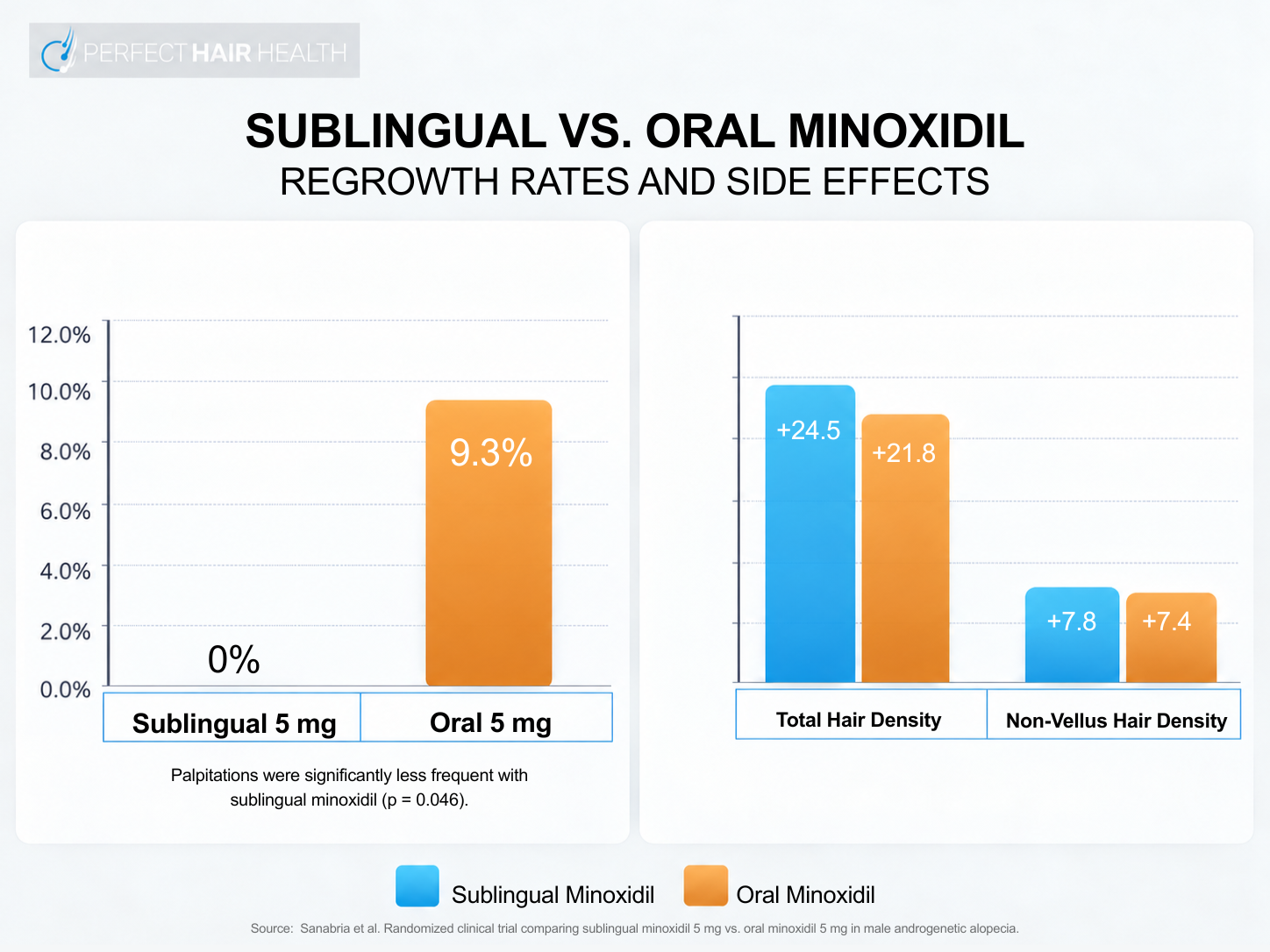
Want help with your hair regrowth journey?
Get personalized support, product recommendations, video calls, and more from our researchers, trichologists, and PhD's dedicated to getting you the best possible outcomes.
Learn MoreArticle Summary
Oral minoxidil is one of the most effective treatments for pattern hair loss. Its main drawback is its impact on the cardiovascular system. Because minoxidil is a vasodilator, it can cause reflex tachycardia, heart palpitations, dizziness, and fluid retention, most commonly at doses of 5 mg and above. These effects are attributed to the active form of the drug, minoxidil sulfate, which oral minoxidil produces in the liver and distributes through the whole body. Sublingual minoxidil (the same tablet dissolved under the tongue) was proposed as a solution. Absorbed through the mouth, it bypasses first-pass metabolism in the liver, so less minoxidil sulfate reaches the blood, and the inactive drug is activated in the scalp instead. But does it grow as much hair? Some studies suggest yes. In this article, we explain why oral minoxidil’s side effects depend on active blood levels, how sublingual delivery might help circumvent some of the side effects of oral minoxidil (while maintaining the benefits), and what the latest studies show.
Full Article
Oral minoxidil has become one of the most popular treatments for pattern hair loss, and for good reason. In clinical trials, it works just as well or even outperforms 5% topical minoxidil, with investigator assessments rating oral minoxidil as performing better than topical minoxidil. [1]Penha, M.A., Miot, H.A., Kasprzak, M., Müller Ramos, P. (2024). Oral Minoxidil vs Topical Minoxidil for Male Androgenetic Alopecia: A Randomized Clinical Trial. JAMA Dermatology. 160(6). 600-605. … Continue reading[2]Ramos, P.M., Sinclair, R.D., Kasprzak, M., Miot, H.A. (2020). Minoxidil 1 mg oral versus minoxidil 5% topical solution for the treatment of female-pattern hair loss: A randomized clinical trial. … Continue reading
Oral minoxidil is also affordable, convenient, and, with the increasing popularity of telemedicine, as accessible as ever.
But there’s a trade-off.
Oral and topical minoxidil work the same way. Minoxidil is enzymatically activated, converted into minoxidil sulfate (the active form of the drug), interacts with the cells in the hair follicle, and, in turn, enhances hair growth.
With the use of topical minoxidil, this activation process happens in the hair follicle itself. With oral minoxidil, some of this happens in the liver, in a metabolic process called first-pass metabolism.
The minoxidil and active minoxidil sulfate then travel through the blood to the scalp and into the hair follicles themselves, where they support hair growth. But because the blood delivers minoxidil sulfate throughout the whole body, it also results in significant exposure to different parts of the body, like the cardiovascular system.
As a result, oral minoxidil has an increased risk of cardiovascular side effects that we don’t typically see with topical minoxidil. These may include:
- Heart palpitations
- Tachycardia
- Fluid retention
- Dizziness
- Pericardial effusion
- and more
However, these side effects typically only occur once the active minoxidil sulfate reaches cardiovascular tissue via the bloodstream. If we can reduce the blood levels of active minoxidil sulfate, we can, in theory, reduce the risk of side effects with oral minoxidil while (hopefully) still maintaining the directionally better results.
This is the premise of sublingual minoxidil, a form of oral minoxidil that dissolves under the tongue.
This article explains the science behind sublingual minoxidil, why it works, and why, in all likelihood, it could be a better form of minoxidil.
Sublingual Minoxidil From our partners at UloSublingual Minoxidil
A rapidly-dissolving sublingual tablet with minoxidil. Available in 1.25 mg and 2.5 mg doses. Prescribed 100% online. Choose a multi-month plan and get up to 30% plus a free gift bundle.
Free full-size gifts with 3-month+ plans Prescribed online, shipped to your door Sublingual deliveryDissolves under the tongue
*Only available in the U.S. Prescription requires an online medical consultation at no extra cost. Off-label products are not endorsed by the FDA. Free gifts included with select multi-month plans while supplies last. Ulo is a partner of Perfect Hair Health; we may earn a commission on purchases.
Is Oral Minoxidil Better Than Topical Minoxidil?
Topical minoxidil is one of two FDA-approved treatments for androgenic alopecia (AGA). It’s been studied since the 1980s. Regrowth tends to peak between months four and eight of treatment, and in people who keep using it, the gains hold through at least year five.
The catch is that it only works for about 40 to 60% of people who try it. Surveys of people who quit topical minoxidil find that most of them stopped because they didn’t see results.
The reason for this is twofold:
- Penetration. Only a small fraction of the minoxidil applied to the scalp makes it through the skin to the follicles.
- Activation. Minoxidil is a prodrug (i.e., it’s inactive until the body converts it). The conversion is done by an enzyme called sulfotransferase, which attaches a sulfate group to minoxidil and turns it into minoxidil sulfate. Minoxidil sulfate is the form of minoxidil that opens potassium channels in the follicle and stimulates growth. If the scalp doesn’t have enough sulfotransferase activity, minoxidil sits inactive in the skin and doesn’t produce an effect. And, as it turns out, a large share of people fall into this category: in one study of 120 patients, 40.8% had low sulfotransferase activity in their scalp.[3]Chitalia, J., Dhurat, R., Goren, A., McCoy, J., Kovacevic, M., Situm, M., Naccarato, T., Lotti, T. (2018). Characterization of follicular minoxidil sulfotransferase activity in a cohort of pattern … Continue reading And the research suggests this likely makes a meaningful difference in the effectiveness of topical minoxidil: around 85% of patients with normal enzyme activity responded to topical minoxidil, compared to just 8.7% of those with low sulfotransferase activity.[4]Goren, A., Shapiro, J., Roberts, J., Desai, N., Zarrab, Z., Pietrzak, A., Lotti, T. (2015). Clinical utility and validity of minoxidil response testing in androgenetic alopecia. Dermatologic Therapy. … Continue reading
Oral minoxidil, on the other hand, is metabolized differently. Instead, part of the oral minoxidil taken orally is activated by sulfotransferase in the liver. It then travels from the bloodstream to the scalp, where it delivers active minoxidil sulfate to hair follicles and supports growth. It also delivers inactive minoxidil, which is then activated by sulfotransferase enzymes in the scalp.
In other words, oral minoxidil overcomes both critical barriers to efficacy with topical minoxidil. It delivers more inactive minoxidil and supplies minoxidil sulfate to the follicle without having to rely on sulfotransferase enzymes in the scalp alone.
But the bloodstream doesn’t just deliver active minoxidil sulfate to the scalp, it also delivers it systemically, including to sensitive tissues like the cardiovascular system. Because minoxidil sulfate is a potent vasodilator (i.e., it relaxes the smooth muscle in blood vessel walls), it can have a significant effect on the cardiovascular system.
As a result, oral minoxidil carries a risk of cardiovascular side effects that we don’t typically see with topical minoxidil, where only around 1.4% of the applied dose reaches the bloodstream. These side effects are typically very rare, but can include:[5]Jimenez-Cauhe, J., Lo Sicco, K.I., Shapiro, J., Hermosa-Gelbard, A., Burgos-Blasco, P., Melian-Olivera, A., Ortega-Quijano, D., Pindado-Ortega, C., Buendia-Castaño, D., Asz-Sigall, D., Vaño-Galvan, … Continue reading
- Heart palpitations and tachycardia (0.9 to 4% of patients)
- Fluid retention (1.3 to 10%)
- Dizziness or lightheadedness (1 to 1.7%)
- Pericardial effusion (extremely rare at doses used in hair loss)
But what if there was a way to deliver active minoxidil to the follicles without exposing the rest of the body to minoxidil sulfate? Could there be an opportunity for us to harness the benefits of oral minoxidil while minimizing the side effects?
Sublingual minoxidil might be the answer. Let’s unpack the research.
Oral vs. Sublingual Minoxidil: The Research
When taken sublingually, oral minoxidil bypasses first-pass hepatic metabolism. In other words, it skips metabolic processing in the liver, including by the sulfotransferase enzyme. So instead of minoxidil sulfate being delivered to follicles alongside the inactive minoxidil, sublingual minoxidil means only the inactive minoxidil is transported via the bloodstream to the scalp, not minoxidil sulfate.
With less active minoxidil sulfate in the bloodstream to interact with tissues other than the scalp, you would expect to see a lower rate of side effects.
And that’s exactly what researchers found.
Study #1
In a randomized, double-blind, placebo-controlled phase I trial, published in 2021, researchers tested the effects of three doses of sublingual minoxidil, 0.45 mg, 1.35 mg, and 4.05 mg, in 40 men and women with AGA. [6]Bokhari, L., Jones, L.A., Sinclair, R.D. (2022). Sublingual minoxidil for the treatment of male and female pattern hair loss: a randomized, double-blind, placebo-controlled, phase 1B clinical trial. … Continue reading
The sublingual minoxidil was considered effective. At 24 weeks, hair density improved in a dose-dependent way: roughly 45% of patients on 0.45 mg showed improvement in frontal density and 55% at the vertex, rising to nearly 67% in both areas with a 4.05 mg dose.
However, because there was no oral minoxidil group in this study, we don’t know how it compares to oral minoxidil for efficacy or side effects.
Study #2
In a hallmark study, researchers directly compared the efficacy and safety of oral minoxidil with sublingual minoxidil. [7]Sanabria, B., Miot, H.A., Sinclair, R., Chaves, C., Müller Ramos, P. (2025). Sublingual Minoxidil 5 mg versus Oral Minoxidil 5 mg for male androgenetic alopecia: A double-blind randomized clinical … Continue reading
110 men with AGA (Norwood-Hamilton 3V, 4V, and 5V) were enrolled. One group took 5 mg of sublingual minoxidil daily plus an oral placebo. The other took 5 mg of oral minoxidil daily plus a sublingual placebo. Total and non-vellus hair density were measured in the vertex by trichoscopy with hair-to-hair matching, and three dermatologists blind to treatment scored global photographs.
After 24 weeks:
- Total hair density rose by 24.5 hairs/cm² in the sublingual group and 21.8 hairs/cm² in the oral group.
- Terminal hair density rose by 7.8 hairs/cm² with sublingual and 7.4 hairs/cm² with oral.
- On global photographs of the crown, 42% of the sublingual group and 40% of the oral group were rated as improved.
While sublingual numbers were directionally a little higher, both sublingual and oral minoxidil were measured as having about the same impact on hair growth.
However, side effects are where the groups separated:
- Heart palpitations occurred in 4 of 43 men (9.3%) on oral minoxidil and 0 of 43 men (0%) on sublingual minoxidil.
- Hypertrichosis was the most common side effect on both routes and was nearly identical at most sites: beard growth in 47.9% vs. 48.8%, chest hair in 43.8% vs. 42.9%. The one exception was the upper back (43.8% sublingual vs. 18.6% oral), which the authors noted as an unusual result.
- Shedding, insomnia, headache, dizziness, and mild swelling were infrequent and similar across groups.
At the end of the study, the authors concluded that sublingual minoxidil and oral minoxidil were about on par in terms of efficacy. Both were well tolerated, with less frequent palpitations in the sublingual group. The authors attribute the absence of palpitations to minoxidil escaping hepatic metabolism.
Sublingual Minoxidil From our partners at UloSublingual Minoxidil
A rapidly-dissolving sublingual tablet with minoxidil. Available in 1.25 mg and 2.5 mg doses. Prescribed 100% online. Choose a multi-month plan and get up to 30% plus a free gift bundle.
Free full-size gifts with 3-month+ plans Prescribed online, shipped to your door
Sublingual deliveryDissolves under the tongue*Only available in the U.S. Prescription requires an online medical consultation at no extra cost. Off-label products are not endorsed by the FDA. Free gifts included with select multi-month plans while supplies last. Ulo is a partner of Perfect Hair Health; we may earn a commission on purchases.
Study #3
The original publishers of the 2021 study revisited their original data, using hair-to-hair matching software to track the diameter of individual hairs from baseline to week 24.[8]Sinclair, R., Sicinska, J., Bokhari, L., Kasprzak, M. (2025). Sublingual minoxidil increases fibre diameter in male androgenetic alopecia: a proxy for reversal of hair follicle miniaturization. … Continue reading
There were considerable differences across doses and placebo:
- In the placebo group, average hair fiber diameter fell by 2 µm over 24 weeks.
- At 0.45 mg, it also fell by 2 µm.
- At 1.35 mg, hair fiber diameter rose by 3 µm.
- At 4.05 mg, it rose by 6 µm, the largest gains in the thickest hairs.
Because hair follicle miniaturization and the resultant shrinking of hair diameter are significant drivers of pattern hair loss, thickening of hair diameter suggests sublingual minoxidil may address a significant underlying factor in hair loss.
Notably, this is the first human evidence that a minoxidil treatment thickens existing hairs, consistent with the vellus-to-terminal reconversion seen in a humanized mouse model.[9]Gilhar, A., Keren, A., Paus, R. (2023). Vellus-to-terminal hair follicle reconversion occurs in male pattern balding and is promoted by minoxidil and platelet-rich plasma: in vivo evidence from a new … Continue reading
However, like the original study, we are limited in our ability to compare this directly to oral minoxidil.
Study #4
In a 2026 randomized, double-blind, placebo-controlled trial, researchers assessed the effect of sublingual minoxidil in transgender people recorded female at birth and taking full-dose testosterone.[10]Tang, G.T., Leemaqz, S., Bhoyrul, B., Eisman, S., Kasprzak, M., Sicinska, J., Sinclair, R., Cheung, A.S. (2026). Treatment of androgenetic alopecia in transgender people receiving testosterone … Continue reading This group develops AGA at about 2.5 times the rate of cisgender women, and finasteride is generally a poor fit because it can interfere with masculinization.
Participants were randomized to sublingual minoxidil (titrated to 1.35 mg twice daily) or placebo for 24 weeks, then moved to 2.5 mg twice daily in an open-label extension through week 48. Blood pressure, heart rate, and testosterone were measured at every visit.
At 24 weeks, midfrontal total hair count rose by 15.7 hairs/cm² more on minoxidil than on placebo (p=0.03), and non-vellus hair count by 12.7 hairs/cm² more (p=0.04). At 24 weeks, sublingual minoxidil didn’t beat placebo for vertex hair growth but eventually outpaced placebo by week 48. Self-rated vertex improvement was 57% on minoxidil versus 30% on placebo. There was no difference between groups in postural hypotension, hypertrichosis, or any other side effect, and sublingual minoxidil didn’t impact blood pressure, heart rate, or testosterone levels.
Study #5
Andrés-Lencina and colleagues reviewed 87 patients (73 women, 14 men) treated with a compounded sublingual minoxidil spray at their clinic.[11]Andrés-Lencina, J.J., Brisco, F., Ricart, J.M., Gómez-Zubiaur, A. (2025). Tolerance and Safety Profile of Sublingual Minoxidil in the Treatment of Androgenic Alopecia. Actas Dermo-Sifiliográficas. … Continue reading Median doses were 0.5 mg per day for women and 1 mg per day for men. Three months in, patients were surveyed by phone about side effects.
The authors compared their results against two large oral minoxidil series. Side effects were less frequent with sublingual minoxidil than in a 435-patient oral minoxidil study that used the same phone survey, and about as frequent as in a 1,404-patient oral minoxidil study that relied on medical records rather than patient surveys.[12]Sanabria, B., de Nardo, V.T., Miot, H.A., Ramos, P.M. (2021). Adverse effects of low-dose Oral Minoxidil for androgenetic alopecia in 435 patients. Journal of the American Academy of Dermatology. … Continue reading[13]Vañó-Galván, S., Pirmez, R., Hermosa-Gelbard, A., et al. (2021). Safety of low-dose oral minoxidil for hair loss: A multicenter study of 1404 patients. Journal of the American Academy of … Continue reading
Sublingual Minoxidil Studies: Where Do We Stand?
All in, while more research is needed, the existing research suggests sublingual minoxidil seems to perform on par with or directionally better than oral minoxidil. Even better, it seems to do so with a much lower risk of some side effects.
According to these studies, it seems the cardiovascular impact of minoxidil may be, in part, related to the spike of the active drug in the blood. If we can prevent a spike of active minoxidil sulfate in the blood, we can, in theory, reduce the risk of side effects with oral minoxidil while (hopefully) keeping the directionally better regrowth.
However, sublingual delivery doesn’t seem to reduce the risk of other side effects like hypertrichosis, insomnia, headache, dizziness, and fluid retention. However, all but hypertrichosis remained rare.
But What If I Have Low Sulfotransferase Levels In My Scalp?
If you have lower sulfotransferase levels in your scalp, you might be worried that sublingual minoxidil might not be as effective as oral minoxidil. After all, if the advantage of oral minoxidil is that it bypasses the need for minoxidil activation in the scalp, then we would expect that bypassing activation in the liver with sublingual minoxidil could theoretically lead to subpar results (compared to regular oral minoxidil).
Except this doesn’t seem to be true. In research comparing oral and sublingual minoxidil, they generally perform about the same despite the fact that sublingual minoxidil bypasses this essential step.
Why might this be the case? There are two reasons:
- Sublingual minoxidil bypasses sulfation in the liver, but it also bypasses glucuronidation. Glucuronidation is another metabolic process that occurs in the liver after taking oral minoxidil. Except instead of activating minoxidil, this process actually inhibits it. As a result, a portion oral minoxidil may be activated by the liver, but a portion is also be inhibited. In short, sublingual minoxidil might be more bioavailable even if it’s not converted to its active form before reaching the hair follicle. This might mean that sublingual minoxidil, by bypassing glucuronidation, supplies a larger amount of minoxidil to be converted to minoxidil sulfate in the follicle. In turn, more bioavailable amounts of minoxidil may make up for less minoxidil sulfate.
- The liver doesn’t contribute much at all to the efficacy of oral minoxidil. If oral minoxidil arrived at the follicle in its activated sulfate form (in sufficient amount), then the number of sulfotransferase enzymes present in your scalp shouldn’t affect response to oral minoxidil at all. But it, as it turns out, it does. In a 2020 study, researchers studying oral minoxidil found that low follicular sulfotransferase activity predicted weaker regrowth with oral minoxidil.[14]Ramos, P.M., Goren, A., Sinclair, R., Miot, H.A. (2020). Oral minoxidil bio-activation by hair follicle outer root sheath cell sulfotransferase enzymes predicts clinical efficacy in female pattern … Continue reading In other words, even with oral minoxidil, sulfotransferase activity at the follicle is likely still a main reservoir of the active drug. As such, the reason oral minoxidil has less to do with bypassing scalp enzymes, and more to do with the amount of inactive minoxidil it delivers to the follicle. By delivering more minoxidil to the follicles, it overcomes the reduced absorption of topical minoxidil, producing a greater effect. It doesn’t mean the active minoxidil sulfate delivered to the scalp via the liver is inconsequential in oral minoxidil treatment, but rather that it’s not the most significant factor.
As a result, it doesn’t seem that there is a disadvantage to using sublingual minoxidil when it comes to expected growth potential.
Is There a Best Sublingual Minoxidil Dose?
Sublingual minoxidil has been tested at various doses in the research, as low as 0.45 mg and as high as 5 mg. While doses of 0.45 mg, 1.35 mg, 2.5 mg, 4.05 mg, and 5 mg have all shown favorable results, only 5 mg has data to support its non-inferiority to standard oral minoxidil. 1.35 mg and 2.5 mg were rated as more effective than placebo, but weren’t validated against standard oral minoxidil.
This doesn’t mean doses lower than 5 mg won’t be effective, but it is the most evidence-backed dose when it comes to sublingual minoxidil.
Is Sublingual Minoxidil Available Today?
Ulo just released their Sublingual Minoxidil Rx. It’s an orange-flavored, rapidly dissolving tablet that easily dissolves under the tongue. It’s a convenient, easy way to take oral minoxidil while harnessing the potential of sublingual delivery.
Sublingual Minoxidil From our partners at UloSublingual Minoxidil
A rapidly-dissolving sublingual tablet with minoxidil. Available in 1.25 mg and 2.5 mg doses. Prescribed 100% online. Choose a multi-month plan and get up to 30% plus a free gift bundle.
Free full-size gifts with 3-month+ plans Prescribed online, shipped to your door
Sublingual deliveryDissolves under the tongue*Only available in the U.S. Prescription requires an online medical consultation at no extra cost. Off-label products are not endorsed by the FDA. Free gifts included with select multi-month plans while supplies last. Ulo is a partner of Perfect Hair Health; we may earn a commission on purchases.
Bottom Line
Sublingual minoxidil made its way into research on the premise that its delivery route might have less of an impact on the cardiovascular system. And in a landmark head-to-head trial, researchers found exactly that. Heart palpitations occurred in 0% of men taking 5 mg of sublingual minoxidil, compared with 9% of men taking 5 mg of standard oral minoxidil. And importantly, it was just as effective: both groups grew the same amount of hair over six months.
Oral minoxidil’s cardiovascular effects are driven by a spike in the active form of minoxidil, minoxidil sulfate, in the blood. That surge in active minoxidil dips blood pressure and contributes to related side effects.
Sublingual minoxidil minimizes the spike in the active form of minoxidil by bypassing the first-pass metabolism responsible for its activation. Instead, minoxidil gets supplied directly to the scalp tissue, and at higher amounts than topical minoxidil.
This is also why sublingual minoxidil performs on par with oral minoxidil: by delivering higher amounts to the hair follicle, more minoxidil can be converted to the active form in the follicles. By providing a higher dose of minoxidil to follicles, both oral and sublingual minoxidil outperform topical minoxidil.
In general, research around sublingual minoxidil is still in its infancy. However, the early clinical data make it a reasonable option for anyone looking to explore other forms of minoxidil that are best suited to their needs and preferences when approaching hair loss.
References[+]
References ↑1 Penha, M.A., Miot, H.A., Kasprzak, M., Müller Ramos, P. (2024). Oral Minoxidil vs Topical Minoxidil for Male Androgenetic Alopecia: A Randomized Clinical Trial. JAMA Dermatology. 160(6). 600-605. Available at: https://doi.org/10.1001/jamadermatol.2024.0284 ↑2 Ramos, P.M., Sinclair, R.D., Kasprzak, M., Miot, H.A. (2020). Minoxidil 1 mg oral versus minoxidil 5% topical solution for the treatment of female-pattern hair loss: A randomized clinical trial. Journal of the American Academy of Dermatology. 82(1). 252-253. Available at: https://doi.org/10.1016/j.jaad.2019.08.060 ↑3 Chitalia, J., Dhurat, R., Goren, A., McCoy, J., Kovacevic, M., Situm, M., Naccarato, T., Lotti, T. (2018). Characterization of follicular minoxidil sulfotransferase activity in a cohort of pattern hair loss patients from the Indian subcontinent. Dermatologic Therapy. 31(6). e12688. ↑4 Goren, A., Shapiro, J., Roberts, J., Desai, N., Zarrab, Z., Pietrzak, A., Lotti, T. (2015). Clinical utility and validity of minoxidil response testing in androgenetic alopecia. Dermatologic Therapy. 28(1). 13-16. Available at: https://doi.org/10.1111/dth.12164 ↑5 Jimenez-Cauhe, J., Lo Sicco, K.I., Shapiro, J., Hermosa-Gelbard, A., Burgos-Blasco, P., Melian-Olivera, A., Ortega-Quijano, D., Pindado-Ortega, C., Buendia-Castaño, D., Asz-Sigall, D., Vaño-Galvan, S. (2025). Characterization and Management of Adverse Events of Low-Dose Oral Minoxidil Treatment for Alopecia: A Narrative Review. Journal of Clinical Medicine. 14(6). 1805. Available at: https://doi.org/10.3390/jcm14061805 ↑6 Bokhari, L., Jones, L.A., Sinclair, R.D. (2022). Sublingual minoxidil for the treatment of male and female pattern hair loss: a randomized, double-blind, placebo-controlled, phase 1B clinical trial. Journal of the European Academy of Dermatology and Venereology. 36(1). e62-e66. Available at: https://doi.org/10.1111/jdv.17623 ↑7 Sanabria, B., Miot, H.A., Sinclair, R., Chaves, C., Müller Ramos, P. (2025). Sublingual Minoxidil 5 mg versus Oral Minoxidil 5 mg for male androgenetic alopecia: A double-blind randomized clinical trial. Journal of the European Academy of Dermatology and Venereology. 39(8). e700-e702. Available at: https://doi.org/10.1111/jdv.20508 ↑8 Sinclair, R., Sicinska, J., Bokhari, L., Kasprzak, M. (2025). Sublingual minoxidil increases fibre diameter in male androgenetic alopecia: a proxy for reversal of hair follicle miniaturization. Clinical and Experimental Dermatology. 50(7). 1362-1365. Available at: https://doi.org/10.1093/ced/llaf012 ↑9 Gilhar, A., Keren, A., Paus, R. (2023). Vellus-to-terminal hair follicle reconversion occurs in male pattern balding and is promoted by minoxidil and platelet-rich plasma: in vivo evidence from a new humanized mouse model of androgenetic alopecia. Acta Dermato-Venereologica. 103. 12320. ↑10 Tang, G.T., Leemaqz, S., Bhoyrul, B., Eisman, S., Kasprzak, M., Sicinska, J., Sinclair, R., Cheung, A.S. (2026). Treatment of androgenetic alopecia in transgender people receiving testosterone therapy with sublingual minoxidil: A randomized, double-blind, placebo-controlled clinical trial. Journal of the American Academy of Dermatology. 95. 724-733. Available at: https://doi.org/10.1016/j.jaad.2026.05.020 ↑11 Andrés-Lencina, J.J., Brisco, F., Ricart, J.M., Gómez-Zubiaur, A. (2025). Tolerance and Safety Profile of Sublingual Minoxidil in the Treatment of Androgenic Alopecia. Actas Dermo-Sifiliográficas. 116(2). 122-123. Available at: https://doi.org/10.1016/j.ad.2023.09.031 ↑12 Sanabria, B., de Nardo, V.T., Miot, H.A., Ramos, P.M. (2021). Adverse effects of low-dose Oral Minoxidil for androgenetic alopecia in 435 patients. Journal of the American Academy of Dermatology. 84(4). 1175-1178. ↑13 Vañó-Galván, S., Pirmez, R., Hermosa-Gelbard, A., et al. (2021). Safety of low-dose oral minoxidil for hair loss: A multicenter study of 1404 patients. Journal of the American Academy of Dermatology. 84(6). 1644-1651. Available at: https://doi.org/10.1016/j.jaad.2021.02.054 ↑14 Ramos, P.M., Goren, A., Sinclair, R., Miot, H.A. (2020). Oral minoxidil bio-activation by hair follicle outer root sheath cell sulfotransferase enzymes predicts clinical efficacy in female pattern hair loss. Journal of the European Academy of Dermatology and Venereology. 34(1). e40-e41. Want help with your hair regrowth journey?
Get personalized support, product recommendations, video calls, and more from our researchers, trichologists, and PhD's dedicated to getting you the best possible outcomes.
Learn More
Perfect Hair Health Team
"... Can’t thank @Rob (PHH) and @sanderson17 enough for allowing me to understand a bit what was going on with me and why all these [things were] happening ... "

 — RDB, 35, New York, U.S.A.
"... There is a lot improvement that I am seeing and my scalp feel alive nowadays... Thanks everyone. "

 — Aayush, 20’s, Boston, MA
"... I can say that my hair volume/thickness is about 30% more than it was when I first started."

 — Douglas, 50’s, Montréal, Canada
Want help with your hair regrowth journey?
Get personalized support, product recommendations, video calls, and more from our researchers, trichologists, and PhD's dedicated to getting you the best possible outcomes.
Join Now - Mission Statement